
Background
Founded in 1954 as Luxi Ethnic Hospital, Dehong People’s Hospital is the only Grade A tertiary general hospital in Dehong Prefecture, providing medical care, education, research, disease prevention, rehabilitation, and emergency services. It is also a key healthcare institution supporting the Belt and Road Initiative and border-opening efforts in the prefecture.
The hospital operates two campuses, an old campus and a new campus. This two-campus structure places higher demands on its IT infrastructure planning and digital transformation. The hospital needed a unified underlying platform to reduce the complexity of infrastructure deployment and the cost of operations and maintenance, while also ensuring that the overall solution met the stringent requirements for high-level electronic medical record and healthcare information interoperability ratings.
Implementation Plan: Building a Unified IT Foundation for Multiple Campuses
Previously, the hospital set out to build a unified IT foundation capable of supporting multiple campuses. It developed an integrated IT infrastructure plan for both the old and new campuses, using a single infrastructure platform to replace and upgrade the old campus’s traditional VMware architecture while meeting the new campus’s requirements for higher-level infrastructure ratings. The plan included:
Old campus: Core production systems currently run on a traditional architecture based on vSphere and centralized storage. As computing and storage resources are nearing exhaustion, further expansion of the existing architecture would require costly storage hardware and software licenses. In line with the growing demand for domestically developed and controllable IT infrastructure, the hospital planned to replace the traditional VMware architecture with a domestic SmartX ECP architecture for core business systems, while maintaining service stability and flexible scalability.
New campus: The new IT infrastructure was planned to use the same solution as the old campus. Since the old campus had already achieved Level 4 in electronic medical record grading and Grade A in healthcare information interoperability, the new campus needed to meet higher-level requirements through disaster recovery capabilities, including active-active clustering, backup, and disaster recovery, as well as network security protection for the virtualized environment.
Based on these requirements, the hospital planned to adopt a domestic SmartX ECP solution with multi-level disaster recovery and virtualized network security capabilities, building an integrated healthcare platform to support both campuses.
Old Campus Modernization: Replacing VMware Virtualization to Host Core Systems Such as PACS and LIS
The hospital selected the old campus as a pilot for modernization and adopted SmartX ECP to replace its VMware vSphere architecture. The new platform hosts all business systems at the old campus except HIS, including core systems such as PACS, LIS, electronic billing, paperless workflows, CA, rational drug use, and electrocardiography.
With SmartX ECP, the hospital selected its own servers for deployment, ensuring that performance and capacity could scale together and laying the foundation for continued development of the new campus. For workload migration, the hospital used the native SMTX Migration Tool to perform online migrations. By synchronizing incremental data online, it shortened downtime and minimized the impact on business operations.
New Campus Development: Full-Stack Hyperconverged Infrastructure for All Intranet Workloads and Databases, Meeting Higher-Level Rating Requirements and Enabling VDI Modernization
- Phase One: Building an Active-Active Data Center with SmartX ECP to Meet Higher-Level Disaster Recovery and Security Requirements
Based on its experience with the old campus, Dehong People’s Hospital deployed a SmartX ECP cluster at the new campus to host all workloads and databases in the intranet zone, including core systems such as HIS and EMR, as well as various general business systems. With SMTX Backup & Disaster Recovery and Everoute software-defined network security components, the hospital further improved its disaster recovery and data security capabilities:
The hospital built an active-active stretched SmartX ECP cluster for core business systems. Data is distributed across two data centers in multiple replicas, enabling real-time synchronization between the data centers and automatic failover of application services between them.
SMTX Backup & Disaster Recovery backs up virtual machines to standalone NAS storage, providing logical disaster recovery for virtual machines.
Everoute provides a distributed firewall to protect east-west traffic in the virtualized environment, as well as access control and virus spread prevention.
CloudTower centrally manages and operates the SmartX ECP clusters in both data centers.
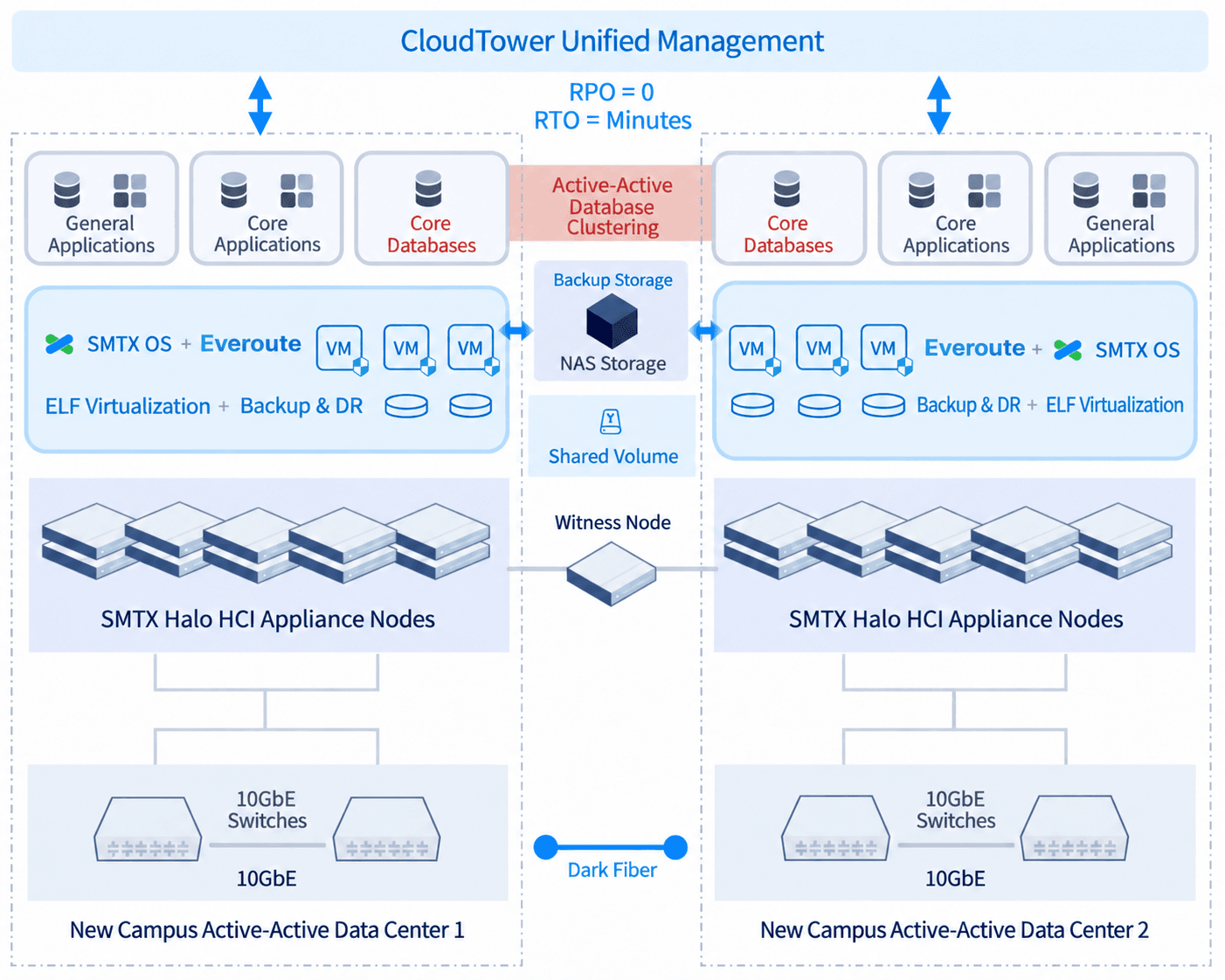
By combining local high availability within the clusters, a cross-data-center active-active cluster, backup and disaster recovery, and network security components, Dehong People’s Hospital established a comprehensive disaster recovery and VM security solution at the new campus. The solution provides virus protection, recovery from logical errors, and protection against data-center-level disasters.
The current disaster recovery capabilities meet the requirements for Level 6 electronic medical records and Grade 5B healthcare information interoperability, supporting the hospital in achieving higher ratings in the future.
- Phase Two: Implementing VDI with the SmartX and OS-EASY Joint Solution to Improve Office and Operations Efficiency
After the business systems at the new campus had operated stably for six months, the hospital further implemented VDI based on SmartX ECP.
For many years, the hospital had used traditional PCs as business terminals. This resulted in high hardware replacement costs, significant space requirements, and limited operations efficiency. Hundreds of PCs were distributed across different floors, consultation rooms, and nursing stations. Whenever a software pop-up appeared, a printer mapping was lost, or the system became unresponsive, engineers had to travel to the relevant location. In practice, they often spent “30% of their time troubleshooting and 70% traveling, waiting for departments, or crawling under desks to unplug cables.”
Based on its experience with the earlier project, Dehong People’s Hospital recognized the reliability and flexibility of SmartX ECP and adopted a joint SmartX and OS-EASY solution to build its VDI infrastructure.
SmartX ECP serves as the IT foundation for the virtual desktop environment, while OS-EASY provides the desktop cloud system, delivering secure, stable, and high-performance virtual desktops and cloud applications for hospital users. The overall logical architecture of the desktop cloud system is shown below:
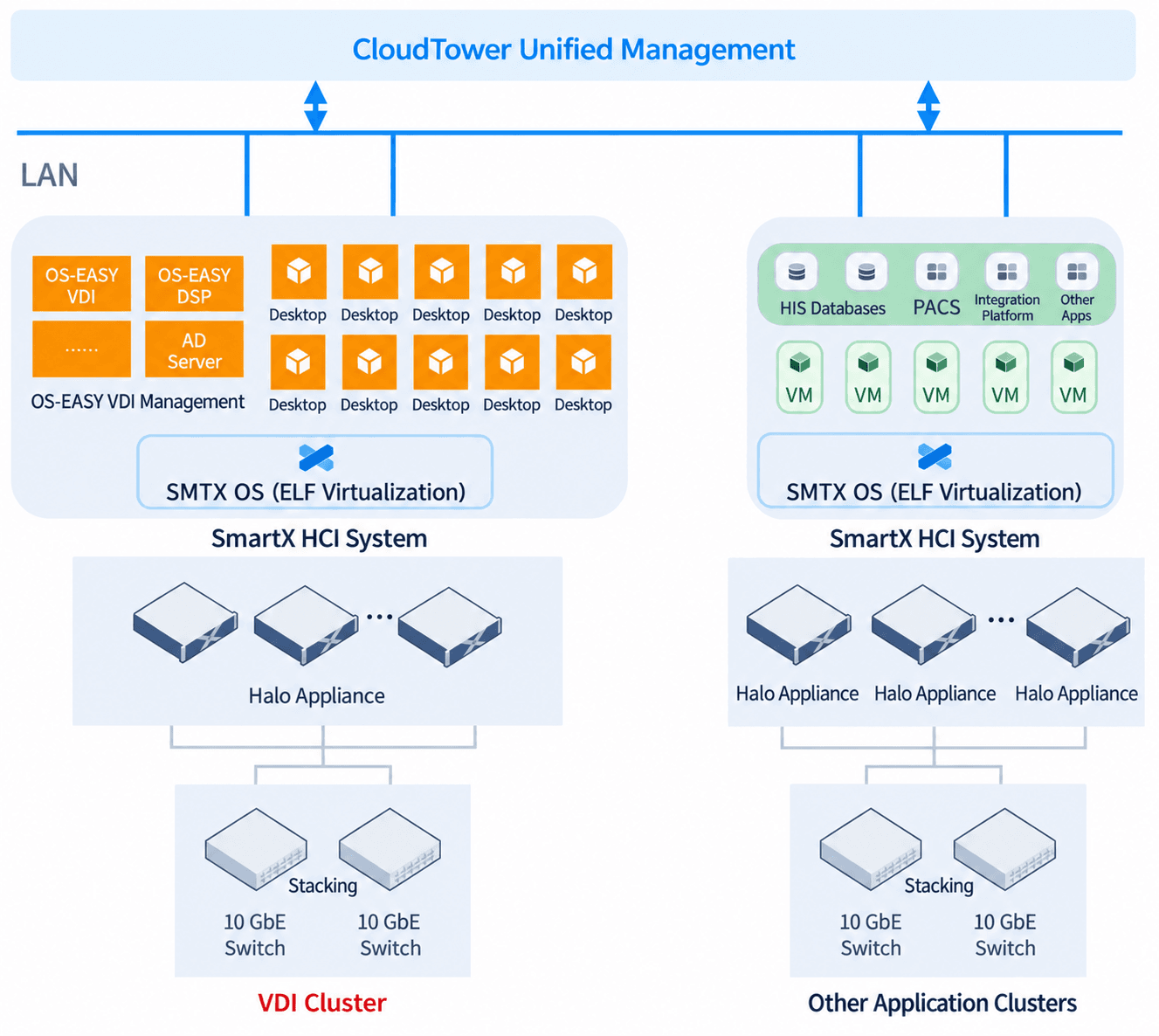
The hospital also uses CloudTower to centrally manage the desktop cloud infrastructure resources and its existing SmartX ECP business clusters, reducing the complexity of business system operations and improving operations efficiency.
- Smooth user experience for daily operations: Testing showed that cloud desktop terminals, including thin clients and cloud terminals, typically take 20 to 40 seconds to boot into the system, depending on network conditions and server load. Compared with traditional PCs using mechanical hard drives, this is slightly faster or broadly comparable. Daily office work, business system operations, and document processing are as smooth as on traditional PCs. Under normal workloads, users experience virtually no noticeable delay.
- Significantly reduced operations workload: Software installation, system patches, and security policies can be centrally deployed from the server, with a single configuration applied to all terminals. Troubleshooting is mainly focused on the network or VM layer, eliminating the need to inspect hardware on-site in each department. The daily hardware failure rate has fallen to nearly zero, and operations staffing requirements have decreased by approximately 30% to 40%.
- Greater flexibility and security: When users move between departments or workstations, data does not need to be migrated. Systems can be quickly restored after a crash without waiting for repairs, improving workplace flexibility and the user experience.
Benefits
- Hospital-wide IT transformation across multiple campuses: Built a unified SmartX ECP foundation for centralized management and visualized operations of IT resources across the old and new campuses and different data centers.
- Phased full-stack modernization: Replaced VMware virtualization and modernized and localized the full-stack infrastructure, including active-active disaster recovery and distributed firewalls.
- Support for clinical and office operations: Ensured the stable operation of core systems across both campuses and provided a smooth, flexible, and easy-to-manage cloud desktop experience, turning technology upgrades into tangible efficiency gains.
- Improved healthcare IT ratings: Established a solid technical foundation for achieving Level 6 electronic medical record and Grade 5B healthcare information interoperability ratings.


