
Background
Huai’an Second People’s Hospital believes that ITAI tranformation for IT infrastructure requires more than simply replacing existing products. While meeting compliance requirements, the hospital aims to build a unified, trusted, and continuously evolving infrastructure that integrates business continuity, data protection, and network security, ensuring that its ITAI platform delivers the reliability, availability, and operational capabilities required for healthcare services.
Business Continuity: Replace Hyper-V with domestic servers and virtualization technologies, upgrading the traditional virtualization infrastructure to a distributed architecture based on SmartX ECP. High-availability capabilities, including virtual machine high availability and multiple data replicas, ensure the stable operation of the hospital’s core business systems.
Data Protection: Strengthen comprehensive data backup and continuous data protection (CDP) capabilities to ensure medical data can be recovered and audited, while meeting smart hospital evaluation requirements.
Network Security: Transition from physical network isolation to software-defined security using Everoute’s Distributed Firewall (DFW), enabling more flexible network isolation and security policy control to meet the requirements of different security boundaries, including the hospital’s internal business network and DMZ.
Full-Stack ITAI Infrastructure Solution Based on SmartX ECP
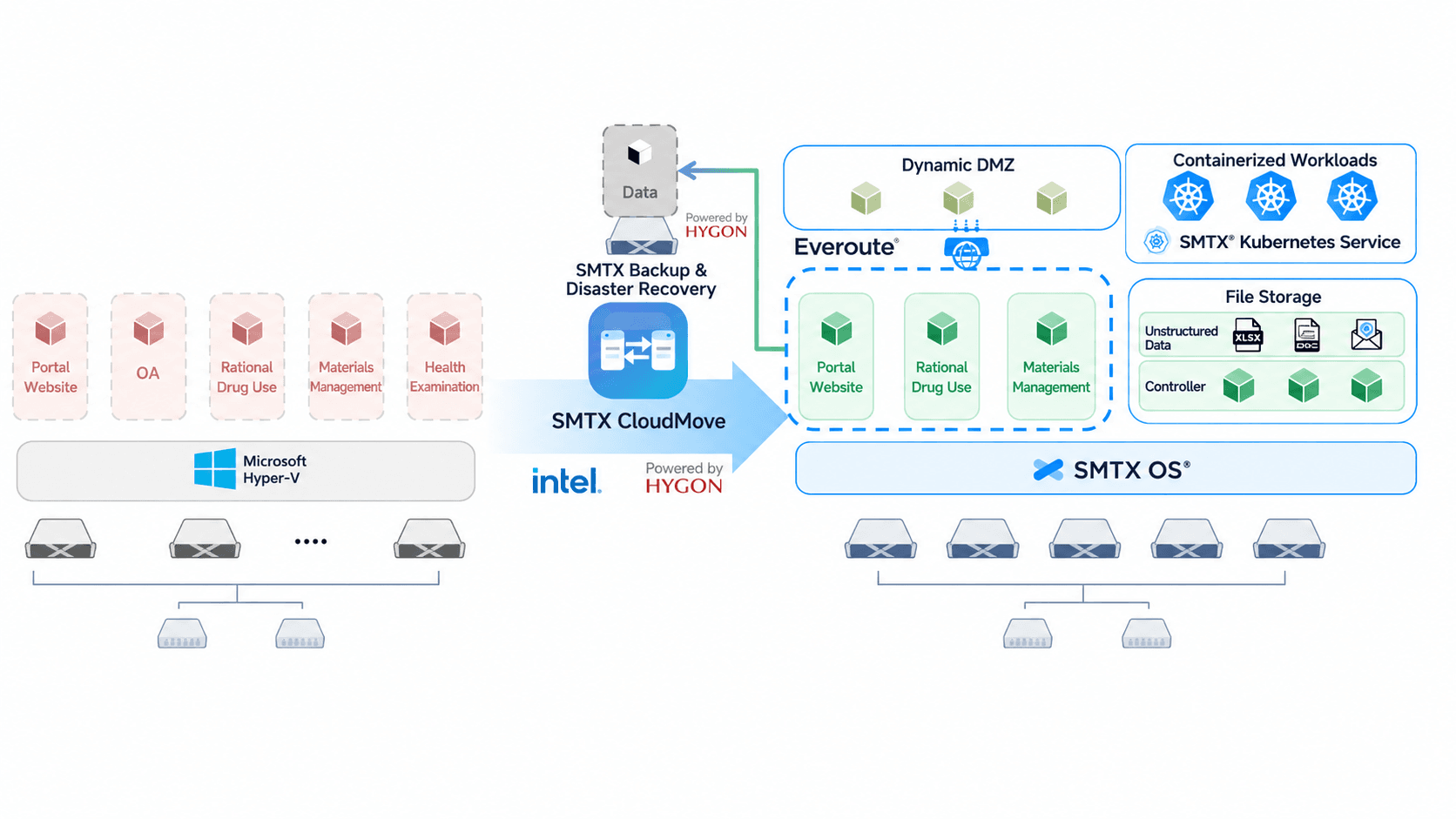
To meet its requirements for ITAI compliance, production workload hosting, network security isolation, data protection, and the continued development of internet hospital services, Huai’an Second People’s Hospital adopted SmartX ECP and domestically manufactured servers powered by Hygon processors to build an all-flash healthcare ITAI cloud infrastructure.
Replacing the existing Hyper-V platform, the new infrastructure supports production systems for electrocardiography (ECG), rational drug use, central sterile supply department (CSSD) traceability, materials management, and health examinations, as well as office applications such as OA, approval platforms, and web portals.
Building on this unified cloud infrastructure, the hospital further integrated SmartX ECP components, including Everoute for software-defined networking and security, the native SMTX Backup & Disaster Recovery, SMTX Kubernetes Service (SKS), and SMTX File Storage (SFS). These components address requirements for dynamic DMZ security isolation, end-to-end trusted backup, internet hospital containerization, and unified data storage. As a result, the ITAI cloud infrastructure goes beyond resource hosting to provide an integrated platform for business continuity, data protection, and network security.
- Virtualization Platform Migration for a Smooth Business Transition
Huai’an Second People’s Hospital replaced its traditional Hyper-V virtualization infrastructure with SmartX ECP and ITAI-compliant servers. Using the SMTX CloudMove, the hospital smoothly migrated over 200 production VMs. Based on continuous data protection (CDP) replication technology, the tool enables rapid cutover within a short maintenance window, minimizing business disruption while maintaining a high migration success rate.
- Network Virtualization and Isolation to Adapt to Changing Security Requirements
The hospital's business systems require coordination across its internal business network, internet-facing zones, and different security domains. Traditional DMZ deployments typically rely on dedicated hardware firewalls, physical isolation devices, and complex network configurations. This approach involves relatively high deployment costs and increases the burden of subsequent security policy adjustments and daily operations and maintenance (O&M).
After establishing its SmartX ECP infrastructure, the hospital introduced Everoute Distributed Firewall. By combining network port isolation with software-defined security policy management, the hospital built a dynamic DMZ within the SmartX ECP cluster, enabling logical isolation and unified management of DMZ-related workloads.
- Optimizing Data Backup and CDP to Protect Medical Data
Medical data is essential to the continuity of clinical services, making data protection a key priority in the hospital's IT modernization. To meet both the requirements for trustworthy data storage under ITAI transformation and the continuous data protection requirements of electronic medical record (EMR) evaluations, the hospital adopted SMTX Backup & Disaster Recovery and an integrated distributed CDP solution. Together, these solutions establish a three-layer medical data protection system covering disaster recovery, backup, and CDP.
Using the backup capabilities of SMTX Backup & Disaster Recovery, the hospital backs up production data from its SmartX ECP cluster to a domestic storage repository. It also schedules backup tasks during off-peak hours based on business operation patterns to minimize their impact on production workloads.
Currently, all production VMs migrated to the SmartX ECP platform deployed on domestic servers are covered by backup protection. Unified backup policies provide clearer data protection boundaries for these VMs while ensuring that the entire backup system, from storage media to backup software, meets domestic technology requirements.
Building on this foundation, the hospital further introduced an integrated distributed CDP solution to provide straightforward continuous data protection and emergency recovery capabilities for heterogeneous environments comprising physical servers and multiple virtualization platforms. This helps meet the continuous data protection requirements of smart hospital evaluations.
- Internet Hospital Containerization to Support Evolving Business Needs
As internet hospital services continue to develop, hospitals need to gradually move from traditional VM-based application hosting toward more flexible and standardized application platforms. As part of this infrastructure upgrade, the hospital also conducted systematic validation and hands-on evaluation of SMTX Kubernetes Service (SKS).
SKS deploys Kubernetes clusters on virtualized infrastructure, reducing the effort required for cluster configuration and resource management. It also enables unified management and O&M of VMs and containers, improving the operational efficiency of the hospital's integrated IT platform.
The hospital has included an SKS-based containerization project for its internet hospital services in its future plans. It intends to build an integrated virtualization and container infrastructure based on SmartX ECP, enabling virtualized and containerized workloads to run together while reducing the long-term O&M complexity associated with maintaining separate platforms.
- Distributed File Storage for Unified Management of Multimodal Data
Over years of operation, the hospital has accumulated large volumes of unstructured data, including OA attachments, shared documents, departmental reports, and scanned files. Previously, such data was typically stored on separately purchased network-attached storage (NAS) systems.
After building its integrated healthcare ITAI platform, the hospital introduced SMTX File Storage (SFS) to store unstructured data within the SmartX ECP cluster through the NFS protocol. This eliminates the need to purchase dedicated NAS hardware, along with the associated rack space, power consumption, and annual maintenance costs.
File services and VMs share the same cluster and storage resource pool, with capacity expandable online as needed. They can also be managed through a unified management interface, further reducing O&M complexity and overall costs.
Benefits
Reliable Production Operations on Domestic IT Infrastructure: Smoothly migrated production workloads from the legacy virtualization platform to the new infrastructure while meeting domestic technology transition requirements, ensuring business stability and improving platform management and operational efficiency.
Unified Platform for Ongoing IT Development: Integrated compute, storage, network isolation, backup, and container capabilities into a unified domestic cloud infrastructure, providing a scalable foundation for the continued development of internet hospital services and additional business systems.
Meeting Compliance and Evaluation Requirements: Leveraged Dynamic DMZ, backup, and CDP capabilities to strengthen data security and business continuity while supporting smart hospital evaluation requirements, addressing both regulatory compliance and data protection needs.


