
Background
As a global leader in piping and building materials manufacturing, LESSO Group relies on its headquarters IT infrastructure to provide stable support for production operations across branch factories worldwide. However, both its existing VMware virtualization platform and hyperconverged solution had begun to face challenges.
- High refresh costs for the traditional VMware architecture
The existing VMware virtualization platform used traditional centralized storage from vendors such as IBM and NetApp. After nearly seven years of operation, the hardware needed a full refresh, leading to high procurement costs. VMware’s subscription policy changes also drove software subscription and support costs much higher than before.
- Stability issues with the previous hyperconverged platform
The hyperconverged platform previously deployed by LESSO Group experienced frequent failures. When resource utilization approached the upper limit, platform stability declined significantly, affecting the reliability of critical business systems.
- Stronger disaster recovery protection required for key production systems
Continuous 24/7 production across branches and factories depends heavily on the headquarters MES system. The underlying infrastructure therefore needed to support active-active deployement and disaster recovery, achieving RPO = 0 and RTO < 1 hour for critical production workloads.
To reduce infrastructure costs and ensure production continuity, LESSO Group decided to rebuild its infrastructure foundation with SmartX ECP as the core enterprise cloud platform, while smoothly migrating its existing production systems.
Phase 1: Replace the Previous Hyperconverged Software with No Service Interruption and Seamless Hardware Reuse
1. Build a Temporary Migration Cluster
Deploy SMTX Halo HCI Appliances as a temporary migration cluster, and use SMTX CloudMove to migrate development and testing VMs from the previous hyperconverged platform.
2. Reuse Multi-Vendor Servers for Heterogeneous SmartX ECP Clusters
Reuse servers from vendors such as H3C, Inspur, and Inventec that were previously used by the original hyperconverged platform, and deploy SmartX ECP across them to form three heterogeneous clusters for development and testing VMs.
3. Migrate Development and Testing Workloads Back
Use the cross-cluster online migration feature built into SmartX ECP to smoothly migrate development and testing VMs from the temporary migration cluster to the newly built SmartX ECP clusters.
Phase 2: Repurpose the Migration Cluster to Build Active-Active Production Clusters and Replace VMware
1. Convert the Migration Cluster into Active-Active Production Clusters
Redeploy the servers from the migration cluster across two data centers to build two production clusters and enable metro active-active clustering.
2. Migrate VMware VMs and Centrally Manage Multiple Clusters
Use SMTX Migration Tools to gradually migrate production VMs from the original VMware platform to the active-active clusters. CloudTower is then used to centrally manage five clusters and more than 30 nodes across development, testing, and production environments.
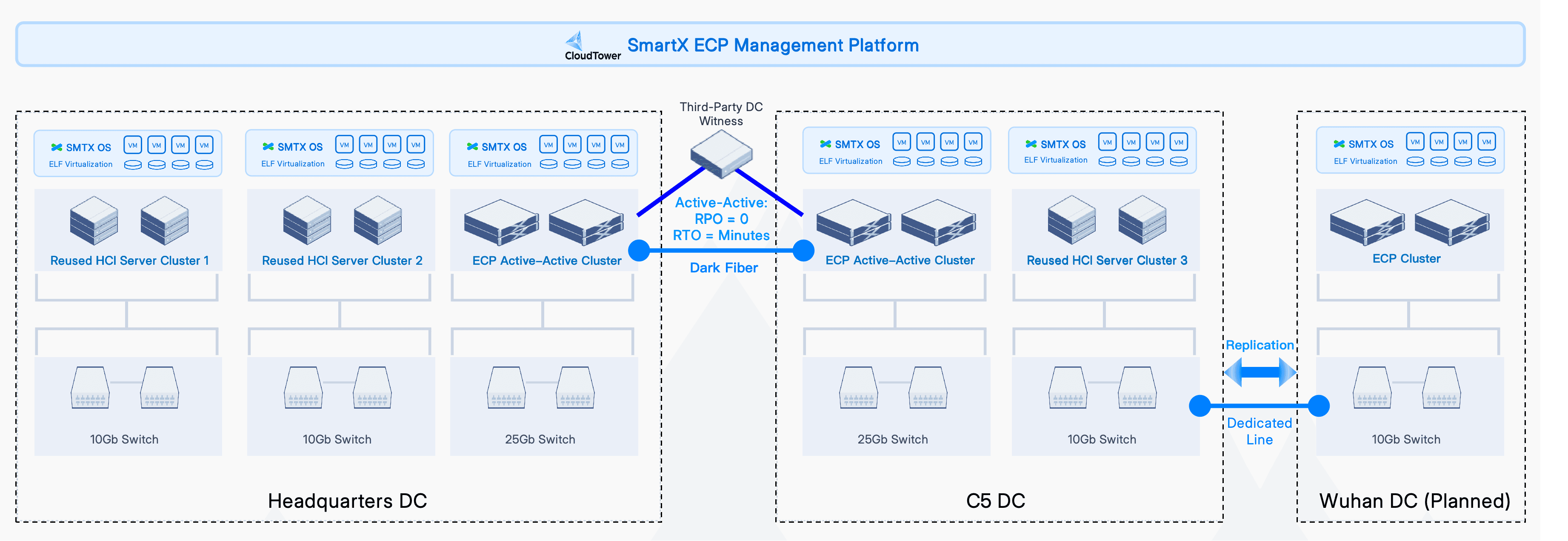
Today, SmartX ECP stably supports key business systems such as MES, SAP, production workshop systems, and STARLIMS, as well as data platforms such as StarRocks, for LESSO Group’s headquarters IT.
LESSO Group also plans to gradually introduce SmartX ECP components such as SKS and SMTX Backup & Disaster Recovery to build an enterprise cloud foundation with cloud-native capabilities and remote disaster recovery.
Results
- Significantly Improved Performance for Critical Workloads
In testing, SmartX ECP outperformed the previous VMware + centralized storage architecture, fully meeting the concurrent access requirements of the core SAP system and Oracle databases and ensuring stable operations during business peaks.
- Verified Reliability for Critical Workloads
Reliability was validated across multiple failure scenarios, including NIC, node, power supply, disk, and full cluster power failures. SmartX ECP delivered better stability than the previous hyperconverged platform and reliably supports core business systems such as MES and OA.
- Lower TCO and Reduced Operations Complexity
LESSO Group reused all multi-vendor servers from the previous hyperconverged platform, saving hardware procurement costs, while replacing VMware to reduce software subscription costs. With CloudTower, multiple clusters can be centrally managed, reducing the operations burden across cluster environments.
- Software-Hardware Decoupling
SmartX ECP enables unified deployment and validated performance across multi-vendor servers, reducing vendor lock-in and improving flexibility for future expansion.
Customer Insights
- Align Infrastructure Upgrades with Business Needs
Infrastructure upgrades should be driven by business requirements. By adopting a distributed architecture, enterprises can address the long expansion cycles and slow response of centralized storage, enabling IT to move beyond system support and help accelerate business innovation.
- Gain More Control with a Full-Stack Software-Defined Approach
Infrastructure evolution in the post-VMware era should center on a full-stack software-defined approach. It should also support hardware reuse, smooth migration of core workloads, and future expansion, giving enterprises greater control from hardware compatibility to application continuity.
- Rebuild Technical Confidence Through Thorough Validation
For concerns about running core workloads on a domestic distributed architecture, enterprises can validate platform reliability and performance across multiple failure scenarios and benchmark tests, providing a solid basis for core system migration.


