SmartX officially releases SECP Compute (originally SMTX ELF) 6.4. Building on support for SmartX ECP and SMTX ZBS, it further extends support for mainstream storage arrays, helping enterprises build production-grade server virtualization solutions that can smoothly replace VMware vSphere. At the same time, SECP Compute 6.4 adds features including memory overcommitment and virtual Trusted Platform Module (vTPM), helping customers address rising hardware costs and meet the rigid requirements of building a secure and trusted cloud infrastructure.
SmartX ECP 6.4 has also been released, offering key virtualization capabilities except for third-party storage support.
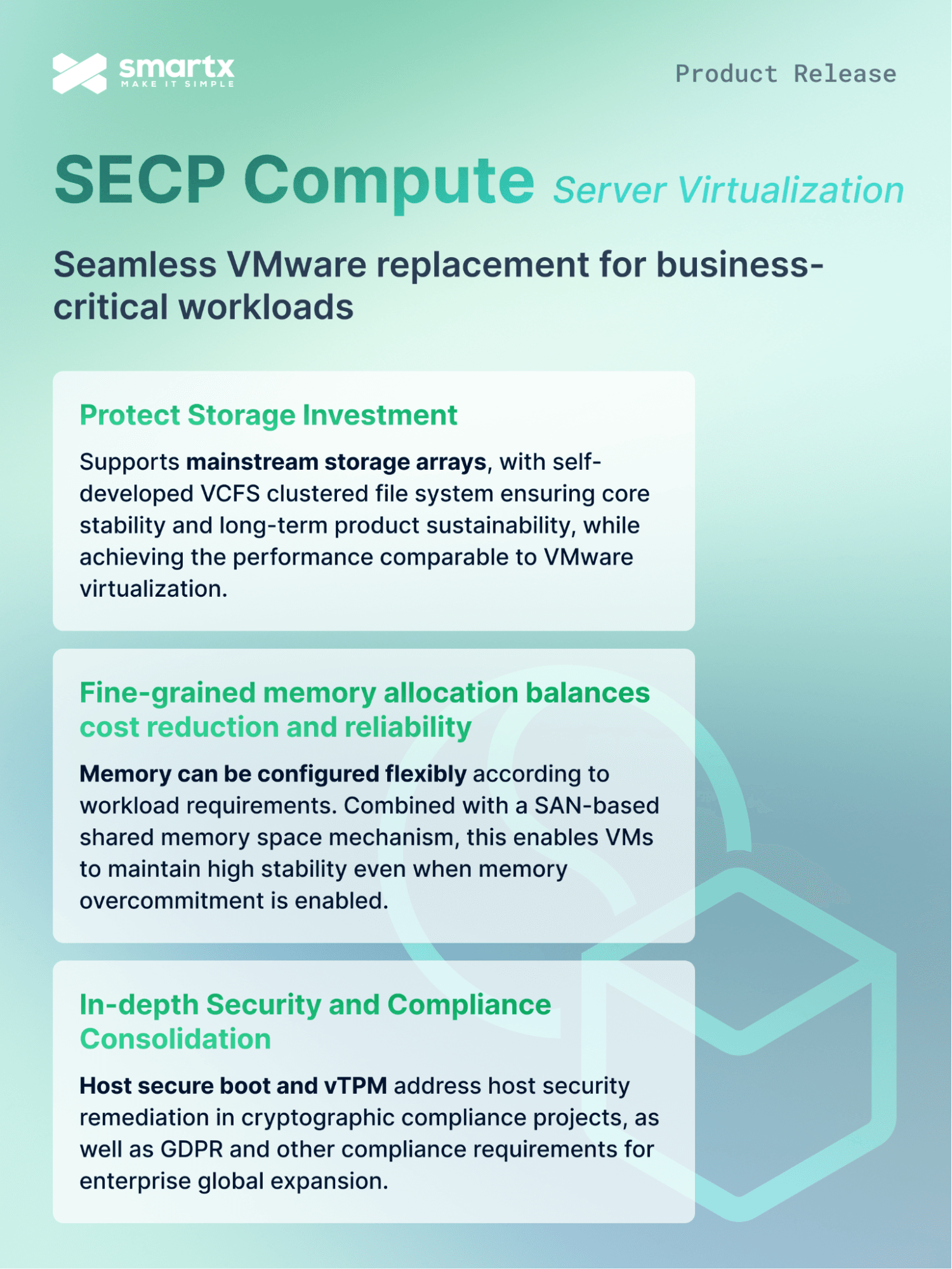
Protect Existing Storage Investments and Support Smooth VMware Virtualization Replacement for Business-Critical Workloads
SECP Compute 6.4 introduces the self-developed virtualization cluster file system, which connects to compatible storage arrays through FC and iSCSI. It protects customers' existing storage investments and provides a smooth alternative path for VMware virtualization in business-critical scenarios.
Compared with mainstream implementations based on secondary development of the open-source OCFS2 component, SmartX’s self-developed virtualization cluster file system, like VMware VMFS, is also designed and fully developed around VM data access, storage operations, and cluster operations and maintenance. Its core features include:
Coordinating high reliability for multiple hosts sharing access. It manages access permissions through locks and heartbeats on shared disks. It can coordinate high-reliability mechanisms without relying on Ethernet connectivity between hosts, thereby reducing the risk of host-level failures caused by network faults.
An efficient I/O path for VMs. VMs can connect to the local virtualization cluster file system primary service through vHost, and access shared LUNs through a proprietary file system, reducing redundant paths introduced by general-purpose open-source file systems and improving I/O efficiency and stability.
Native support for capabilities required in virtualized environments. It offers snapshots, clones, and space reclamation. It works with the virtualization platform’s live migration and HA workflows without requiring secondary development on top of general-purpose open-source file systems, improving efficiency and making feature evolution and troubleshooting easier.
Compared with VMware VMFS and OCFS2, SmartX’s virtualization cluster file system runs its primary service and monitoring components in user space. This reduces the impact of software upgrades on users by decoupling components from the kernel, further improving the user experience.
In addition, SECP Compute 6.4 supports enabling storage I/O Boost per VM. Administrators can selectively configure it according to each workload's requirements for I/O performance. Built on an efficient end-to-end I/O path design, users can gain performance comparable to VMware virtualization.
Configure Memory Overcommitment per VM to Balance Cost and Stability
SECP Compute 6.4 adds memory overcommitment, using a self-developed user-space paging mechanism and storing swapped-out memory pages on shared storage. In environments where memory demand is lower than configured capacity and workload peaks are staggered, customers can make fuller use of existing servers, increase VM density, and ease the pressure to expand memory. Its key features include:
Enable overcommitment selectively and choose its scope by workload. Administrators can enable memory overcommitment selectively and set its ratio based on VM importance, allowing suitable workloads to share spare physical memory while reserving the full configured memory for critical VMs without overcommitment enabled.
Adjust memory allocation as workloads change. The system dynamically adjusts physical memory allocation based on host memory pressure and VM usage, reclaiming pages as pressure rises and constraining new consumption.
Provide unified and reliable management of swap space. The platform prepares independent swap space for VMs, automates its creation, expansion, and cleanup, and leverages enterprise-grade storage backends’ data protection to support higher overcommitment ratios on shared storage.
Support key virtualization features. VMs with overcommitment enabled also allow live migration, dynamic resource scheduling (DRS), and high availability (HA) workflows, supporting routine host maintenance and failure recovery.
Strengthen Boot Security and Trust Foundation from Hosts to VMs
On the security front, SECP Compute 6.4 enhances security at both the host and VM levels. On the host side, it adds host secure boot and software integrity verification, as well as strengthens host security hardening. On the VM side, it adds VM secure boot and vTPM, laying a foundation for boot security and TPM-based encrypted applications. These capabilities support a range of scenarios, from security compliance audits in key domestic industries to GDPR compliance for enterprises expanding overseas.
Support host security remediation in cryptographic application transformation projects. For government and enterprises that carry out host security remediation in parallel with cryptographic application transformation, host secure boot and software integrity verification provide a platform for boot validation and software tamper detection, making it easier to improve underlying protection while replacing virtualization.
Meet GDPR and other compliance requirements when expanding overseas. For overseas branches using Windows VMs, vTPM works with TPM key protection mechanisms to reduce the risk of data leakage, and, together with VM secure boot, helps meet GDPR data security requirements.
Currently, SECP Compute has been deployed and validated in production based on hyperconverged architecture by 65% of existing SmartX customers, and named a Representative Vendor in Gartner’s Market Guide for Server Virtualization for three consecutive years.
A major state-owned bank: Deployed 1,500+ ITAI ( Information Technology Application Innovation) ECP nodes based on the native hypervisor across its head office and branches, supporting tens of thousands of VMs.
A leading insurance group: Used SMTX Migration Tool to migrate 1,000+ VMware VMs, reducing business impact.
Beijing Jishuitan Hospital Affiliated to CCMU: Uses SmartX Halo appliances based on the native hypervisor to run hospital-wide business systems across multiple campuses.
Huashan Hospital Affiliated to Fudan University: Built ECP clusters with the native hypervisor and domestic servers, exploring hospital-level AI MaaS platform development.
A leading power lithium battery manufacturer: Uses SmartX native hypervisor as the sole virtualization platform for all future clusters, with 300+ nodes supporting core business systems such as MES.
A globally renowned new energy innovation technology company: Deployed 300+ nodes across 20+ bases and branches, using SmartX native hypervisor to run core business systems such as MES, AGV, and battery-swapping operations.
The capabilities delivered in SECP Compute 6.4 provide further support in protecting enterprise storage investments, reducing memory procurement costs, and strengthening security and reliability, helping customers flexibly address multiple challenges, including cost reduction and efficiency improvement, security compliance, and VMware alternatives.


