Highlights
- By building active-active clusters across data centers using the SmartX Enterprise Cloud Platform (ECP), Xinyi Glass has enhanced IT infrastructure availability while mitigating the technical and cost challenges associated with the original “vSphere + all-flash centralized storage” architecture.
- Replaced VMware virtualization for hosting core databases, achieving approximately 18% performance improvement and around 30% reduction in total investment cost.
- Enhanced data center network security by deploying the Everoute distributed firewall, providing east-west traffic protection within the virtualized environment.
In the global glass manufacturing industry, Xinyi Glass Holdings Limited (abbr. “Xinyi Glass”) has long positioned itself as an innovator and industry leader. With over 30 years of history, the company’s diverse product portfolio spans float glass, automotive glass, architectural glass, and solar glass. Through its listed subsidiaries—Xinyi Solar, Xinyi Electric Storage, Xinyi eGlass, and Xinyi Energy—the company has built a comprehensive industrial ecosystem.
Under a group-wide operational model, multiple listed subsidiaries of Xinyi Glass share core IT resources to achieve efficient business collaboration. However, this centralized approach also places stricter demands on the reliability and security of the group’s IT infrastructure.
- Stringent availability: Critical business systems, such as OA, CRM, and ERP, must have a fault tolerance window of no more than 15 minutes—a key metric for ensuring seamless operations across all listed subsidiaries listed under its group-wide operational model.
- Risk prevention: A previous data center power outage incident underscored the importance of IT infrastructure disaster recovery (DR). Moving forward, infrastructure planning must fully account for force majeure events and their potential to cause data center-level failures, with robust and reliable recovery strategies in place.
Original Infrastructure Layout: Hybrid Cloud Across Multiple Data Centers
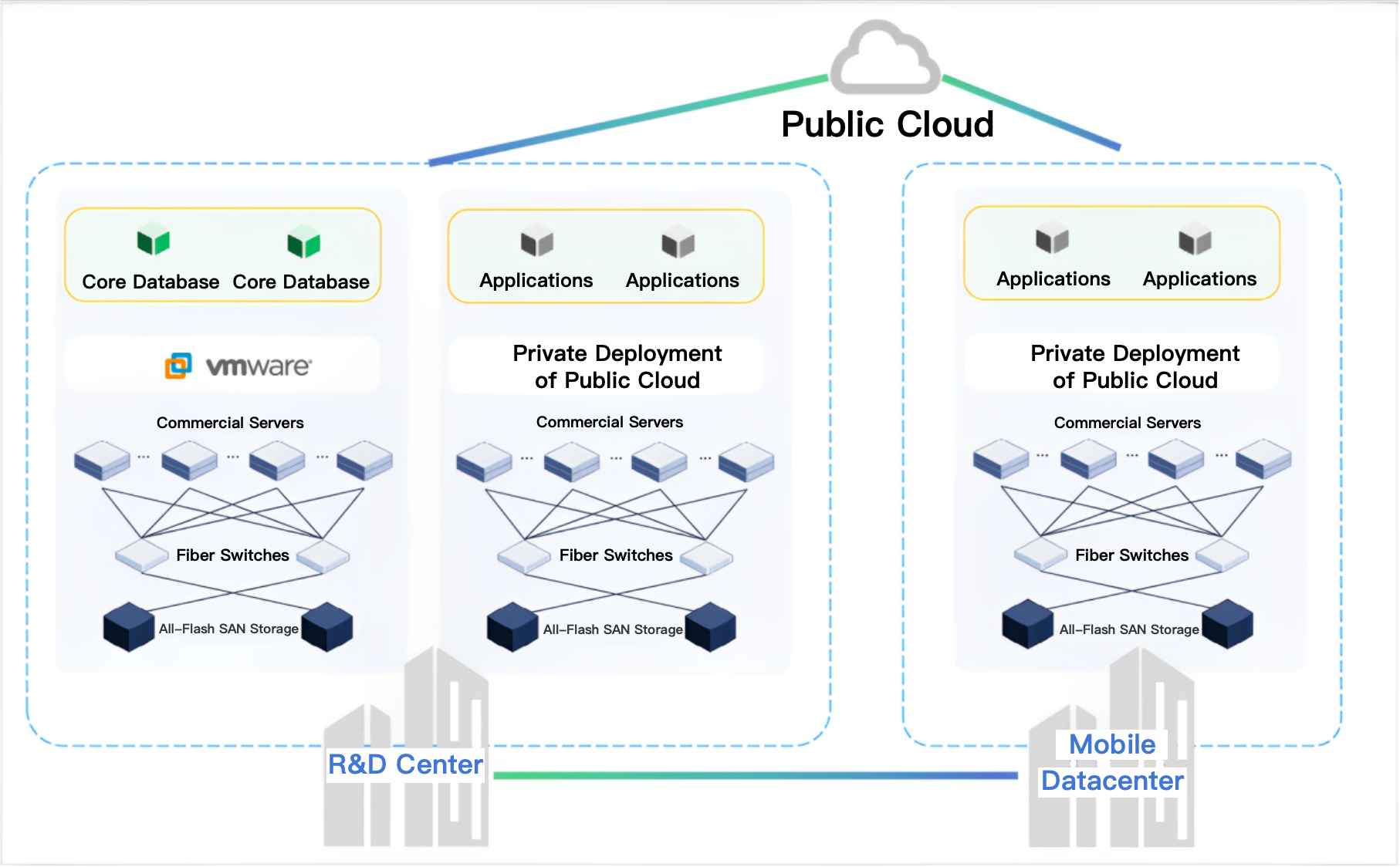
Based on the above requirements for infrastructure reliability, Xinyi Glass picked the hybrid cloud as its core approach for digital transformation.
- Public Cloud: Strategically selected a domestic public cloud platform to host data governance services, leveraging the flexibility of public cloud services to reduce the cost of private deployments.
- Private Cloud:
- Deployed public cloud in a private approach to run application services and some general-purpose databases.
- The VMware platform, based on a “vSphere + Dorado all-flash storage” architecture, served as the main platform supporting core database workloads.
This data center infrastructure strategy embodies the integration of stability with innovation. Based on the privatized deployment of the domestic public cloud solution, the company built a dual data center architecture—comprising a mobile hosting IDC and an R&D IDC—with both centers constructed in a 1:1 ratio to ensure data-level redundancy and resilience.
High Availability Challenges: Technical and Cost Bottlenecks in Building Active-Active Data Centers
While the current architecture has achieved a certain level of data redundancy, it still falls short of meeting key business availability requirements for core databases; implementing an active-active architecture on the existing setup would introduce significant technical and cost challenges.
- Limitations of the Privatized Public Cloud:
- Combined with centralized storage, the privatized public cloud cannot meet the performance expectations for core database scenarios, especially when it involves high concurrency and heavy workloads.
- The ongoing maintenance cost is high, especially in cross-data-center active-active scenarios, as this technology stack requires proportional storage capacity expansion across both data centers.
- Contradictions Between Cost and Feasibility in the vSphere + Centralized Storage Approach:
- Technically, an active-active data center built on vSphere and centralized storage has been validated by the customer and can meet performance requirements. Economically, however, implementing this solution across data centers requires significant hardware investment. Hardware costs remain high—particularly Fibre Channel (FC) switches, each of which can cost over RMB 100,000 more than standard Ethernet switches. Storage synchronization needs multiple FC switches deployed, for example, synchronization across data centers typically requires at least four FC switches. Additionally, centralized storage comes with a high price tag: the per-unit capacity cost is 3 to 5 times that of distributed storage.
- VMware’s shift to a subscription-based licensing model has further driven up costs. Although a vSAN stretched cluster can reduce dependency on certain hardware, the overall TCO remains higher than software-defined storage solutions based on standard x86 servers.
In addition, as Xinyi Group moves toward smart manufacturing, many of its subsidiaries are planning to build unmanned factories in the future. This requires consistency with the data center infrastructure to minimize management and O&M complexity. However, the traditional three-tier architecture has a high entry threshold, involves substantial investment, and presents complex O&M challenges, making it ill-suited for smart factory deployment.
Building Active-Active Data Centers with SmartX ECP: Lower TCO with Higher Availability
After extensive research and testing in real-world environments, Xinyi Glass ultimately chose SmartX ECP to build active-active clusters across data centers. This allowed the company to construct a highly available IT infrastructure that fully meets business requirements, at a significantly lower TCO.
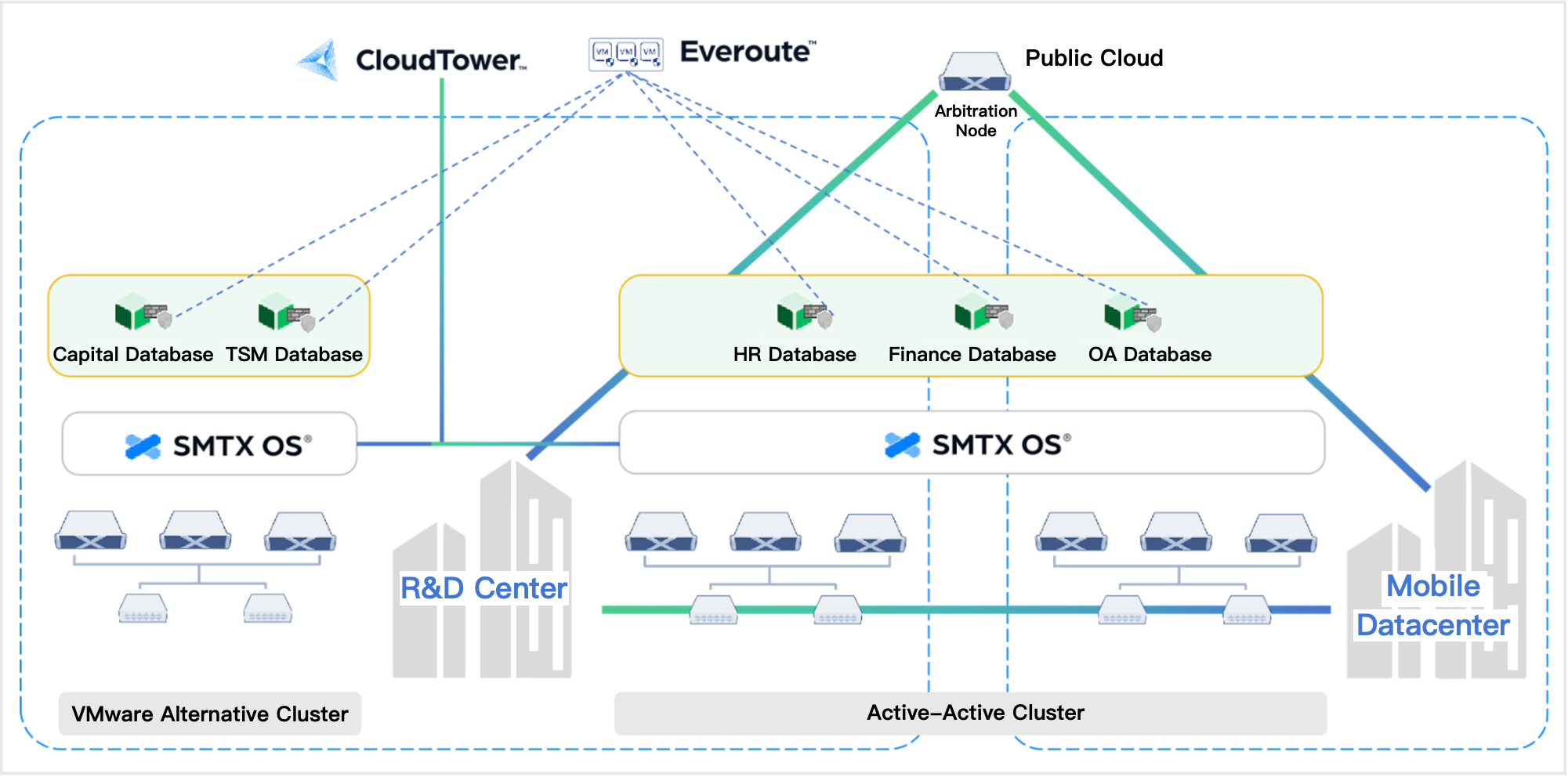
Building “3+3+1” Active-Active Clusters to Support the Group’s Core Shared Business Databases
Xinyi Glass deployed 3-node SmartX ECP (ELF) clusters respectively at its R&D center and mobile data center, and added a public-cloud-based VM as a witness node. This forms a “3+3+1” active-active cluster architecture that supports databases for HR, finance, and OA systems, enabling DR for core business workloads.
Feature #1: Cross-Data-Center Data Protection
The active-active clusters store two replicas of each data block in the primary availability zone (R&D center) and one replica in the secondary zone (mobile data center), ensuring triple-replica data protection. This setup guarantees data security in the face of various failure scenarios.
Feature #2: Minute-Level Service Availability Across Datacenters
When a physical node in the primary availability zone (R&D center) fails, the VM automatically triggers high availability (HA) and is rebooted on another node within the same zone—avoiding cross-site VM migration and associated network configuration changes. In the event of a data-center-level outage, services can be migrated across data centers, with VM failover verified to occur within 3 minutes.
Feature #3: Seamless Reuse of Existing Network Infrastructure
The SMTX OS (SmartX ECP’s core software foundation) active-active clusters have minimal network requirements, all of which are already met in Xinyi’s existing environment—no hardware changes were needed:
- Storage network bandwidth between availability zones must be ≥10 Gbps. Bandwidth between the witness node and the primary/secondary availability zones must be ≥1 Gbps. If a converged network is used for both management and storage networks, the bandwidth must be ≥10 Gbps.
- Storage network ping latency between the primary and secondary availability zones must be <5 ms. Ping latency between the witness node and either zone must be <100 ms.
Hardware Configuration
The solution uses third-party server hardware with full NVMe configuration to ensure performance for active-active database workloads. The 3+3 server cluster spans multiple data centers, while the witness node is hosted as a VM on the existing public cloud platform used for data governance.
Hardware configuration per server in the active-active clusters:
| Component | Specification | Quantity |
| CPU | Intel Xeon 6426Y | 2 |
| Memory | DDR5 32GB | 12 |
| SSD | PM9A3 | 11 |
| Boot Drive | M.2 SSD 480G | 2 |
| Storage Controller | RAID-9540-8i | 1 |
| 10GbE NIC | MCX512A-ACAT | 2 |
Replacing VMware Virtualization: 3-Node ECP Cluster Supports Non-Shared Business Databases
Xinyi Glass also adopted the SmartX ECP to fully replace the original “vSphere + all-flash centralized storage” architecture used for hosting non-active-active business databases that support applications such as fund management and TSM, helping the company reduce virtualization costs associated with VMware.
In terms of hardware, the solution utilizes third-party servers. A 3-node cluster built with all-SATA SSDs can meet the performance needs of databases.
| Component | Specification | Quantity |
| CPU | Intel Xeon 6426Y | 2 |
| Memory | DDR5 32GB | 8 |
| SSD | S4520 | 11 |
| Boot Drive | M.2 SSD 480G | 2 |
| Storage Controller | RAID-9540-8i | 1 |
| 10GbE NIC | MCX512A-ACAT | 2 |
Customer Benefits
While meeting Xinyi Glass’s requirements for active-active clusters deployment across data centers, the SmartX ECP also delivered significant benefits across multiple dimensions:
Extensive Hardware Compatibility Reduces Procurement Costs
SmartX ECP supports a wide range of third-party hardware, greatly increasing procurement flexibility. In this project, SmartX ECP fully supports third-party servers equipped with Intel 4th Gen processors, enabling the customer to achieve performance equivalent to mainstream next-generation appliances at lower investment, meeting performance needs while significantly reducing overall hardware costs.
Minimal Hardware Changes for Active-Active Deployment
On the network side, SmartX ECP required no major changes to the customer’s existing network architecture. Under Xinyi’s current network setup, only four additional 10GbE switches were needed to complete the upgrade. The active-active architecture was achieved using standard x86 servers and a software-defined approach—no proprietary hardware required—greatly reducing overall solution complexity.
Improved Operational Efficiency
Tests showed that compared to the original VMware + all-flash centralized storage architecture, SmartX ECP delivered even better performance for core databases. Swingbench testing results showed an 18% improvement in average TPS, with an overall cost reduction of approximately 30%.
High Availability Assurance
Comprehensive testing confirmed that in the event of the entire data center failure, the SmartX ECP active-active clusters can automatically fail over business VMs within three minutes, effectively meeting availability requirements.
Comprehensive Network Security Protection
SmartX ECP incorporates Everoute to address security risks in virtualized environments, offering efficient east-west traffic protection. This mitigates security blind spots typically left unaddressed by traditional hardware-based solutions. Its ease of use and effectiveness significantly enhance east-west security in the data center.
For more information on SmartX ECP, please download the product brief.
