As the backbone of banking operations, deposit, loan, and accounting core systems require absolute stability and high performance to support all downstream business functions. Facing rapid growth in sectors like online lending and an explosion in data volume, a prominent regional bank prioritized optimizing the cost-efficiency of the Oracle standby databases that safeguard these critical systems.
To achieve this, the bank evaluated SmartX ECP as a hosting platform for Oracle Active Data Guard (ADG) standby databases. The testing demonstrated that ADG latency and stability on SmartX ECP not only significantly surpassed the vSAN environment but also rivaled the performance of mid-to-high-end all-flash centralized storage.
Background
For core business systems such as deposits and loans, the regional bank utilizes Oracle databases in a Primary and ADG Standby configuration. The primary database is architected with physical servers and high-end all-flash centralized storage, while the standby runs on the VMware vSphere & vSAN platform.
To mitigate pressure on the core database amidst rapid growth in online lending requests, specific query workloads were offloaded to the standby database, and data processing tasks for reporting and submission were routed via the standby to the big data platform. However, operational usage revealed that the performance of the standby database was increasingly failing to meet escalating business demands:
- In batch processing scenarios, the standby resource pool’s I/O performance was insufficient to meet real-time replication requirements, resulting in an apply delay exceeding 30 minutes during daily settlement batches.
- The big data ETL extraction initiated immediately after the daily settlement batch exhibited a 30-minute data lag, resulting in inaccuracies in reports, regulatory submission data, and even front-end query data.
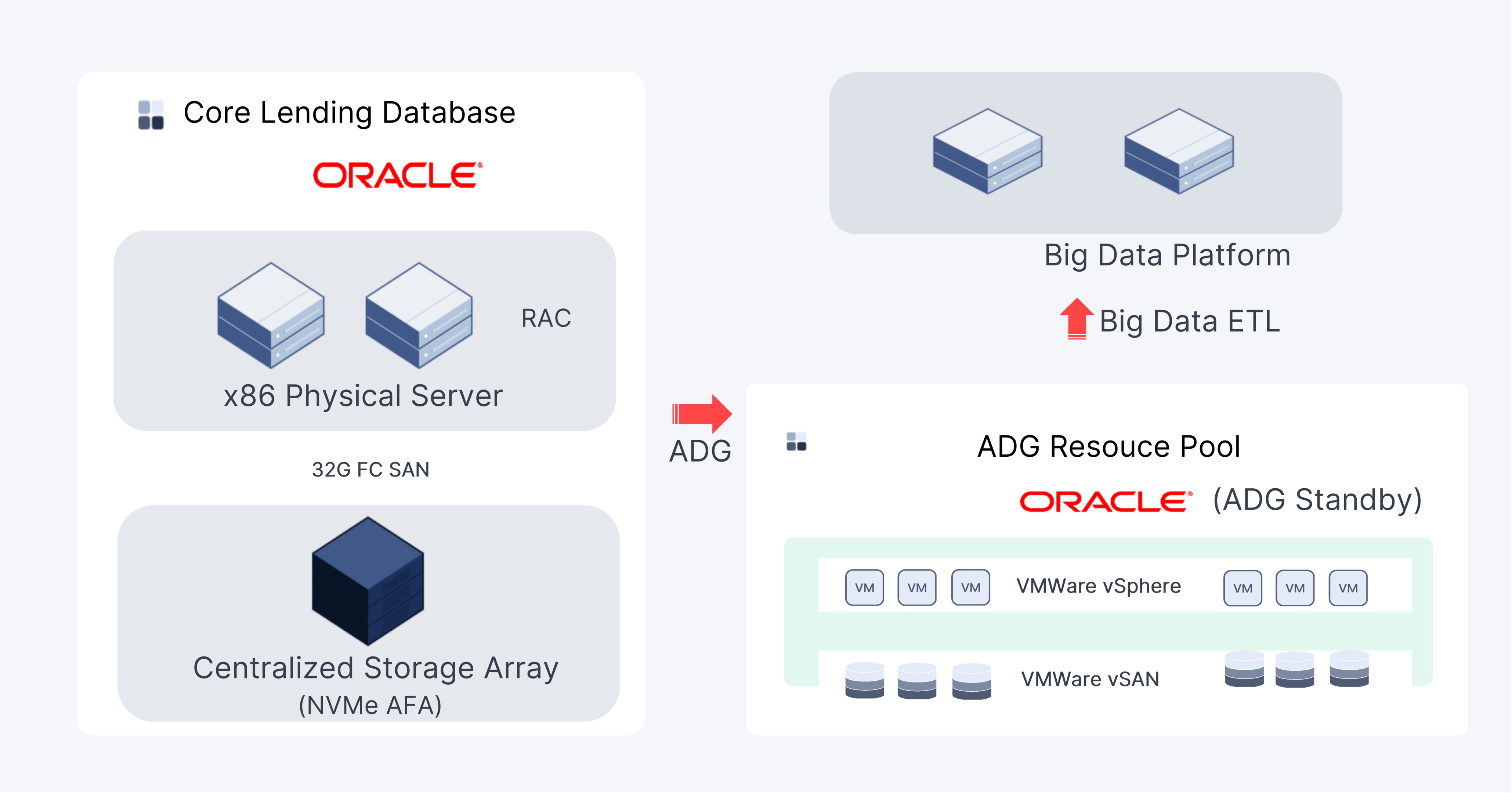
Concurrently, anticipating significant subscription cost increases following Broadcom’s acquisition of VMware, the bank planned to upgrade the standby databases with a more performant and cost-efficient vSAN alternative.
Initially, the user evaluated the solution of migrating the standby database to the existing all-flash centralized storage. Although this approach can fulfill I/O requirements, as the centralized storage already supported the primary core transaction database and other high-I/O standby databases, this might result in high expansion costs, alongside potential risks of performance interference.
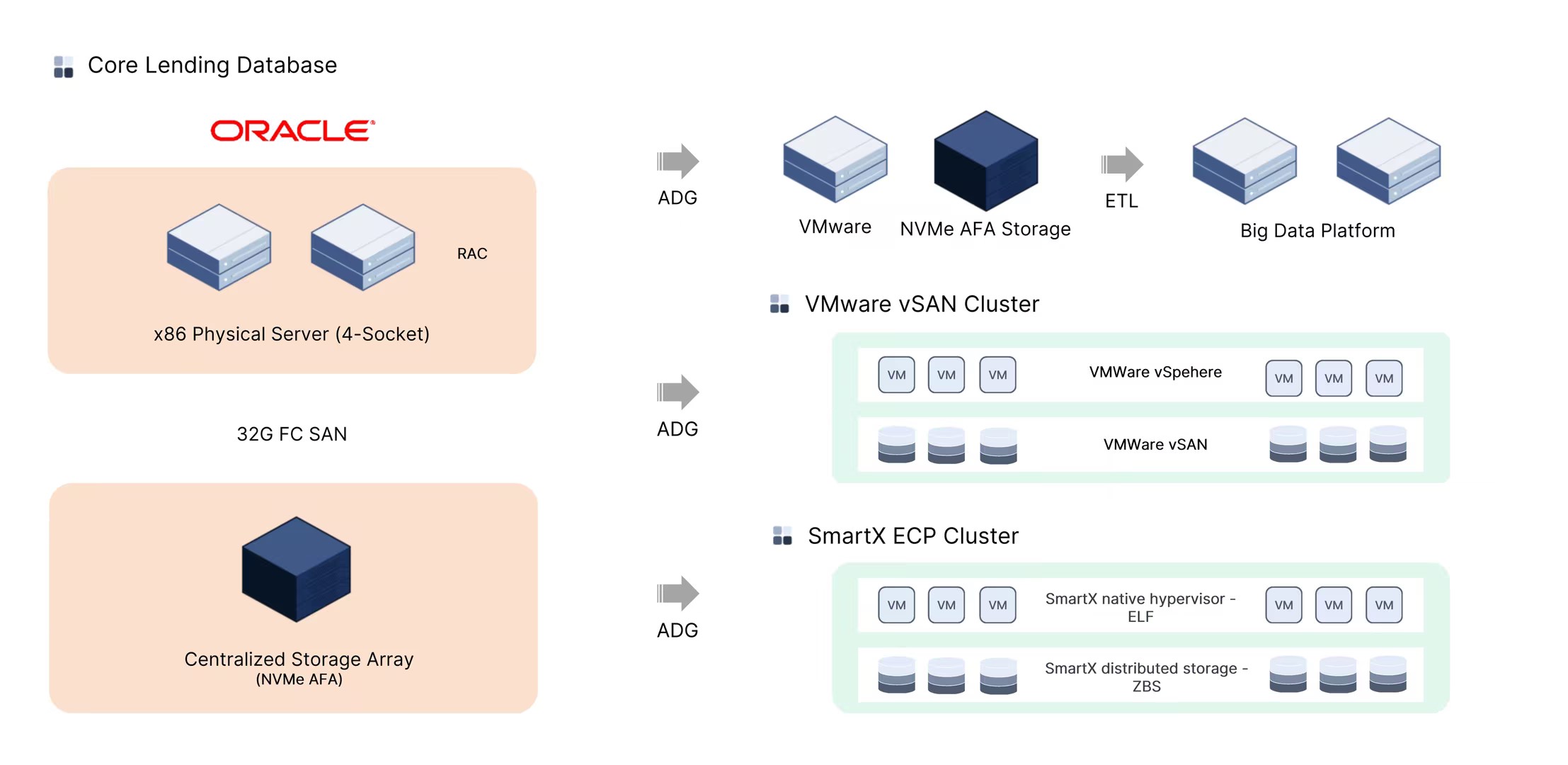
To balance performance, cost, and reliability, the bank decided to assess the feasibility of replacing vSAN with an alternative hyper-converged infrastructure (HCI) solution for hosting standby databases. Having already deployed SmartX ECP (featuring SmartX native hypervisor – ELF) in production to support MySQL slave databases for over 100 production systems—excluding the core accounting Oracle databases—the bank planned to validate the platform’s capability to host Oracle ADG databases.
Test Case
The test was conducted in the production environment using a comparative analysis approach, with standby databases running simultaneously on three clusters: vSAN, all-flash centralized storage, and SmartX ECP.
Cluster configurations were standardized, with a focus on monitoring ADG latency to ensure reliable real-time data replication. The test simulated real-world business scenarios, particularly during peak daily settlement batches, utilizing monitoring scripts to capture standby latency data in real-time.
Test Result
Monitoring over one month revealed that while the vSAN cluster largely met latency requirements, performance instability caused multiple severe spikes exceeding 900 seconds. Conversely, the all-flash centralized storage and SmartX ECP clusters demonstrated consistent stability, maintaining latency below 100 seconds during peak periods. With maximum latencies of 78 seconds and 85 seconds, respectively, their performance significantly outperformed the vSAN cluster.
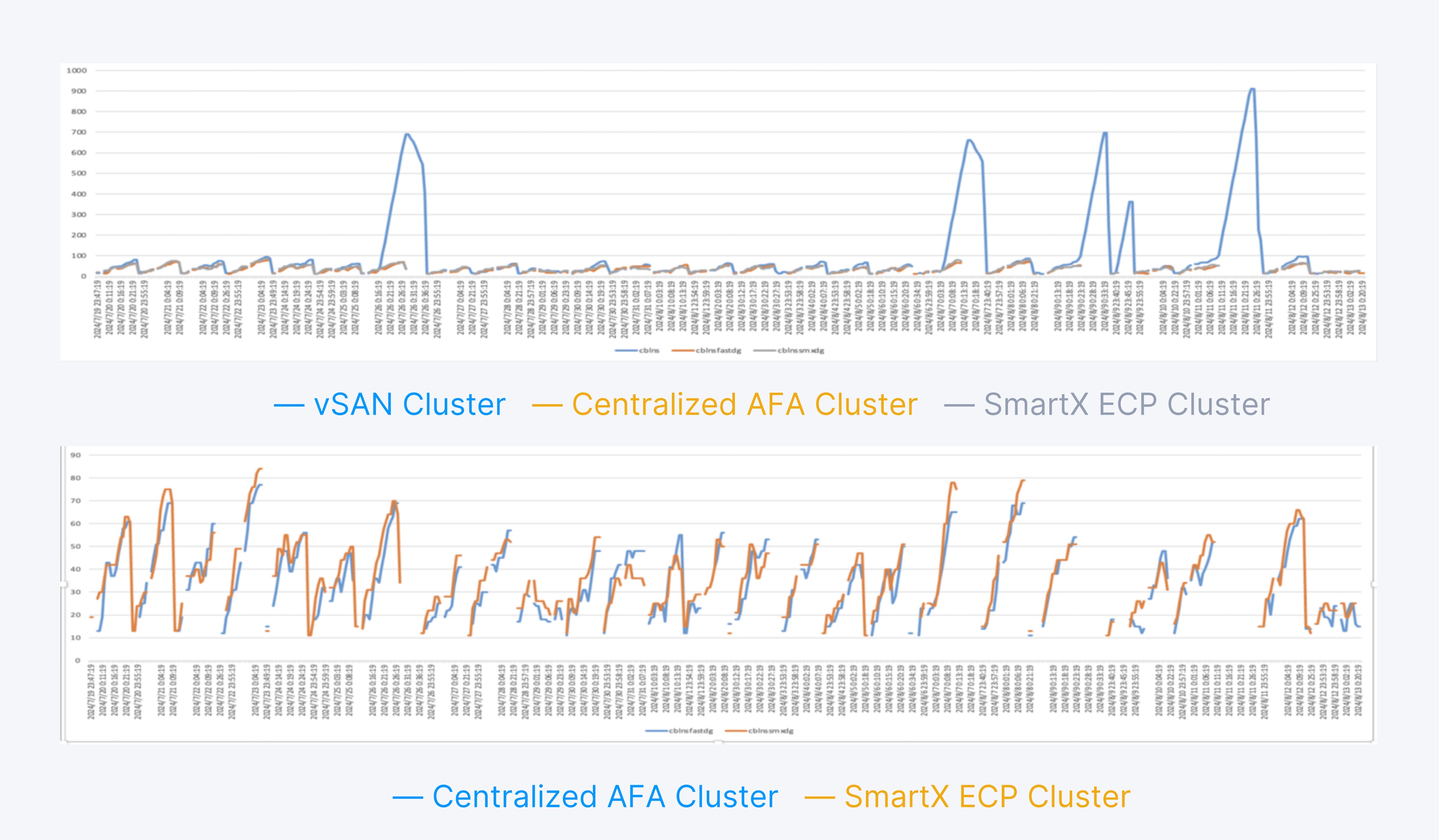
These test results demonstrate that SmartX ECP satisfies the real-time performance requirements of core business operations when handling high I/O loads, particularly in real-time data replication scenarios. Looking ahead, the bank plans to gradually extend support for existing Oracle primary and standby databases by utilizing SmartX ECP and SMTX ZBS tailored to specific use cases.
Key Outcomes
- Validated the capability of running core banking standby databases like Oracle ADG on SmartX ECP.
- Validated the capability of distributed storage to replace mid-to-high-end centralized storage, providing a new approach for banking users’ digital transformation in the era of all-cloud data centers.
- Hosting core databases on SmartX ECP (HCI architecture) significantly reduces reliance on mid-to-high-end storage hardware in traditional solutions, while simultaneously lowering hardware procurement and O&M costs.
Visit our website to learn more about how SmartX ECP provides innovative support to our FSI customers.
You may also be interested in:
SmartX ECP in Financial Services: Banking and Insurance Customer Stories
SmartX ECP in Financial Services: Securities and Futures Customer Stories
SmartX ECP in Financial Services: Funds and Trusts Customer Stories
SmartX ECP Supports Low-Latency Securities Trading: Achieving Bare-Metal-Level Latency
Boosting Oracle Data Warehouse Batch Processing Performance with SmartX HCI
