Hong Kong, March 24, 2026 — SmartX officially released SmartX ECP 6.3 with the latest HCI core SMTX OS v6.3. The new version is the first in the domestic HCI market to deliver synchronous replication for disaster recovery (RPO=0) in hyperconverged infrastructure (HCI), along with business continuity capabilities for high-performance applications, including NIC Teaming and SR-IOV high availability.
Through deep architectural evolution at the underlying layer, it fully leverages high-speed storage networks and media to achieve 11M+ IOPS and 130+ GiB/s bandwidth in a three-node cluster. Together with newly introduced security and compliance features, including agentless antivirus and national cryptographic algorithm encryption, SMTX OS 6.3 provides the industry’s most comprehensive support for mission-critical applications in HCI environments.
Launching Background
Enterprises now face multiple challenges, including cost optimization, rising hardware prices, and VMware replacement. Particularly in mission-critical scenarios that require the highest cost investment, compared with traditional three-tier architectures (physical servers/VMware virtualization + high-end all-flash arrays), mainstream cloud infrastructure solutions struggle to meet enterprises’ demands for high cost efficiency, ease of O&M and elastic scalability, as they are unable to simultaneously match key capabilities such as ultra-high performance and low latency, high availability, and disaster recovery.
SMTX OS 6.3 delivers a comprehensive leap in high availability, disaster recovery, performance, and security and compliance capabilities, becoming the first in the industry to provide complete support for mission-critical production workloads and offering a truly viable alternative to traditional architecture for significant TCO reduction.
High Availability for Critical Workloads: Enhancing High-Speed Network & Virtual Device Resilience
SMTX OS 6.3 provides more complete high-availability support for mission-critical high-performance workloads, enabling users to achieve both the performance and reliability required for key applications.
HA for RDMA Storage Network
By introducing RDMA storage network cross-NIC bonding, a highly reliable redundant storage network path is built, increasing network bandwidth while strengthening the underlying fault tolerance and availability of the HCI cluster at the physical link level.
HA for VMs Using SR-IOV NIC
Supports HA scheduling for VMs using SR-IOV NICs. For low-latency workloads on high-speed network devices, such as financial trading, host hardware failures can be mitigated, reducing downtime and ensuring business continuity.
HA for HCT (Hygon Cryptographic Technology) Devices
HCT and similar CPU-based encryption technologies are widely used to secure workloads due to their high cost-efficiency. SMTX OS 6.3 adds HA support for VMs using HCT devices, ensuring the continuous operation of compliance-sensitive workloads.
Additionally, SMTX OS 6.3 provides HA support for VMs using vGPU, ensuring reliable operation for AI and VDI use cases.
Disaster Recovery for Critical Workloads: Supporting Native Synchronous Replication and Management Platform Resilience
SMTX OS 6.3 addresses the high data consistency requirements of industries such as finance and healthcare by providing native synchronous replication (RPO=0) and enhanced features like CloudTower High Availability.
This improvement reduces reliance on costly external storage in traditional active-active architectures, delivers real-time data protection for critical workloads, and reduces disaster recovery costs and operational complexity.
VM-Level Synchronous Replication with RPO=0
Building on the existing stretched active-active cluster capabilities, SMTX OS 6.3 is the first in the industry to provide VM-granular native synchronous replication with RPO=0. Compared with stretched active-active clusters, this replication solution does not require protecting the entire cluster, can automatically tolerate disaster recovery network fluctuations, reduces network resource usage, and supports failover and DR drills.
CloudTower HA
Leveraging CloudTower HA capabilities, SMTX OS 6.3 not only ensures continuity of the data plane but also enables automatic failover of the cross-site management plane, providing more complete disaster recovery protection.
Additionally, SMTX OS 6.3 lowers the minimum requirement for building cross-site active-active clusters from six nodes to four, reducing deployment costs. It also provides placement group availability domain policies to ensure applications are deployed and fail over in active-active domains according to business requirements.
Storage Performance for Critical Workloads: Surpassing 11M IOPS and 130 GiB/s Bandwidth, Comparable to High-End All-Flash Arrays
With deep architectural advancements, SMTX OS 6.3 fully utilizes high-speed storage media and networks, effectively meeting the stringent I/O latency and concurrency requirements of core database workloads.
SMTX OS 6.3 deeply integrates Intel DSA (Data Streaming Accelerator), the high-performance kernel asynchronous I/O framework (IO_uring), multiple storage instances and disk groups, and RDMA high-speed storage network multi-link aggregation, combined with existing striping and Boost modes, achieving a leap in storage efficiency.
In performance tests on a standard Intel three-node cluster, SMTX OS 6.3 achieves I/O throughput comparable to high-end all-flash arrays, delivering multiple-fold improvements over version 6.2:
- 11 Million+ IOPS (4K random read, +360%)
- 130+ GB/s throughput (sequential read, +260%)
- <100 μs 4K random read latency
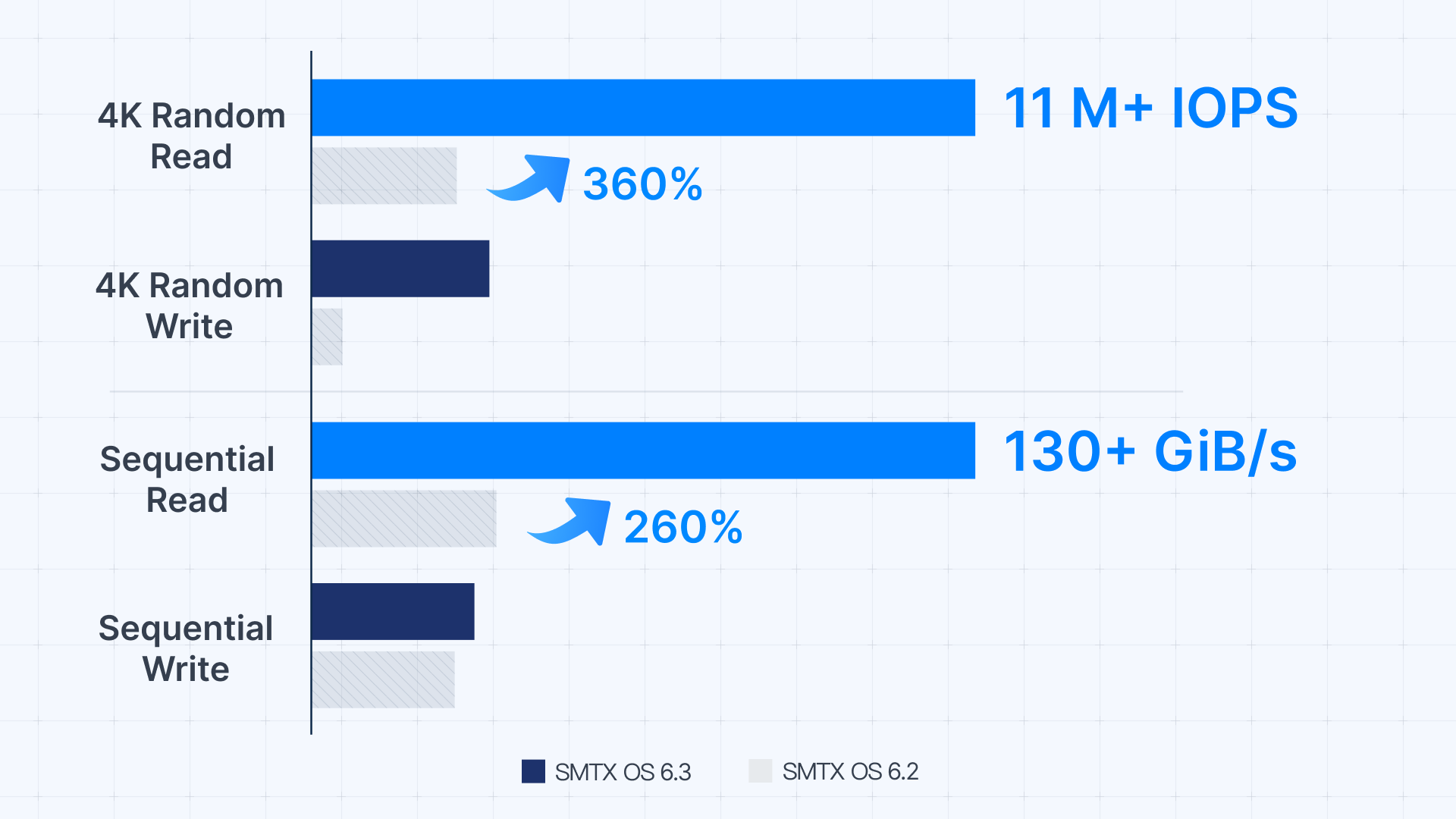
In tests on Hygon and Kunpeng platforms, SMTX OS 6.3 also demonstrates excellent adaptation and acceleration capabilities. Through deep optimization of CPU architectures, the system achieves multiple-fold performance improvements over version 6.2: 4K random read/write performance increased by 350% to 570%, and sequential read/write throughput grew by more than 50% to 200%.
* Performance data is based on internal tests with specific hardware configurations (including Intel, Hygon, and Kunpeng platforms, three-node clusters, 100Gb/200Gb storage networks, SMTX OS 6.3 + 4 storage instances); actual results may vary depending on system environment, workload, and hardware specifications. The performance gains are measured against the version 6.2 baseline, and this configuration represents the highest performance level observed in testing.
Optimized I/O Path
SMTX OS 6.3 deeply integrates with the Intel DSA (Data Streaming Accelerator) hardware engine to offload memory copy tasks that would normally consume CPU resources to dedicated hardware. Combined with the kernel IO_uring asynchronous framework and RDMA high-speed network multi-link aggregation, SMTX OS 6.3 effectively reduces system call overhead and processing latency in high-concurrency environments.
Multi-Storage-Instance for High Throughput
Supports multiple physical disk pools and storage instances in a single node. Combined with existing striping and Boost modes, SMTX OS 6.3 can significantly improve underlying storage parallelism. This efficiently handles bursty I/O from core databases and high-density computing tasks, delivering high-concurrency performance for critical workloads.
Optimized Support for High-Performance, Low-Latency Workloads in the FSI Industry
To meet the demands in FSI use cases such as high-frequency trading and market data distribution systems, SMTX OS 6.3 provides features including IGMP/MLD Snooping and configurable queues and lengths of vNIC, meeting high-performance, low-latency requirements while reducing network overload risks.
Security and Compliance: Supporting National Cryptographic Algorithm and Agentless Antivirus Solution
SMTX OS 6.3 leverages a native security architecture, deeply integrating agentless antivirus solutions, national cryptography algorithm, built-in key management service (KMS), and live migration traffic encryption. This optimized design reduces deployment and operational costs while meeting the stringent data encryption, compliance, and auditing requirements of critical industries.
Agentless Antivirus Protection
Integrates an agentless antivirus solution from AsiaInfo Security, effectively enhancing virus protection efficiency in large-scale cloud environments while reducing operational costs.
National Cryptography Support and Built-in KMS
Natively supports VM disk encryption based on national cryptography algorithms and provides a built-in KMS service to simplify full lifecycle management of keys.
Additionally, SMTX OS 6.3 introduces VM live migration traffic encryption to ensure the confidentiality and compliance of critical data during storage and workload migration. At the network layer, it provides ERSPAN to support network operations and security auditing.
ITAI Ecosystem Support: Enhance Compatibility to Build ITAI Infrastructure with Higher Performance and Flexibility
SMTX OS 6.3 addresses heavy-load challenges on IT Application Innovation (ITAI, also known as Xinchuang) CPU platforms like Kunpeng by delivering deep platform optimizations. By raising VM configuration limits and supporting heterogeneous node live migration, it resolves performance bottlenecks and hardware upgrade difficulties for core applications during infrastructure transformation.
Breaking Compute Configuration Limits
SMTX OS 6.3 raises resource allocation limits for each VM on the Kunpeng platform, allowing up to 512 vCPUs and 1 TiB memory, providing equivalent virtualized capacity for core databases and other compute-intensive workloads previously running on physical servers.
Enabling Smooth Evolution of ITAI Infrastructure
Supports VM hot migration across heterogeneous Kunpeng nodes to achieve goals like cross-model migration within the same CPU generation. This gives enterprises more flexibility in hardware selection and reduces operational risks during hardware updates or dynamic cluster scaling.
Agile O&M: Simplifying Large-Scale Cluster Management
SMTX OS 6.3 introduces intelligent operations features such as VMTools batch upgrades and optimized migration paths, reducing the risk of application configuration failures and network interruptions during daily maintenance and cross-cluster migrations, and improving operational reliability and modification efficiency in complex environments.
VMTools Batch Upgrade
Upgrade VMTools with one click without entering the OS, and select multiple VMs in the interface for bulk one‑click upgrades, reducing repetitive manual operations.
Cross-Cluster Migration Efficiency
In non-Boost mode, only active data is migrated during cross-cluster live migration, reducing network bandwidth consumption and disk data transfer time.
Cluster NTP Enforcement & Rapid Issue Locating
Simplify NTP configuration and usage.
Multi-Level VM Groups
Provides clearer mapping and management between complex business architectures and virtual machines, enabling more efficient resource management and bulk operations.
Why SmartX ECP?
SmartX ECP delivers a comprehensive infrastructure solution for critical production workloads. It reduces costs and boosts efficiency while ensuring business continuity, with its four industry-leading capabilities:
- High Availability Enhancement: Full support for RDMA storage networks, SR-IOV, and other high-speed devices, ensuring zero downtime for critical workloads.
- Storage Performance Boost: Delivers up to 3–5× higher performance than comparable products, meeting the demands of high-load production workloads.
- Disaster Recovery Upgrade: Supports asynchronous and synchronous replication as well as active-active deployment, fulfilling diverse RTO/RPO requirements.
- Expanded Scenario Coverage: With the support of file storage, big data protocols, and VM-container convergence, it offers the most complete lightweight cloud infrastructure in the industry.
Learn more about SmartX ECP 6.3 from our website: https://www.smartx.com/hk-mo/smartx-ecp/
