SmartX recently released SMTX Kubernetes Service (SKS) 1.6, the latest version of its production-ready container management and service product. This release brings major enhancements in ease of management and domestic IT innovation compatibility, including form-based visual management of Kubernetes resources through the UI, as well as support for TencentOS and Kylin OS. These capabilities help enterprise users build full-stack domestic IT innovation-ready Kubernetes clusters, from servers to operating systems.
SKS 1.6 also introduces support for separating workload cluster management networks from service networks, and for configuring multiple network interfaces for Pods, meeting the requirements of complex networking scenarios.
Release Background
Operating a Kubernetes cluster often involves multiple teams. Infrastructure or container O&M teams manage the cluster, while application O&M or development teams handle business applications. Although they work at different resource layers, they all need a unified visual management interface to reduce collaboration costs and lower the learning curve, especially for teams newly adopting containers or responsible for application rollout.
Meanwhile, users in finance, healthcare, government, and enterprise sectors have stricter requirements for IT infrastructure autonomy, control, security, and compliance. Container platforms must support not only domestic CPUs and servers, but also a full domestic IT innovation environment across the hyper-converged OS, VM node OS, and Kubernetes workload node OS. Some customers also require strict isolation between management and service networks so business applications can access external resources such as databases, middleware, and monitoring targets through independent service networks.
To address these needs, SKS 1.6 enhances usability and security compliance by extending visual management from cluster resources to Kubernetes application resources, strengthening full-stack domestic IT innovation compatibility, and supporting network isolation and multi-network access in complex production environments.
Enhanced Usability: Managing Kubernetes Resources Through Forms
SKS 1.6 supports deploying and managing Kubernetes resources through forms, eliminating the need to write complex YAML files. This enables unified visual management of infrastructure, Kubernetes clusters, and business applications.
With resource aggregation in a single view, quick access to frequent operations, integrated container image registry permissions, and end-to-end storage topology linkage, SKS 1.6 helps O&M teams reduce interface switching, accelerate operations and application rollout, and locate issues faster.
Key advantages include:
- Fewer interface switches: Related resources are aggregated in the same view, reducing the need to move between interfaces and improving troubleshooting and change efficiency.
- Faster operations: Quick entries are added for frequent operations, shortening operation paths and enabling changes to be completed more directly.
- Faster application rollout: Integration with the container image registry permission system allows images to be selected and used directly without repeated credential configuration, improving both efficiency and security.
- Faster troubleshooting: The PVC → PV → Volume topology provides end-to-end visibility from containers to infrastructure, helping users quickly locate storage issues.
Full-Stack Domestic IT Innovation: Supporting TencentOS and Kylin OS
Previous versions of SKS already supported two mainstream domestic server architectures at the CPU level: Hygon x86_64 and Kunpeng AArch64, covering common domestic hardware choices in industries such as finance and government.
At the operating system level, SKS 1.6 adds support for Kylin OS and TencentOS on VM nodes, and TencentOS on bare-metal nodes. Users can flexibly choose Kylin OS or TencentOS as the node operating system for workload clusters according to their domestic IT innovation requirements, and combine them with SMTX OS and CloudTower to form a unified full-stack domestic IT innovation solution.
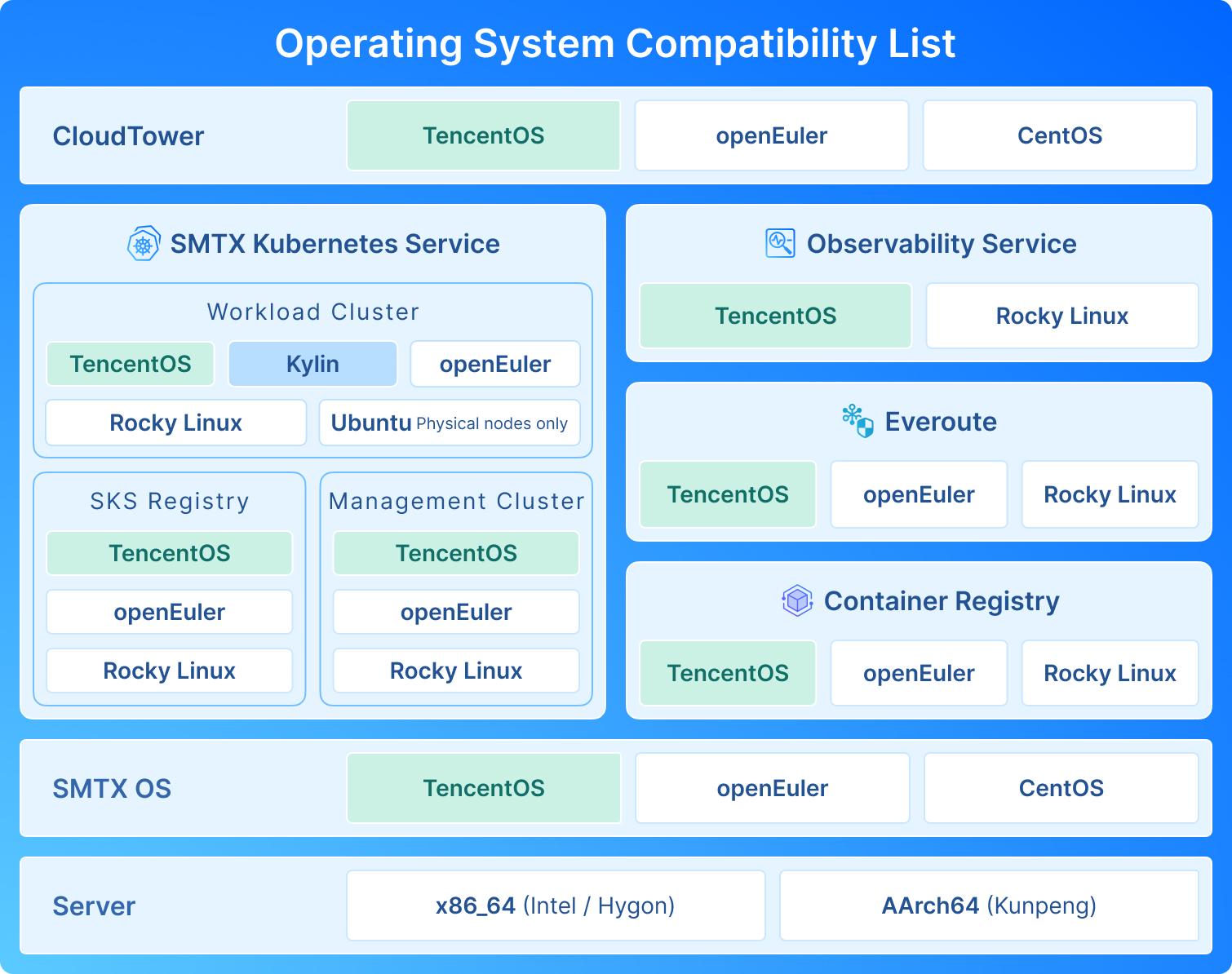
In addition, SKS 1.6 introduces native support for Huawei Ascend NPU resources. It can automatically manage components such as drivers and Container Toolkit, and provides automated discovery, scheduling, and monitoring of domestic AI computing resources. This helps users build AI workloads on domestic IT innovation infrastructure while reducing deployment and maintenance costs.
Optimized Network Management: Separating Management and Service Networks, and Supporting Multiple Pod NICs
Separating Management and Service Networks
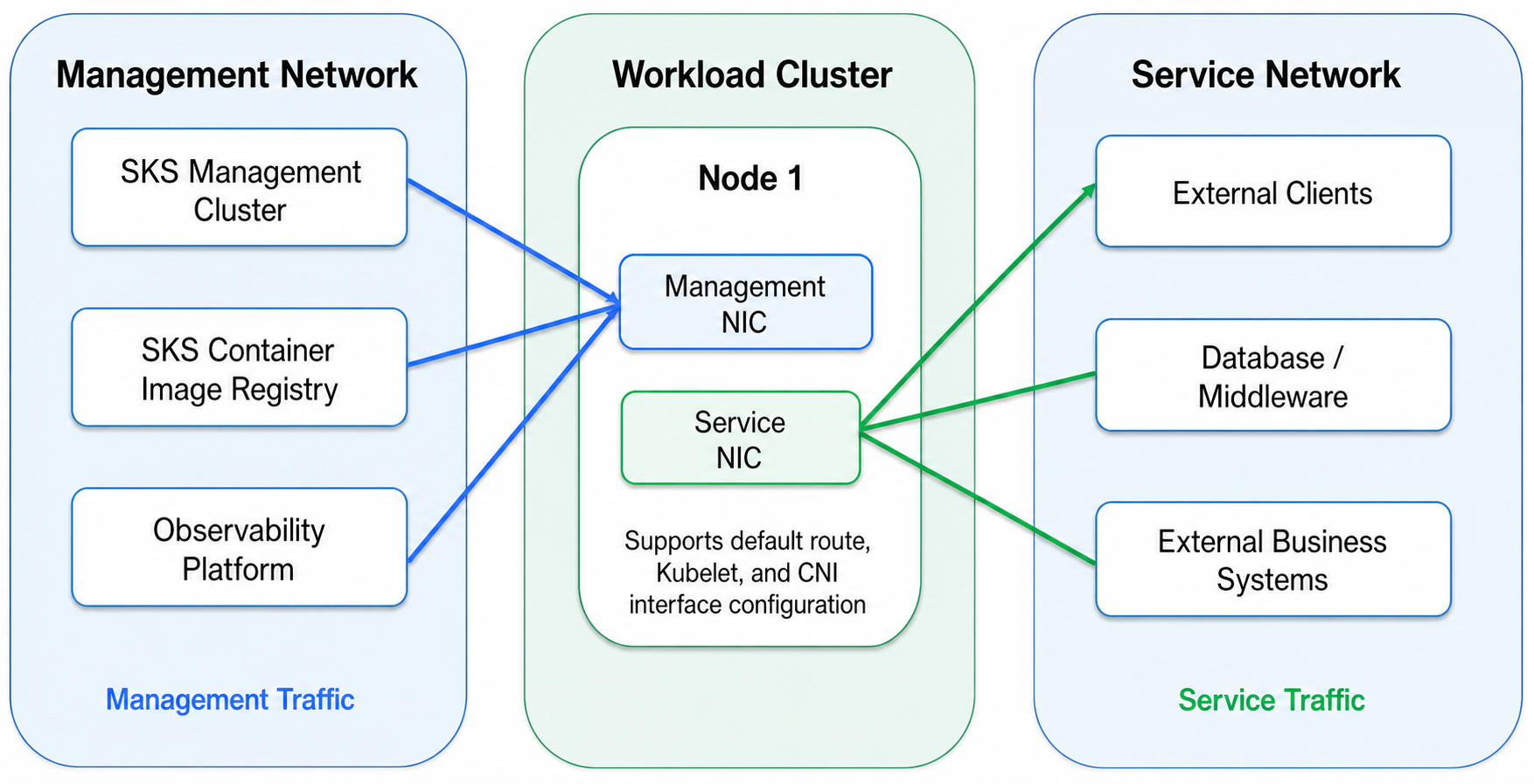
To prevent management and service traffic from affecting each other, SKS 1.6 supports separating the management network from the service network for workload clusters. Management and service traffic are isolated, and the security domains are naturally separated.
The container network cannot route to control-plane components such as the apiserver. Even if a container is compromised, control-plane operations remain unaffected. This meets network isolation and security compliance requirements in industries such as finance, government, and enterprise sectors, while improving Kubernetes cluster delivery and O&M efficiency in complex network environments.
Main capabilities include:
- Configuring management NICs and service NICs for workload clusters to separate management and service traffic.
- Configuring the default route egress, static routes, Kubelet Node IP, and CNI primary interface during cluster creation.
- Adding service NICs after cluster creation and maintaining static routing rules.
- Providing graphical configuration entries to reduce deployment and O&M complexity in complex network environments.
Supporting Multiple NICs for Pods
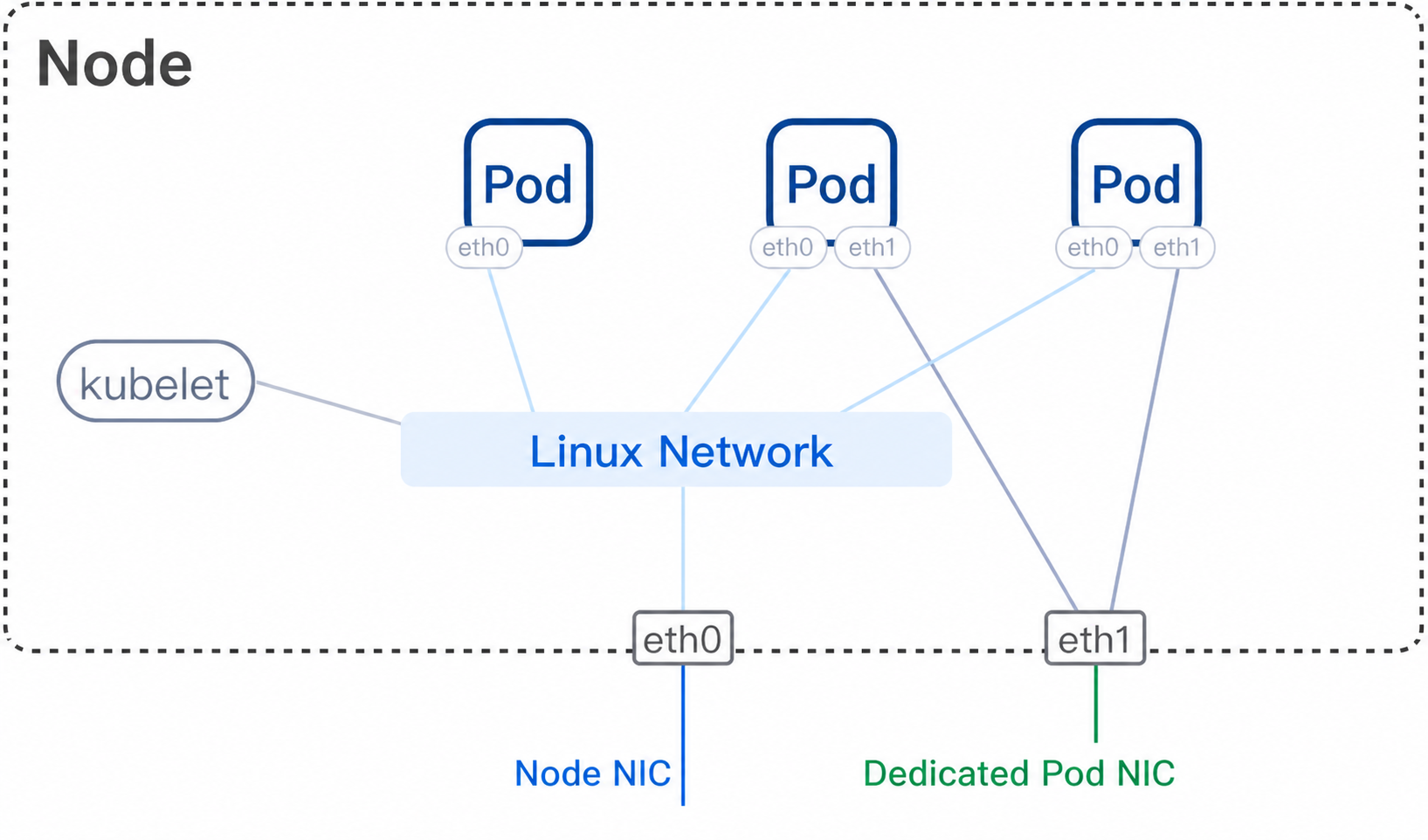
For scenarios with strict network isolation requirements, such as high-performance applications that need access to multiple network planes for both throughput and isolation, SKS 1.6 supports configuring multiple NICs for Pods. Once enabled, the system automatically configures dedicated Pod NICs for each node, allowing direct connectivity to external application systems while keeping traffic isolated from other network planes.
With the multi-NIC Pod capability, containers can access flat networks through additional NICs for direct communication. This avoids the performance overhead of Overlay networking and delivers higher throughput and lower latency, with an approximately 20% performance improvement. The feature also supports connecting specific Pods precisely to designated dedicated networks.
User Practices
Since its release, SKS has been deployed in production environments by users in finance, healthcare, and other industries, helping them build converged virtualization and container infrastructure.
- A Trust Company: VMware replacement and active-active construction from virtualization to container platform practice. >>Learn more
- Zigong First People’s Hospital: Hyper-convergence and SKS support core business applications like HIS, accelerating localization and cloud-native transformation. >>Learn more
- A State-Owned Water Utility: Full-stack hyper-convergence builds a lightweight cloud foundation for unified management of virtualized and container environments.
- An Autonomous Driving Company: Virtualization and container hybrid infrastructure promotes the architectural upgrade of intelligent port systems.
Learn More
