As enterprises plan to exit VMware, container management capabilities provided by vSphere with Tanzu and Tanzu Kubernetes Grid are critical criteria for evaluating potential alternatives.
With SMTX Kubernetes Service (SKS), SmartX Enterprise Cloud Platform (ECP) offers feature parity with Tanzu while reducing operational complexity through targeted technical optimizations. It streamlines container O&M, enables unified management and security policy enforcement across hybrid (VM-container) environments, and improves compatibility with domestic software and hardware ecosystems.
This article details how SKS competes with vSphere with Tanzu, covering core feature comparisons, key advantages, and real-world customer deployments.
Feature Comparisons
As a critical part of SmartX ECP, SKS helps IT operations teams easily deploy and manage production-ready Kubernetes clusters on servers with multiple CPU architectures. Integrating industry-leading SmartX virtualization, distributed storage, networking, and security, as well as other product components, SKS enables enterprises to build a VM-Container Converged Infrastructure (VCCI) for unified infrastructure management, seamless VM-container networking, and faster Kubernetes and AI workload delivery.
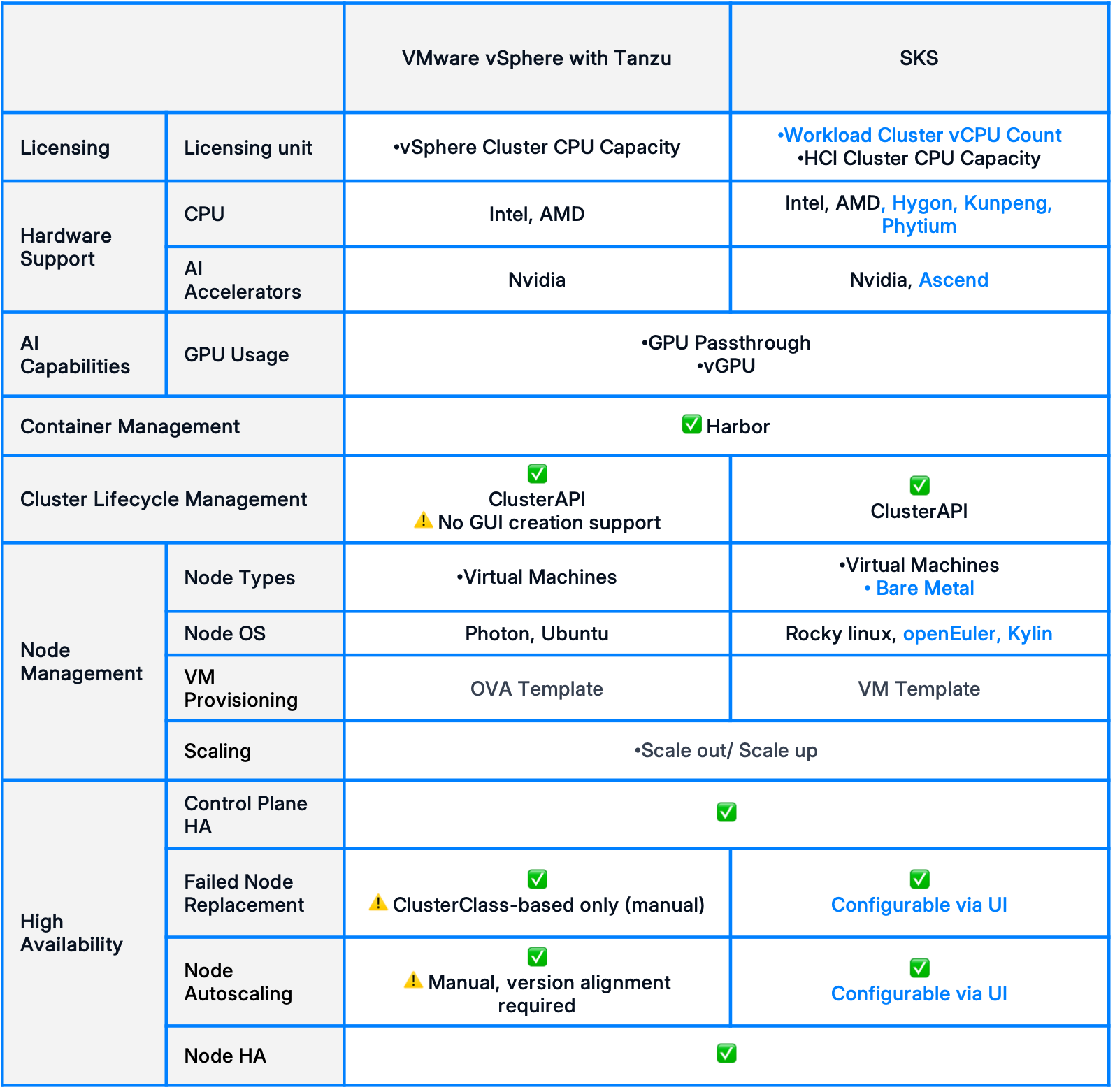
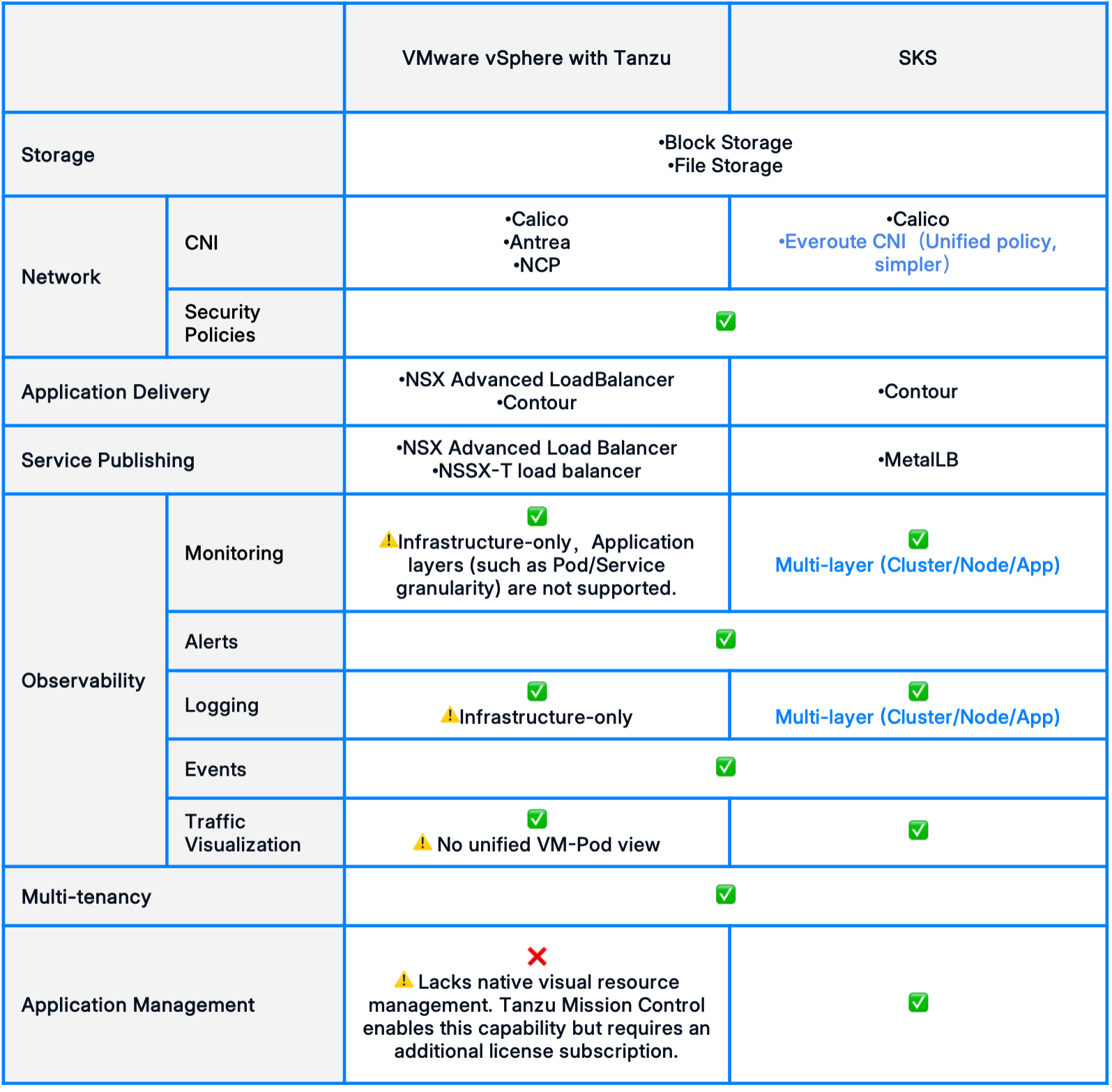
A detailed comparison between SKS and VMware vSphere with Tanzu key features is shown below.
Five Key Advantages to Replace vSphere with Tanzu with SKS
#1 Better Tailored for HK/MO Enterprises
Subscribe on-demand
VMware vSphere with Tanzu employs a licensing model based on the total CPU capacity of the vSphere cluster, which can result in underutilized resources and unnecessary costs. In contrast, SKS offers two flexible licensing options:
- Licensing based on SmartX ECP CPU capacity: Ideal for large-scale, continuous workloads
- Licensing based on Kubernetes cluster vCPU amount: Charges based on the total vCPU of Kubernetes clusters — perfect for early-stage container users with elastic, pay-as-you-use demands. This approach is particularly attractive to SMEs to reduce initial investment costs.
Broader Domestic Compatibility
SKS supports a wide range of local ecosystems:
- Hardware: Full support for domestic CPUs like Hygon, Kunpeng, Phytium, and GPUs like Ascend.
- Software: Compatible with domestic operating systems such as Kylin and openEuler. For instance, Zigong First People’s Hospital built Kubernetes clusters with SKS and openEuler, enabling a seamless transition to cloud-native architecture while ensuring safe, stable operations for critical systems. Read more here: From VMware to SmartX ECP: The Cloud Native Journey of Zigong First People’s Hospital
Two deployment approaches for diverse workloads
Different workloads require different deployment approaches:
- VM clusters: Ideal for Dev/Test environments that require rapid scaling.
- Bare metal clusters: Better suited for compute-intensive tasks such as AI training or real-time analytics, eliminating virtualization overhead.
Unlike VMware vSphere with Tanzu, which only supports VM-based clusters, SKS supports both VM-based and bare-metal-based Kubernetes clusters, covering a broader range of use cases. Tests also show SKS (VM-based Kubernetes) can achieve 82%–96% of bare metal performance. Learn more: Kubernetes on VMs vs. Bare Metal: Comparison of Performance
#2 A More User-Friendly GUI
Simplified Kubernetes Cluster Lifecycle Management
VMware vSphere with Tanzu supports automated management of Kubernetes clusters. But its operations often rely on tools such as kubectl, YAML files, and the command-line interface (CLI), which present a higher barrier for beginner users to learn and operate.
In contrast, SKS offers a simple and intuitive graphical interface that enables users to create Kubernetes workload clusters within minutes. Additionally, SKS provides a unified management interface for full lifecycle operations across all Kubernetes clusters, including creation, configuration, upgrades, scaling, and deletion.
Graphical Configuration for Advanced Features
Both VMware vSphere with Tanzu and SKS provide features to ensure the reliability, availability, and self-healing capabilities of Kubernetes clusters — for example, automatically replacing failed nodes and triggering horizontal scaling when resources are insufficient for deployments. However, while VMware typically requires manual configuration, SKS allows users to flexibly set key parameters via a graphical interface, such as failure detection policies, timing thresholds, and scaling range, making configuration more intuitive and efficient.
Graphical Management of Container Applications
VMware vSphere with Tanzu includes certain graphical capabilities for Kubernetes cluster management, but falls short in managing the lifecycle of containerized applications. In the vCenter interface, administrators cannot directly manage native Kubernetes resources (e.g., Deployments, Pods), often requiring CLI tools or third-party platforms to create, update, or delete them.
SKS allows direct access to consoles for clusters, nodes, and Pods within the management interface, enabling users to perform related operations without switching between multiple tools, thereby improving operational efficiency.
#3 Simpler Management of Security Policy in a Hybrid Environment
As enterprises advance in modernizing their applications, the coexistence of VMs and containers has become the norm. This hybrid architecture introduces unique security challenges; due to the fundamentally different network architectures between VMs and Pods, unified traffic monitoring is difficult, and security policy configuration becomes complex and inefficient.
VMware has attempted to integrate NSX Container Plugin (NCP) and Antrea within Tanzu to bridge this gap. To some extent, it enables unified security policy management between VMs and Pods in vSphere environments, placing VMware ahead of many other vendors in terms of integrating VM and container network security. However, there’s still a disconnect: administrators must manage VMs and Kubernetes clusters via vCenter, while switching to NSX Manager for configuring unified security policies across VMs and Pods.
SKS provides a unified graphical interface to manage VMs, Kubernetes clusters, and containerized resources (such as Pods and Deployments), while configuring security policies and viewing traffic between VMs and Pods — all in one place. Compared to VMware’s approach, SKS’s solution is more streamlined and user-friendly:
- Unified Interface: All VM and Pod operations — including configuration, monitoring, and traffic inspection — can be managed on a single platform.
- End-to-End Traffic Visibility: SKS supports cross-resource topology views, allowing administrators to trace full data flows between Pods, Deployments, VMs, and external IPs.
For more information, please refer to: SmartX VCCI Solution Upgrade: Securing the Interconnection Between Virtualized and Containerized Applications
#4 Finer-Grained Multi-Tenant Management
In VMware vSphere with Tanzu, tenancy is defined at the vSphere cluster level, using vSphere Namespaces as the unit of isolation. The supported objects include Tanzu Kubernetes Grid clusters, vSphere Pods, and VMs. This model is primarily focused on isolating virtualization resources within vSphere, rather than Kubernetes-native resources like Pods.
SKS adopts Kubernetes Namespaces as the foundation for tenant isolation and centralized management. This approach offers finer granularity and is better suited for users seeking a simple and efficient multi-tenant solution.
#5 Richer Observability Features
In terms of observability, VMware vSphere with Tanzu primarily focuses on infrastructure-as-a-service (IaaS) level monitoring and logging. It lacks a unified solution for VMs and Pods traffic visualization, requiring additional integration with tools like Aria Operations for Networks (formerly vRNI) or NSX Intelligence.
SKS, on the other hand, provides multi-dimensional insights — covering clusters, nodes, and applications — within a single management platform. This enables users to gain a more comprehensive understanding of the cluster’s operational status. Learn more: SKS 1.3 Released: Now Supports Physical Machine-Based Clusters and Offers Enhanced Container Visualization in SmartX ECP
Replacement in Practice: A Trust Company Replaces Both VMware Virtualization and Tanzu with SmartX ECP
To support its evolving business needs with greater flexibility, a trust company adopted cloud-native architectures for its application development. In its initial IT strategy, it deployed SmartX ECP clusters (integrated VMware vSphere) to host Tanzu, supporting both containerized development/testing and production workloads. However, with increasing urgency around VMware replacement, the company began evaluating the feasibility of replacing Tanzu with SKS to further modernize its IT infrastructure.
Evaluation and Testing
In the first phase of testing, the company deployed a SmartX ECP cluster based on ELF virtualization using three Hygon-based servers, and conducted extensive validation of SKS. SKS successfully passed all 44 test items covering functionality, performance, integration, and reliability. It demonstrated comparable capabilities to Tanzu in Kubernetes cluster lifecycle management and observability. Additionally, SKS supports Kubernetes-native APIs, maintaining compatibility with the company’s existing operations and monitoring tools, enabling a seamless and efficient transition from Tanzu to SKS without disrupting established workflows.
Deployment and Full Migration
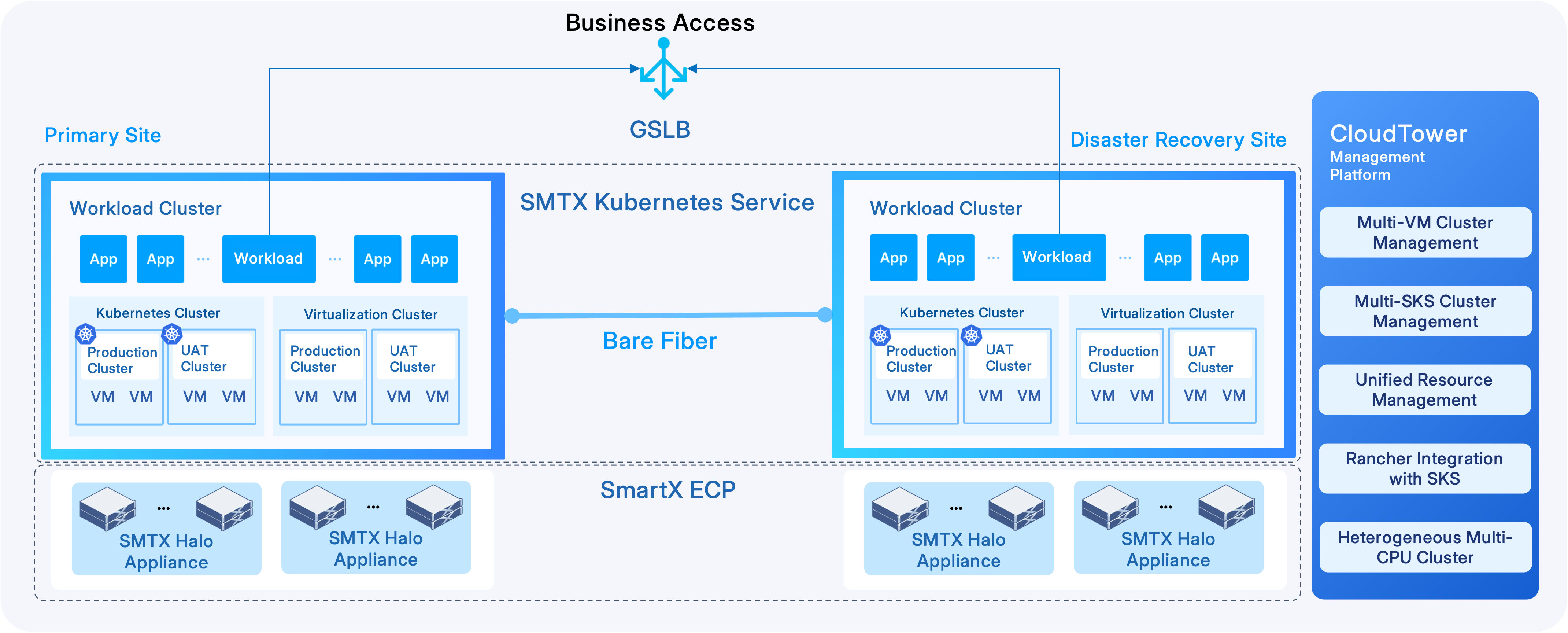
Impressed by the outstanding results, the company redesigned its application architecture and replaced VMware entirely, using SmartX ECP platform with its native hypervisor ELF and SKS to support both virtualized and containerized workloads. To ensure high availability, the company deployed two SKS clusters across its primary and DR sites running on SmartX ECP infrastructure. These clusters respectively serve the production and UAT environments. Both the control plane and worker nodes of the Kubernetes clusters were deployed as VMs, providing flexible deployment, scaling, and self-healing capabilities. Furthermore, the SKS clusters were integrated with the upper platform of Rancher for unified management by operations and development teams.
Result and Benefits
This implementation enabled the customer to simultaneously upgrade its IT infrastructure architecture, enhance high availability, and replace VMware with a localized alternative. These advancements have laid a solid foundation for future transformation.
To learn more, please read: SmartX ECP in Financial Services: Funds and Trusts Customer Stories
