Following VMware’s acquisition by Broadcom, many transportation organizations are actively exploring domestic IT infrastructure solutions, particularly alternatives to VMware virtualization and vSAN.
However, many transportation applications have stringent requirements for continuity and stability, and some enterprises have also set up both internal and external network environments to ensure data security and network isolation. Is there a domestic solution that can provide high performance and high reliability for critical applications, meet diversified needs such as data security and disaster recovery, and simultaneously assist transportation enterprises in IT Application Innovation (ITAI)?
Currently, leveraging the SmartX Enterprise Cloud Platform (ECP) and in-house migration tools, SmartX has assisted numerous transportation enterprises—covering railways, aviation, ports, and logistics—to accelerate the domestic replacement of VMware virtualization and vSAN. These enterprises utilize SmartX’s native hypervisor – ELF – to build resource pools for core business systems, databases, disaster recovery, VDI, development, testing, and more scenarios.
A Leading Airline: Replacing vSphere & vSAN While Achieving ITAI Transformation
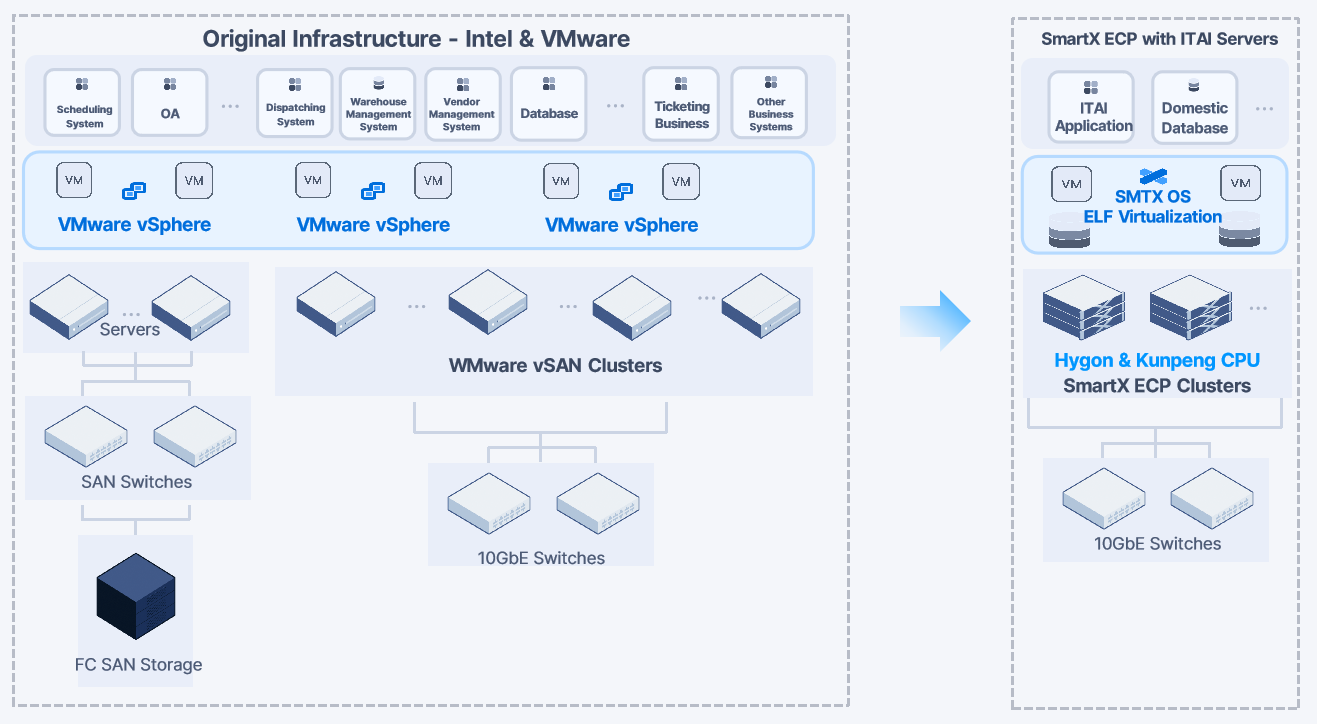
To support the daily operations of over 100 domestic and international flight routes, a leading Chinese airline has been continuously modernizing its IT infrastructure. From the early use of minicomputers and centralized storage to the introduction of VMware virtualization and vSAN in 2019, the airline has gradually expanded to over 200 all-flash vSAN nodes, supporting most of its business systems and databases. However, as VMware was acquired by Broadcom and the trend of ITAI continued, challenges with the use of vSAN became evident:
- Poor Hardware Compatibility: vSAN demands a high level of compatibility between the server model and accessories, creating challenges for hardware selection and future scalability.
- Risks and Costs Increased Due to VMware’s Adjustments: After VMware’s acquisition by Broadcom, technical support in mainland China was significantly reduced, and upgrading versions and features required new product subscriptions, substantially increasing subscription costs.
- ITAI Trends: The airline sought to explore domestic virtualization and hardware solutions to meet the ITAI transformation needs.
For a domestic alternative solution, the airline set the following four requirements:
- Stability and Reliability: The platform should provide a stable and highly available infrastructure to ensure the continuous operation of critical business systems.
- Flexible Decoupling: It should support chips from multiple brands, including Intel, Hygon, and Kunpeng, enabling parallel deployment across multiple architectures, breaking vendor lock-in, and reserving space for future technological upgrades and hardware iterations.
- Cost-Effectiveness: The new platform should offer better performance compared to vSAN while lowering the total cost of ownership (TCO) to ensure the efficiency of the replacement project.
- Smooth Migration: The platform must ensure seamless VM migration across platforms without impacting the ongoing business systems.
After thorough testing and validation, the airline highly recognized the performance and reliability of SmartX’s self-developed distributed storage, and ultimately chose to use SmartX ECP to replace both vSphere and vSAN. Multiple ECP clusters were built with Haiguang and Kunpeng CPUs. Currently, several heterogeneous CPU clusters are deployed across different network security domains, and production systems such as aircraft maintenance, office automation (OA), and various development and testing systems and databases have been successfully migrated. These systems are managed centrally by CloudTower.
In the future, the airline plans to further enhance its domestic IT ecosystem and introduce more SmartX ECP capabilities, such as SMTX Backup and Disaster Recovery, Everoute (for network security), and SMTX Kubernetes Service (for container management), to build a full-stack enterprise cloud platform.
A Regional Airline: Providing DR for Core Databases with SmartX ECP (ELF)
A regional airline originally relied on a “VMware virtualization + FC SAN storage” architecture to support most of its business systems, while core databases for systems such as FOC (Flight Operations Control) and aircraft maintenance were deployed on physical servers as Oracle RAC.
To ensure high availability of the FOC system and its database, the airline had set up a local ADG standby database for DR protection. However, under Oracle ADG’s maximum protection mode, a failure of the standby database would also affect the primary database, posing risks to business continuity. In addition to FOC, other core systems such as aircraft maintenance, electronic flight package, and air-ground datalink also required a more advanced HA solution. Strengthening database resilience and achieving unified management of multiple standby databases became pressing challenges.
The airline evaluated both VMware-based and SmartX ECP–based solutions. They found that traditional virtualization was complex to operate and maintain, and its construction costs were relatively high. In contrast, adopting SmartX ECP significantly reduced deployment complexity and costs, enabled unified hosting and management of multiple standby databases, and improved standby database query performance with features like I/O localization.
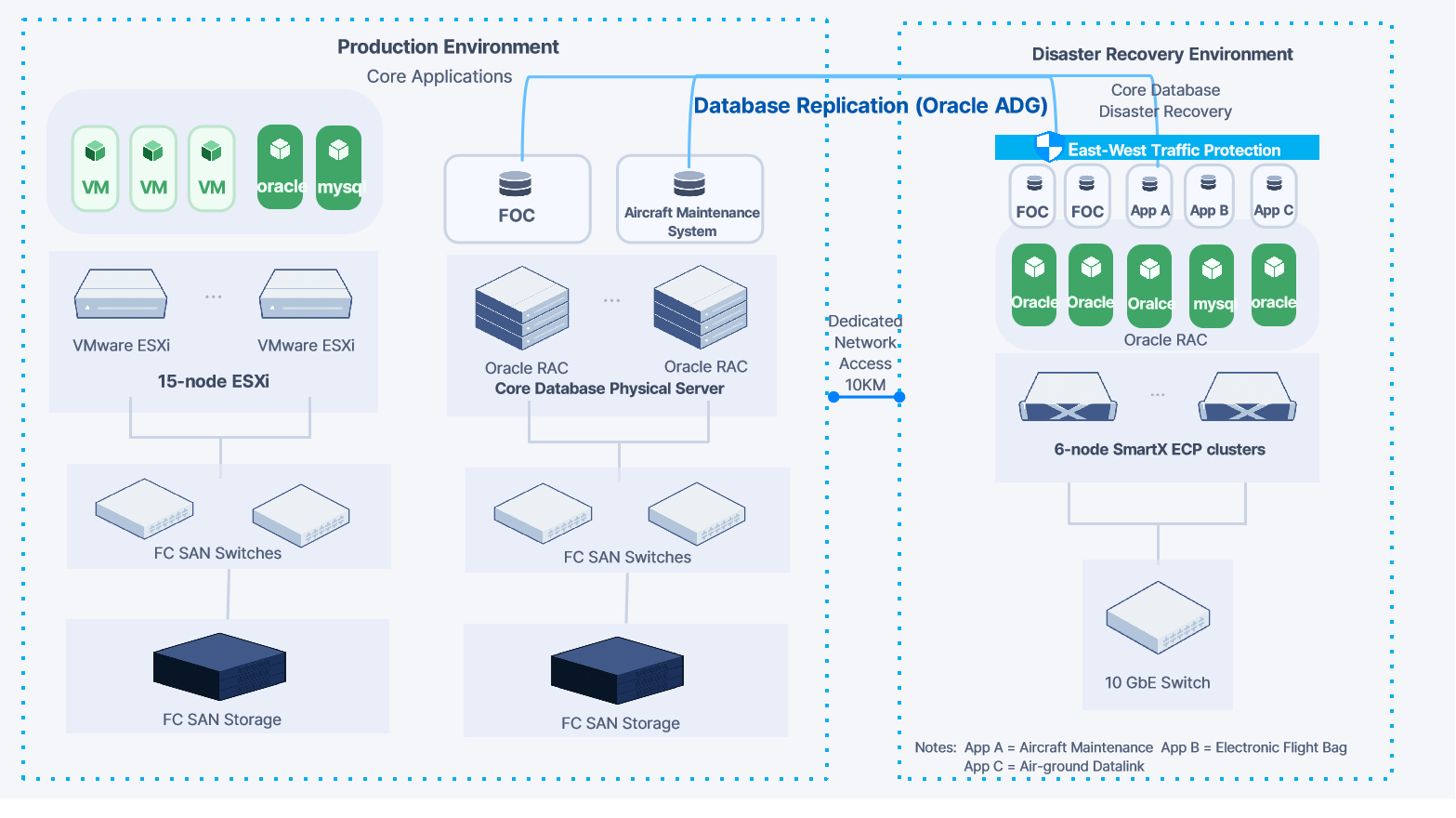
Ultimately, the airline chose to build its database disaster recovery environment on SmartX ECP (using native hypervisor – ELF), supporting standby databases for FOC, aircraft maintenance, electronic flight package, and air-ground datalink systems, with CloudTower enabling unified management across multiple standby databases.
The production and DR environments achieve real-time database replication through Oracle ADG, with data transmitted over a 10GbE dedicated Internet access. The airline also introduced Everoute for microsegmentation protection within the virtualized environment. To date, the SmartX ECP–based database standby system has been running stably for over one year, fully validating its ability to replace VMware.
A Railway Group: Replacing VMware Virtualization and vSAN with SmartX ECP Across Two Branches
Two regional branches of a railway group had long been relying on VMware virtualization and vSAN. However, with the needs of ITAI becoming increasingly urgent—and facing licensing risks and rising costs after VMware’s acquisition by Broadcom—the two branches began evaluating domestic alternatives to VMware virtualization and vSAN. Their key requirements were:
- Performance and stability on par with vSphere and vSAN to ensure continuous and stable operation of railway business systems.
- High code controllability, security, and broad compatibility with domestic ecosystems to support ITAI.
- Smooth migration from VMware to ensure business continuity.
After extensive testing and evaluation, both regional branches of the railway group decided to replace VMware with SmartX ECP and adopt domestic-CPU servers in their intranet and extranet environments to meet the following business requirements:
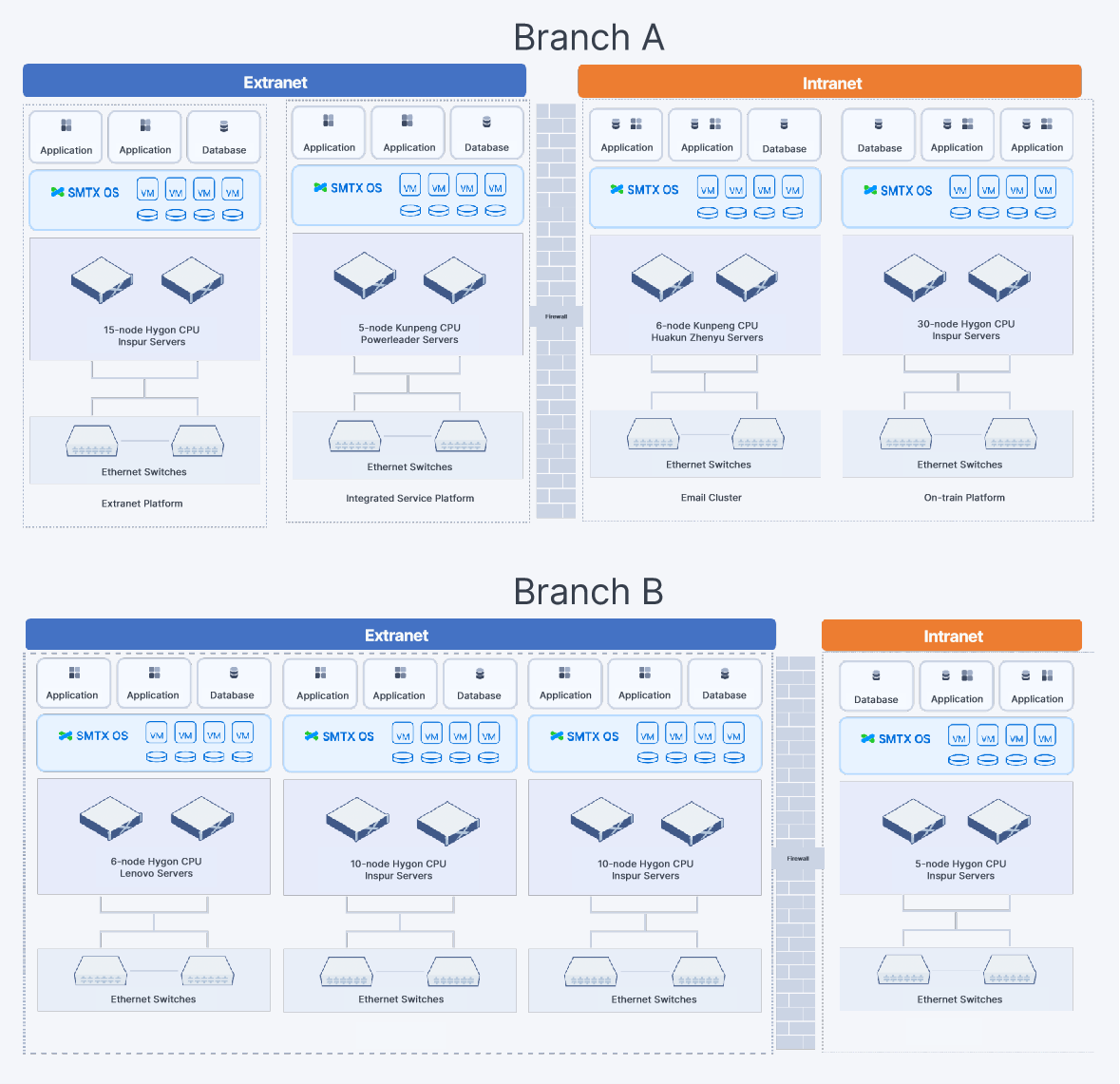
- Branch A: Deployed over 30 SmartX ECP nodes (based on a heterogeneous CPU architecture of Hygon and Kunpeng) in the intranet and over 20 nodes in the extranet, supporting the intranet’s on-train and email systems, as well as the extranet’s integrated service platform.
- Branch B: Deployed more than 30 SmartX ECP nodes (based on Hygon CPUs) across its intranet and extranet data centers to support a wide range of applications and databases. Additionally, a regional department deployed three non-ITAI nodes to host management systems for workflow, HR, and training/exams.
Currently, both branches’ SmartX ECP clusters have been running stably for over a year. The railway group also plans to continue expanding its ECP clusters to further advance VMware replacement and ITAI. The flexible scalability of the ECP cluster and its broad compatibility with domestic hardware provide greater flexibility for future development.
Learn more about the four VMware replacement solutions with SmartX ECP and feature comparisons between key components of SmartX and VMware:
Your VMware Exit Plan: Four Solutions to Consider Based on SmartX ECP
Replacing VMware vSphere with SmartX ELF: Higher Availability with Optimized Performance
Replacing VMware NSX with SmartX Everoute: Comparable Capabilities with Simpler Operations
Replacing VMware Tanzu with SmartX SKS: Streamlined Operations and Superior VM-Container Management
Three Performance Comparisons Disclose Why You Should Choose SmartX HCI as a VMware Alternative
