With many organizations now seeking full-stack alternatives to VMware, virtualization platforms are under increasing scrutiny. As the virtualization module of SmartX Enterprise Cloud Platform (ECP), SmartX native hypervisor – ELF provides robust enterprise-grade virtualization capabilities with high availability and optimized performance, enabling IT teams to manage and operate virtual machines (VMs) with greater efficiency and confidence.
The following sections provide a detailed look at ELF’s key capabilities, side-by-side comparisons with vSphere, and customer cases of VMware replacement.
ELF vs. vSphere: Feature Comparisons
As a KVM-based virtualization, ELF offers full compute virtualization and VM lifecycle management. It enhances VM stability and performance through features such as dynamic resource scheduling (DRS), VM high availability (HA), GPU passthrough and vGPU, and network I/O virtualization — making it well-suited for high-performance computing workloads, including AI workloads.
When integrated with CloudTower, users gain additional advanced capabilities such as VM templates, content library, and network traffic visualization, further streamlining VM operations and management.
A detailed comparison between ELF and VMware vSphere in terms of key virtualization functionality is provided below:
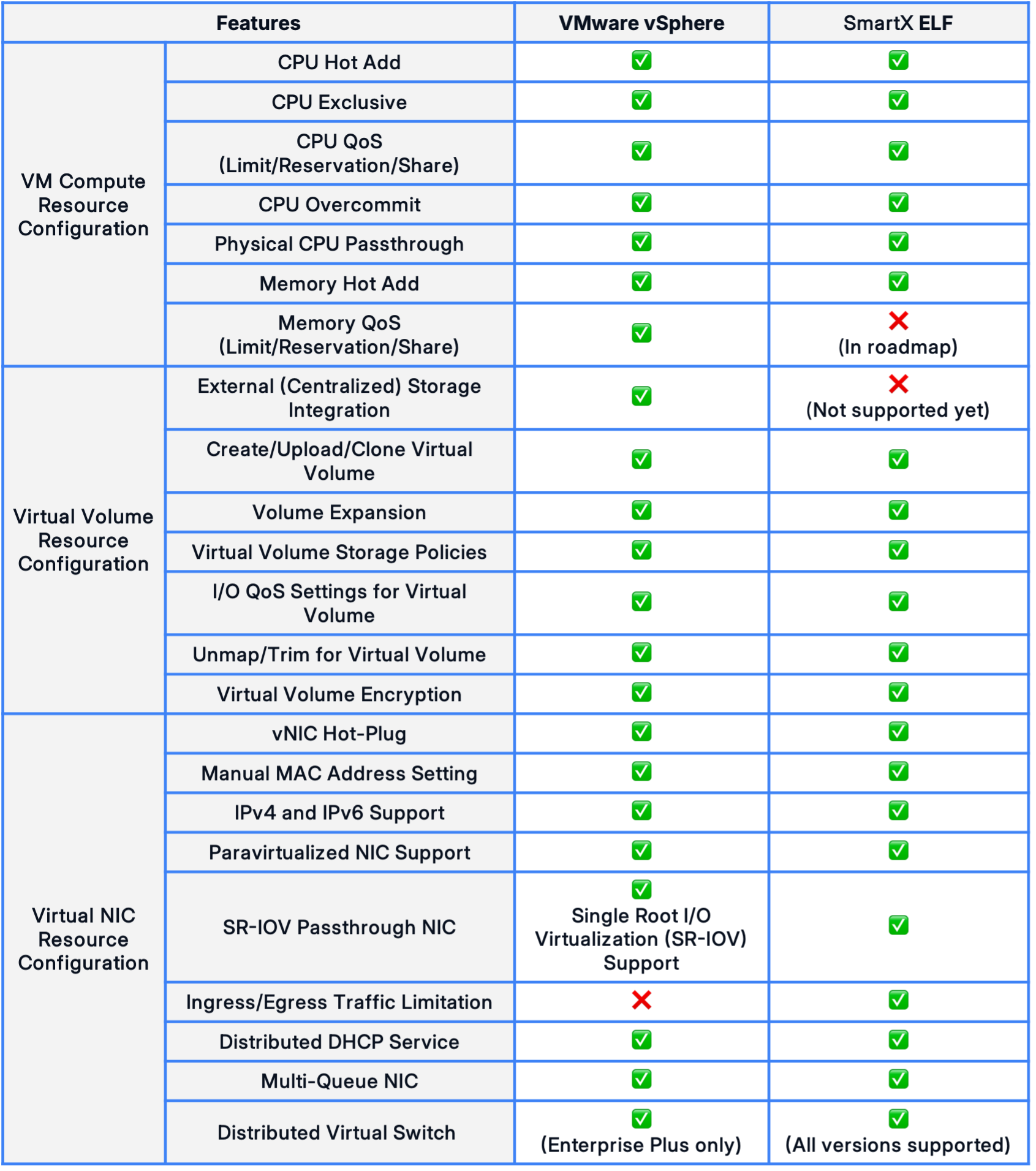
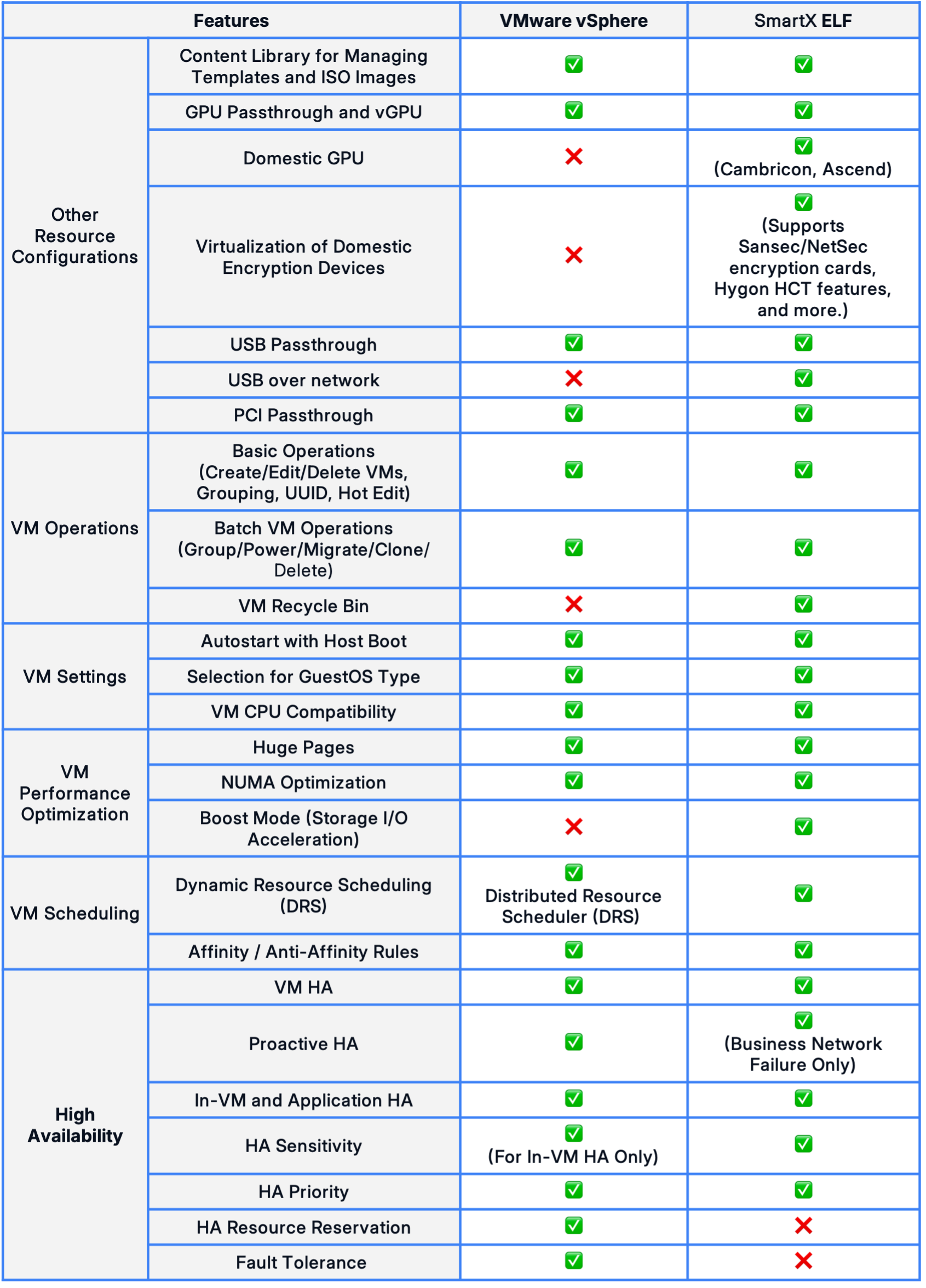
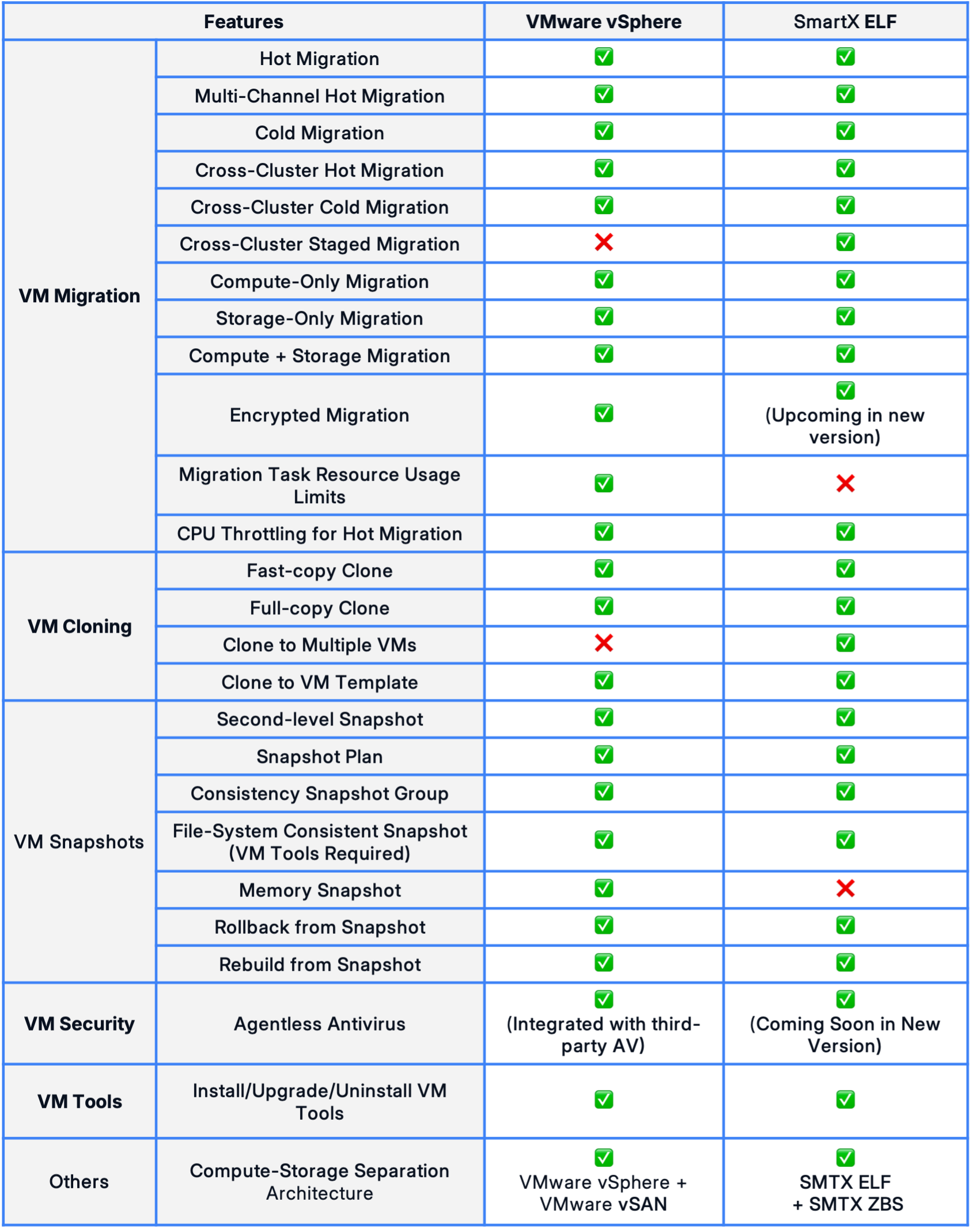
In terms of functionality, ELF provides nearly all enterprise-grade virtualization features available in VMware vSphere, including VM configuration, lifecycle management, HA, DRS, as well as snapshots and cloning. In addition, ELF incorporates advanced capabilities typically found in vSphere Enterprise Plus (VEP), such as SR-IOV passthrough, distributed switches, GPU passthrough, and vGPU — all at lower licensing costs.
Advantages of ELF as a vSphere Alternative
Production-Grade HA Features
ELF ensures business continuity and stable operations through:
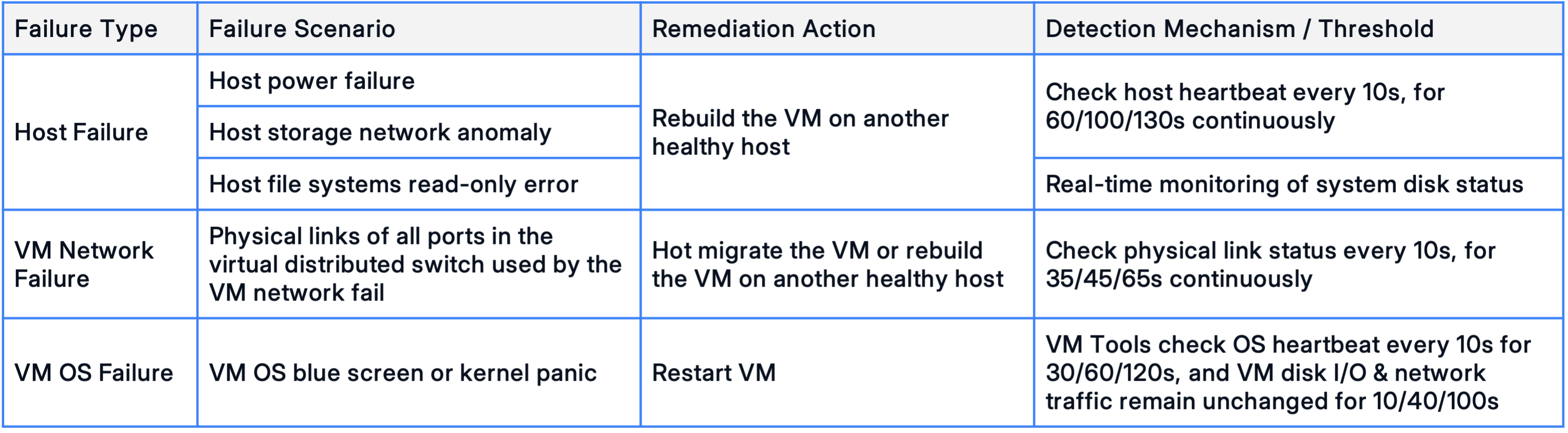
- VM HA: ELF delivers comprehensive fault detection and flexible recovery actions for common failure scenarios to maintain high availability (see table below). Users can also configure VM HA priorities for more granular control.
- Hot Migration: Supports seamless migration of running VMs for hardware maintenance, load balancing, or recovery from VM network issues.
- VM Snapshot: Provides fast VM snapshots, rollback and restore capabilities, including second-level snapshots, file-system consistent snapshots, local snapshot plan, and snapshot list management.
- VM Cloning: Enables creating complete VM replicas, including OS, application data, and configuration, supporting both fast-copy clones (second-level) and full-copy clones (with exclusive storage and superior performance).
- Native Backup & Disaster Recovery: Provides integrated backup and replication services, enabling VM backups, replication, and recovery to ensure resilience.
Simple and Intuitive Management
DRS – Smarter and More Flexible
ELF introduces a VM responsiveness–oriented evaluation framework, extending DRS coverage to a wider range of application scenarios. By factoring in storage performance and benefit analysis, ELF minimizes unnecessary migrations, improves decision-making, and reduces overhead. Adjustable sensitivity and automation levels make it simple for administrators to fine-tune resources.
USB Passthrough Across Hosts — Shared and Flexible Device Resources
ELF provides a unified USB device list for centralized management. A single device can be mounted to multiple VMs (with only one active user at a time). Even when the VM is migrated within the cluster, the USB connection stays intact.
Content Library & Cross-Cluster Hot Migration — Simplified Multi-Cluster Resource Management
The content library enables unified management and easy distribution of resources, supporting the unified management of VM templates and ISO images. It allows one-click distribution of bulk VMs across clusters and real-time selection of ISOs or templates from the library when creating VMs.
Additionally, ELF supports cross-cluster hot migration, allowing workloads to move without service interruption — ideal for load balancing, planned maintenance, disaster recovery, and multi-site expansion.
Performance Optimization
Although ELF is KVM-based, SmartX has consistently enhanced its performance through innovations such as:
- Boost Mode – Zero-copy I/O between Guest OS, QEMU, and SmartX ZBS via vhost-shared memory, eliminating QEMU bottlenecks. Testing shows 3–4x IOPS improvement in 4K random read/write.
- NUMA-Aware Scheduling – For exclusive CPU VMs, ELF prioritizes resource allocation within the same NUMA node to reduce latency. Real-world tests show:
- Sysbench memory test: 5%–114% improvement in multithreaded scenarios, with ~12% gain at 32 threads.
- DM database deployment: ~11% performance increase.
Other optimizations include CPU exclusivity, resource reservation, and high-performance networking via SR-IOV.
Comprehensive Localization Support
ELF ensures compatibility with a wide range of domestic servers, operating systems, CPUs, GPUs, network interface cards, and encryption technologies—helping enterprises smoothly advance their localization strategies while maintaining stability, performance, and compliance. A partial compatibility list is as follows:
Domestic Servers
Compatible with mainstream domestic processors and server platforms, including Kunpeng, Hygon (Gen 2/3/4), and Phytium S5000C.
Domestic Operating Systems
Verified with Kylin OS (NeoCertify and Galaxy), UOS, and Tencent OS, ensuring seamless integration into localized IT environments.
Domestic GPU Passthrough
Supports Huawei Ascend and Cambricon GPUs with passthrough and vGPU features, enabling high-performance computing and AI model workloads in localized architectures.
Domestic Network Cards
Adapted to NetXen 10GbE NICs with SR-IOV support, delivering high-performance networking for mission-critical workloads.
Domestic Encryption Technologies
- Encryption Cards: Supports Yuweng and SWSec encryption cards passthrough to VMs via SR-IOV, meeting security and compliance requirements while reducing hardware costs.
- Hygon HCT: Enables virtualization passthrough of Hygon HCT features, providing hardware-accelerated cryptographic algorithms in localized environments with minimal cost.
Customer Success: Replacing vSphere with ELF
Today, leading enterprises across financial services, healthcare, manufacturing, and energy are adopting ELF-based SmartX ECP to replace VMware vSphere.
- A Large State-Owned Bank
Since 2017, this bank has conducted in-depth evaluations of domestic and international HCI platforms as part of its VMware replacement strategy. After extensive testing, the bank validated the functionality and stability of ELF and gradually deployed 1,500+ ELF-based ECP nodes across HQ and 30+ branches, supporting over 10,000 VMs. These clusters now run production workloads such as DB2 databases, Redis, and critical financial applications. - A Leading Insurance Group
To replace its Nutanix+VMware infrastructure with a localized platform, this insurer leveraged the SMTX Migration Tool to move 500+ VMs (including life insurance, property insurance, operations, and office systems) from VMware to ELF. The migration process proved smooth, reliable, and minimally disruptive to ongoing business operations. - Beijing Jishuitan Hospital
Adopted ELF-based ECP appliances to support DMZ internet healthcare services (e.g., online consultations, appointment booking, video visits). Over time, deployments expanded to 40+ nodes, carrying core hospital systems such as HIS, LIS, and EMR. The hospital also unified cluster management across multiple CPU architectures and enhanced security with Everoute Zero Trust networking. - Fudan University Huashan Hospital
Transitioned from VMware vSphere and vSAN to pure-software SmartX ECP with domestic servers. Using the SMTX Migration Tool, the hospital successfully migrated 40+ production VMs (including anesthesia and financial systems) online. Additional protections were added through Everoute distributed firewall and SMTX backup & disaster recovery. - A Leading Li-ion Battery Manufacturer
Replaced its VMware+SAN infrastructure with ELF as its exclusive virtualization platform for new clusters. To date, it has deployed 100+ nodes supporting core systems such as MES, AI-MES, big data platforms, private cloud, and HR systems, achieving higher efficiency and scalability. - A Global New Energy Technology Company
Implemented ELF across 7 subsidiaries and factories, replacing over 100 VMware clusters. The new platform supports MES, AGV, process management, and integrated management systems. Leveraging ELF with ZBS (distributed storage) and a permanent licensing model, the company reduced licensing and O&M costs while maintaining compatibility with existing backup platforms.
More VMware alternatives cases:
Four Case Studies Disclose How to Replace vSAN and VMware HCI with SmartX HCI
Why Enterprises Choose SmartX ELF Virtualization as a VMware Alternative: Five Customer Stories
SmartX ECP in Healthcare: Running Core Systems and Databases, Replacing VMware and Nutanix
From VMware to SmartX ECP: The Cloud Native Journey of Zigong First People’s Hospital
ConnectWave: Boosting O&M Efficiency and Cost-Efficiency of IT Infra with SmartX HCI
Zheshang Securities: An Ex-User of VMware and Nutanix HCI Embraces SmartX HCI
Learn more about SmartX ECP as a VMware alternative from our technical comparisons and solution analysis:
VMware vs SmartX: Snapshot Mechanism and I/O Performance Comparison
VMware vs SmartX: Distributed Storage Caching Mechanism and Performance Comparison
VMware vs SmartX: I/O Path Comparison and Performance Impact
Improving Resource Utilization: Innovative Implementation of DRS in SmartX HCI
Unprecedented Scalability: Explore SmartX HCI’s Flexible Scale-out Options
