In our previous articles, we’ve explored common misconceptions around SmartX Enterprise Cloud Platform (ECP) — from its role in cloud building to running mission-critical workloads, stability, and simplifying O&M.
Yet one major question remains: As an HCI-based solution, is SmartX ECP fundamentally unsuitable for containerized workloads, especially when compared with bare metal in terms of performance? Some misconceptions include:
- “HCI is designed for virtualization, making it unsuitable for running containers.”
- “HCI cannot provide container orchestration, scheduling, and load balancing services.”
- “HCI cannot provide sufficient network and storage resources for containerized applications like AI workloads.”
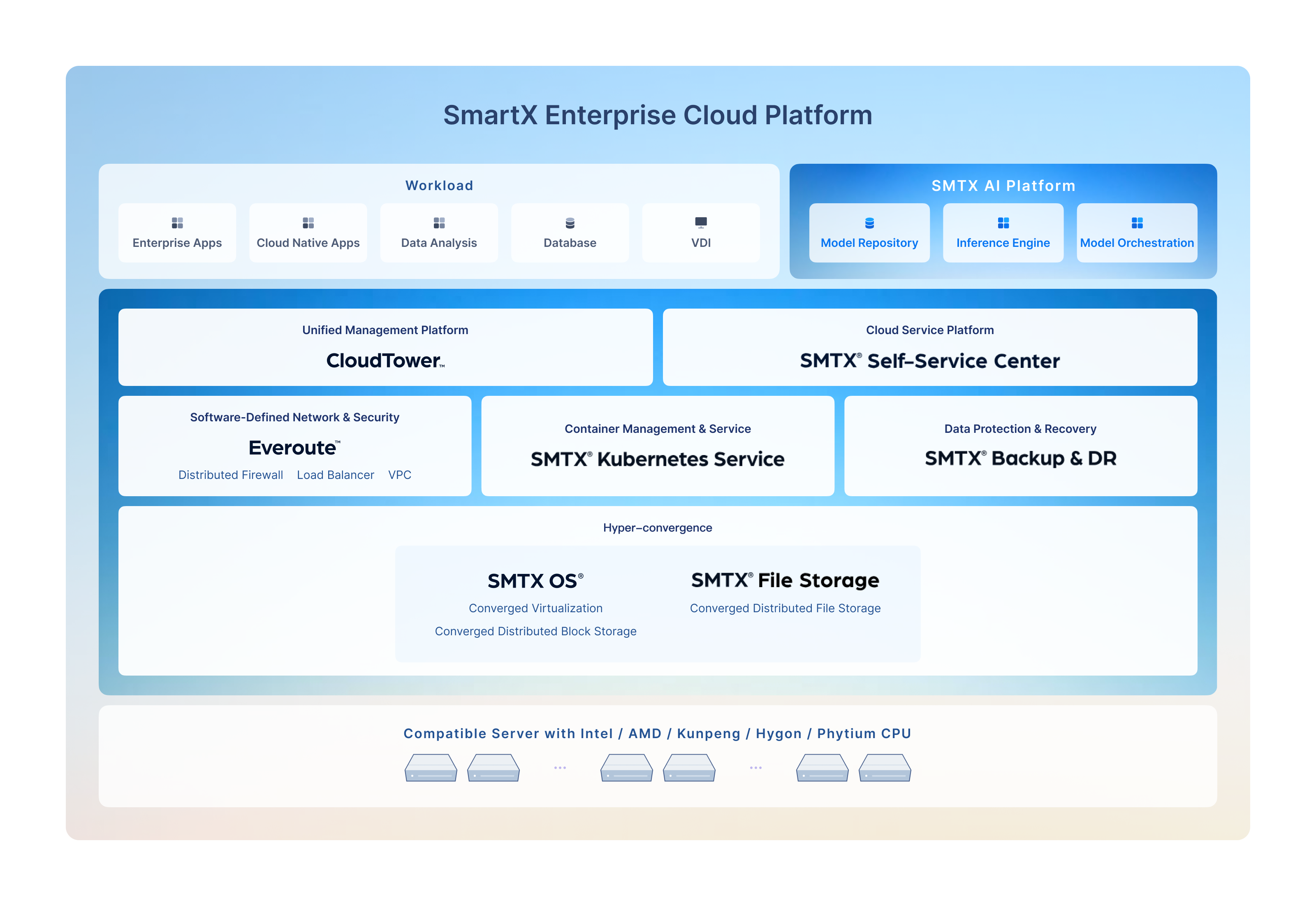
The truth is, as a full-stack infrastructure solution, SmartX ECP integrates SMTX Kubernetes Service (SKS), which provides full-lifecycle support for Kubernetes management and is deeply integrated with SmartX’s virtualization, storage, networking and security services to meet multi-tenant and hybrid-environment needs. Leveraging its robust distributed storage services, SmartX ECP can provide high-performance and secure support for containerized workloads, allowing enterprises to build an efficient VM-container-converged infrastructure on a unified platform.
Misconception #1: Virtualization Is Naturally Unsuitable for Containers—They Must Run on Bare Metal
Many IT teams assume that Kubernetes should be deployed directly on bare metal to avoid the unnecessary overhead, resource waste, and performance reduction caused by virtualization. However, virtualization and containers are not mutually exclusive. For organizations with multi-cluster and hybrid environments, VMs and containers working together is the standard approach for modern architectures.
✅ SmartX ECP: Balancing Performance, Isolation, and Manageability
In practice, deploying containers in virtualization provides significant advantages in management and security. SmartX ECP (SKS) also supports deploying Kubernetes Worker Nodes on bare metal for performance-sensitive workloads:
- Better Resource Isolation & Higher Availability: Virtualization prevents resource contention common in bare metal deployments. With built-in HA and dynamic resource scheduling (DRS), Kubernetes nodes can automatically recover from failures, minimizing downtime.
- Rapid Environment Setup: Enterprises can quickly spin up multiple test, development, staging, and production Kubernetes clusters on VMs, scaling as needed while maintaining uninterrupted business operations with isolated environments.
Hybrid Deployment for Performance-Sensitive Workloads: For extreme performance requirements, SKS also supports a hybrid deployment model with physical nodes. This allows enterprises to run performance-sensitive applications directly on bare-metal nodes while hosting routine operations and general workloads on VM nodes — achieving the optimal balance between peak performance and efficient management.
Misconception #2: Building Kubernetes Clusters on SmartX ECP Is Complex and Inefficient
Some believe deploying Kubernetes clusters on bare metal or public clouds is already a mature and proven approach — so why introduce HCI? Others assume HCI isn’t built for containers, requiring a manual, time-consuming setup that takes hours.
This overlooks a critical factor: the speed of cluster deployment and delivery. In modern IT environments, cluster delivery speed, automation, and configuration consistency directly impact R&D efficiency. When cluster provisioning is slow, inconsistent, or manual, it becomes a major bottleneck for delivering scalable, multi-environment, multi-tenant container services in the enterprise.
Additionally, many fear that Kubernetes scheduling will be disconnected from the virtualization layer, preventing pods from being aware of underlying VM and host resources. This issue becomes more pronounced in multi-tenant or multi-cluster environments, where Pods can end up unevenly distributed, critical services overly concentrated on certain nodes, and VM workloads imbalanced, ultimately impacting system high availability and security.
✅ SmartX ECP: Fast, Automated, and Consistent Kubernetes Cluster Delivery
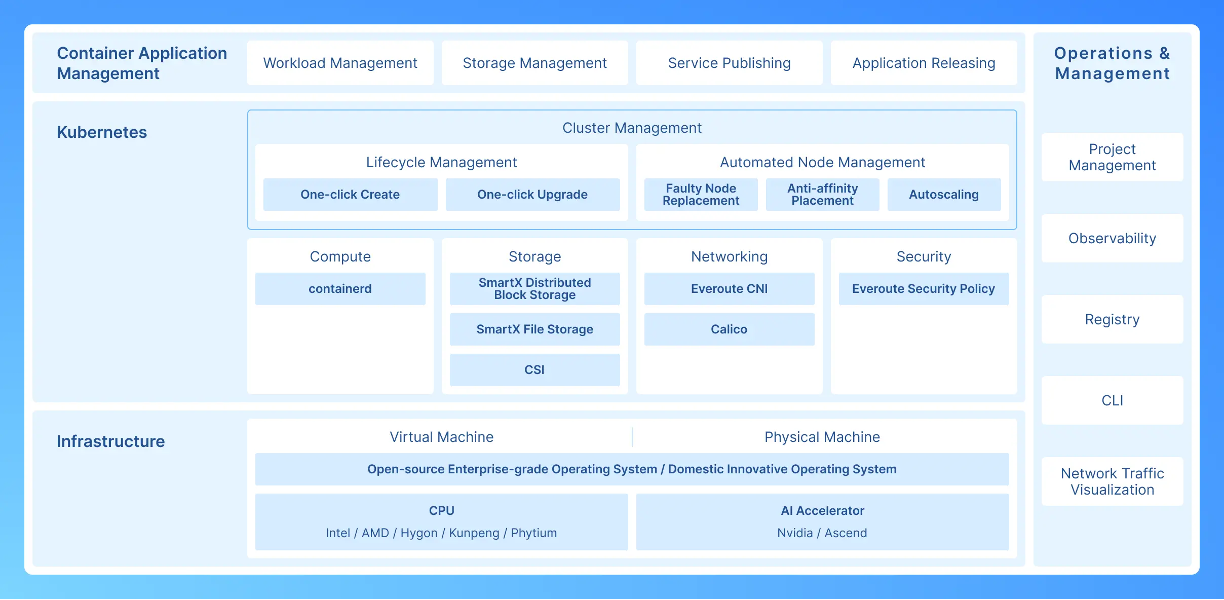
Built on SmartX’s native hypervisor – ELF, SKS offers automated, standardized Kubernetes cluster lifecycle management:
- Rapid Deployment: Through a simple, intuitive UI, users can create fully functional Kubernetes clusters in minutes—far faster than manual setups, greatly improving the O&M efficiency.
- Automated Scaling & Recovery: SKS supports auto-scaling, automated node health checks, and failed node replacement, as well as version upgrades and rollbacks. This reduces operational overhead and manual intervention, enabling enterprise IT teams to quickly respond to changing business demands and dynamically allocate or expand resources as needed.
- Unified Multi-Cluster Management: Multiple Kubernetes clusters of different purposes, versions, and sizes can be managed within the same platform. These clusters maintain logical isolation of resources and networks, ensuring operational independence. Leveraging SmartX ECP’s virtualization capabilities, organizations can efficiently share underlying hardware resources and actively reclaim unused capacity, significantly improving resource utilization and reducing total cost of ownership (TCO).
- Consistent Scheduling Across “Pod-VM-Host”:
- Worknode (VM) to Host: The platform automatically applies anti-affinity policies to control plane and worker node VMs, distributing them across different physical hosts to minimize the impact of hardware-level failures.
- Pod to Worknode (VM): Administrators can define Kubernetes affinity and anti-affinity rules based on labels and workload requirements, guiding critical Pods to be evenly distributed across VMs and preventing resource hotspots.
- Automated Node Replacement: SKS, leveraging Cluster API, automatically replaces failed nodes. The replacement nodes inherit the original scheduling policies, preserving scheduling consistency and maintaining the intended resource layout.
This mechanism eliminates the need for administrators to manually intervene at the host level or build custom scheduling logic. It ensures a fully aligned scheduling chain from Pods to VMs to physical hosts, enabling stable, secure, and production-grade container deployments.
Misconception #3: SmartX ECP Can’t Deliver the Required Performance
Performance-sensitive workloads like databases, Kafka, or Spark lead many enterprises to prefer “bare metal + local storage” for maximum throughput. In reality, as most business applications don’t operate at peak load 24/7, enterprises typically need a balanced tradeoff between performance, stability, and maintainability, instead of merely high performance.
✅ SmartX ECP: Near-Bare-Metal Performance with Hybrid Deployment Flexibility
- Hybrid Node Deployment: SKS allows Kubernetes clusters to deploy on both VM and bare-metal nodes. While regular workloads leverage VMs for efficiency and manageability, performance-critical services can run on bare-metal nodes, avoiding virtualization performance loss and ensuring maximum computing performance.
- Resource Reuse: Older servers can be repurposed as physical nodes within SKS clusters, reducing hardware costs.
- Unified Management: Both bare-metal and VM-based Kubernetes nodes can be centrally orchestrated and managed from a single interface.
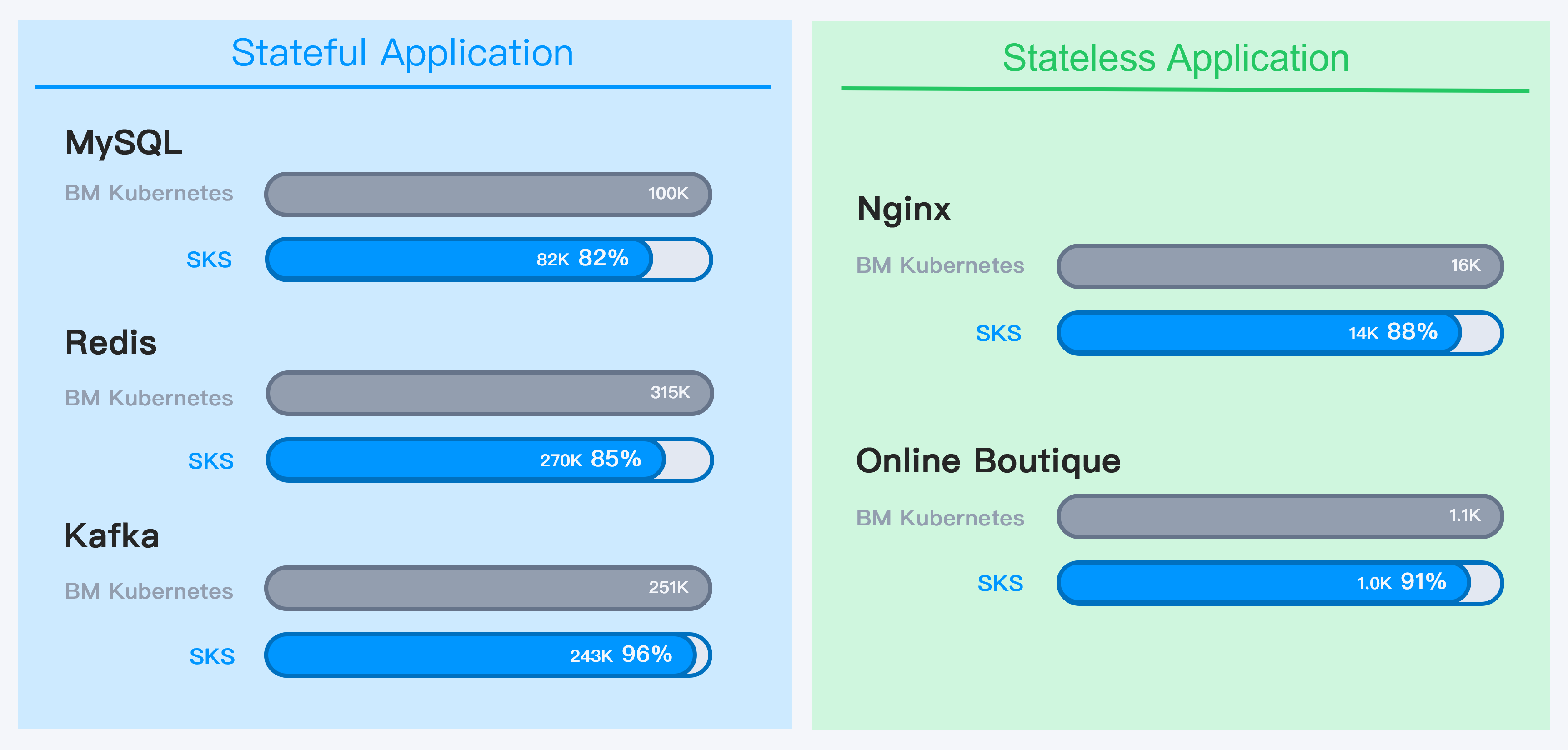
Besides, in extensive benchmark tests, SKS clusters achieved high performance parity with bare-metal Kubernetes clusters across mainstream stateful and stateless application scenarios:
In stateful applications
- MySQL: 82% of bare-metal
- Redis: 85% of bare-metal
- Kafka: 96% of bare-metal
In stateless applications
- Nginx: 88% of bare-metal
- Online boutique: 91% of bare-metal
The minimal performance gap is outweighed by gains in resource utilization, fault isolation, and operational simplicity, making SmartX ECP a viable choice for most enterprise container workloads.
For more details: Kubernetes on VMs vs. Bare Metal: Comparison of Performance
Misconception #4: SmartX ECP Can’t Meet the Complex Network and Security Needs of Containers
Kubernetes networking relies on flat pod-to-pod communication, service discovery, east-west isolation, and north-south access control. However, in real-world cases, VMs and containers often run on separate network stacks, making direct communication difficult. Bridging the two typically requires additional gateways or overlays, introducing latency, complex routing paths, and fragmented security policies.
This reveals a critical need among enterprises for a unified network plane. Without native, seamless connectivity between VMs and containers—or the ability to centrally manage network security policies—VM-container convergence will face challenges in regulatory compliance, service exposure, and inter-application communication.
✅ SmartX ECP: Unified Network and Security Management for Containers and VMs
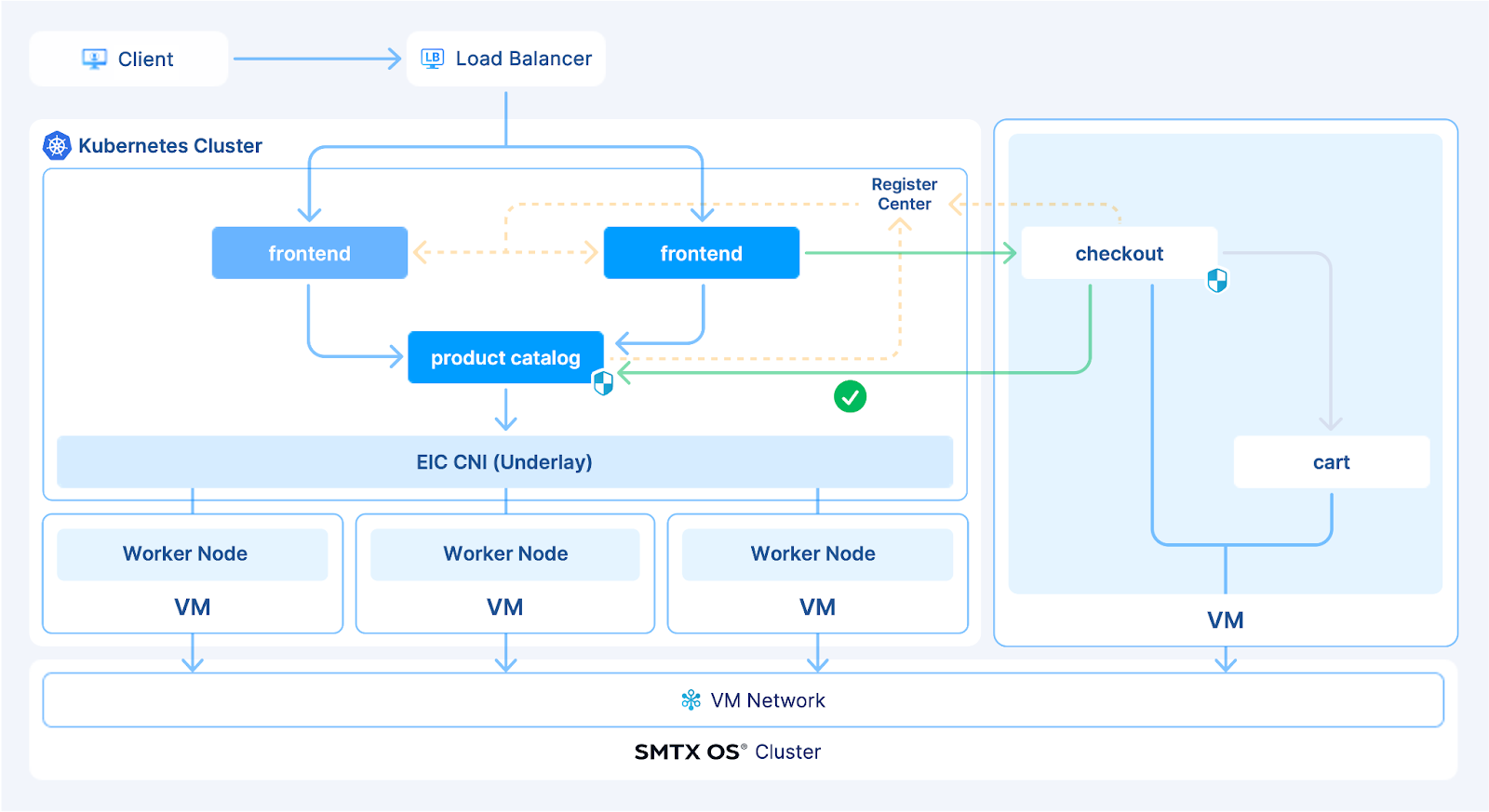
- Integrated CNI for Flat Network: SKS integrates Everoute Integrated CNI (EIC), which uses a flat network design to directly connect Kubernetes pods to the same virtual network as VMs. This avoids overlay network overhead and delivers near-physical network performance.
- Native Pod-to-VM Connectivity: Pods and VMs communicate directly without extra bridges or routing devices, simplifying networking and troubleshooting. Pod IPs remain static even during cross-node rescheduling, easing maintenance.
Unified Network Security Management: EIC is tightly integrated with Everoute security policies, enabling consistent and fine-grained access control between pods and VMs. Enterprises can implement refined security strategies on a unified platform. This simplifies policy management and meets strict security and compliance standards.
Customer Success: Trust Company Replaced VMware vSphere and Tanzu with SmartX ECP
A leading trust company successfully replaced VMware vSphere and Tanzu with SmartX ECP, powered by native hypervisor ELF and SKS.
After testing SKS for functional, performance, and reliability benchmarks, the company migrated both VM and container workloads onto a single unified platform managed via CloudTower.
To ensure high availability, it deployed SKS clusters across primary and backup sites with Rancher-based centralized management. Dual Consul clusters provide application-level failover, enabling seamless disaster recovery without full-site switchover.
To learn more: SmartX ECP in Financial Services: Funds and Trusts Customer Stories
Run Containers on HCI With Confidence
The long-standing belief that HCI is unsuitable for containers and much slower than bare metal no longer holds. With SmartX ECP, enterprises can:
- Seamlessly run virtualized and containerized workloads on a single platform.
- Achieve near-bare-metal performance while benefiting from advanced management and resource isolation.
- Deliver fast, automated, and consistent Kubernetes operations.
- Ensure unified networking and security for both VMs and containers.
By eliminating the traditional “VM vs. container” divide, SmartX ECP empowers organizations to modernize their IT infrastructure without sacrificing flexibility, performance, or reliability—making it a future-proof foundation for enterprise cloud-native transformation.
