Large-scale VM operation and maintenance (O&M) can cost a lot of time and money due to manual work. To solve this, SmartX ECP 6.3 introduces innovative lifecycle management features. While keeping its strong foundation in availability and disaster recovery, this new version focuses heavily on reducing hidden operational costs for large-scale VM O&M. IT teams can now use four automated capabilities: batch updates for VMTools with one click, unified modification of SSH service port number, smart NTP governance, and hierarchical VM grouping.
Support for Batch VMTools Upgrades
SmartX ECP leverages VMTools within the CloudTower to achieve visible, controllable, and efficient VM configuration and management. In previous versions, upgrading VMTools required IT administrators to perform manual operations on each VM individually. For large enterprises managing tens of thousands of VMs, this manual process could consume significant time and operational resources.
With the release of SmartX ECP 6.3, users can now upgrade VMTools with a single click directly from the CloudTower interface—without needing to log into the guest operating system. Furthermore, the platform now supports selecting multiple VMs for one-click batch upgrades.
- Significant Boost in O&M Efficiency:Replaces tedious manual tasks with a fully automated workflow.
- Guaranteed Consistency and Stability:Ensures all VMs are rapidly and uniformly updated to the latest version, minimizing potential compatibility issues across the business environment.

Support for Unified Modification of SSH Service Port Number Across All Hosts in One Cluster
In highly regulated industries such as finance and government, the default SSH port (22) is often flagged as a security baseline risk, requiring risk mitigation and security hardening.
Traditional approaches rely primarily on manual intervention or custom scripts to modify configurations host by host. This method presents three typical challenges:
- The modification process is uncontrolled, which easily leads to configuration omissions or errors.
- Related dependent services are not synchronized, which may cause O&M operations such as upgrades and inspections to fail.
- Rollbacks rely on manual operations, posing potential security loopholes and operational risks.
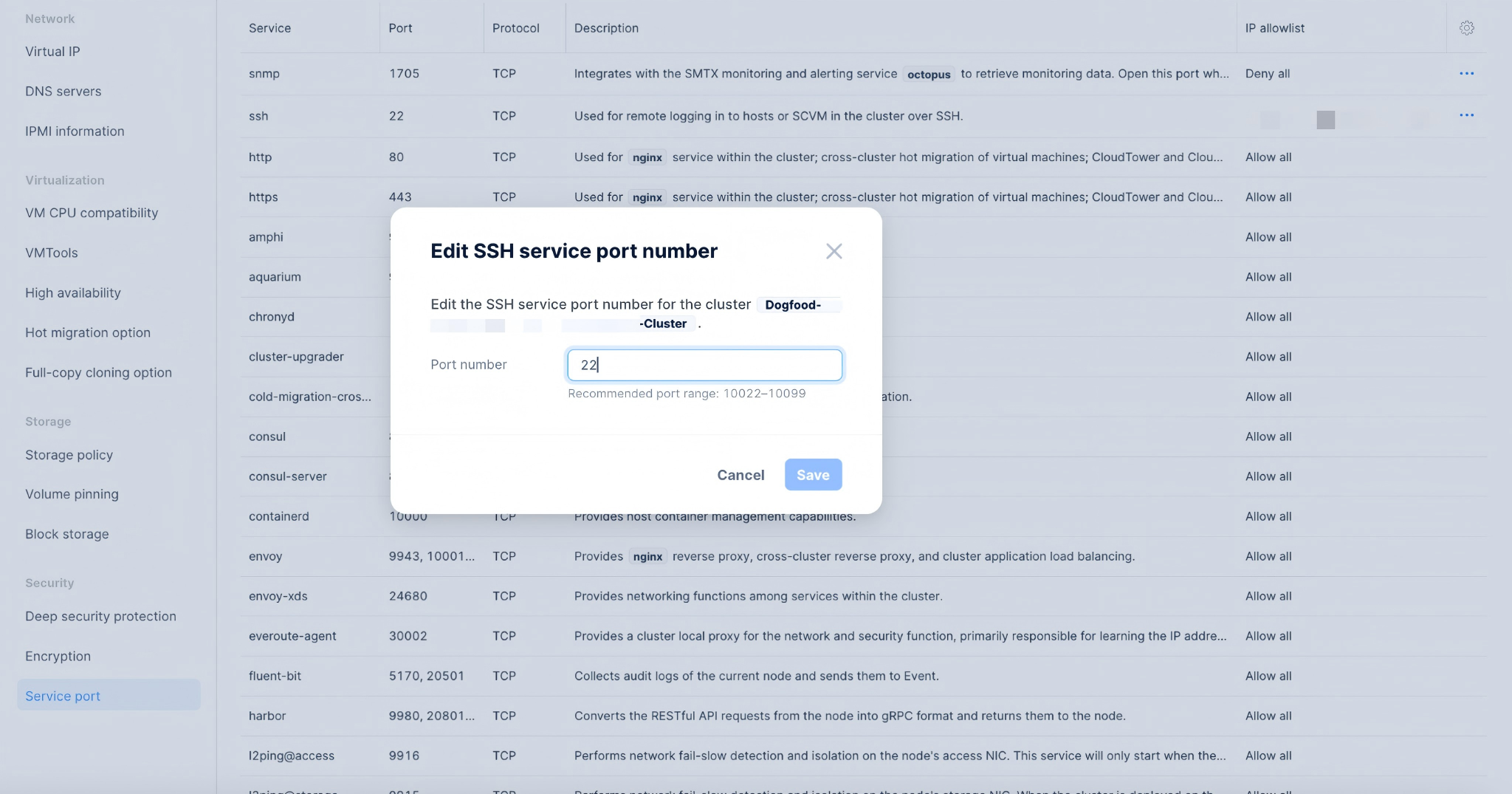
To address these pain points, SmartX ECP 6.3 introduces support for unified modification of SSH service port number for all hosts in a cluster via the CloudTower. With this feature, users can complete cluster-level port modifications with a single click through the GUI, and all dependent service configurations will be automatically updated.
Furthermore, the system includes built-in security safeguards: it automatically performs port connectivity probes before and after the change to prevent host disconnection.
Ultimately, this feature helps enterprise users to achieve both security compliance and operational stability.
- Meet security compliance requirements and reduce audit risks.
- Transform high-risk operations into standardized workflows.
- Complete security hardening without impacting business operations.
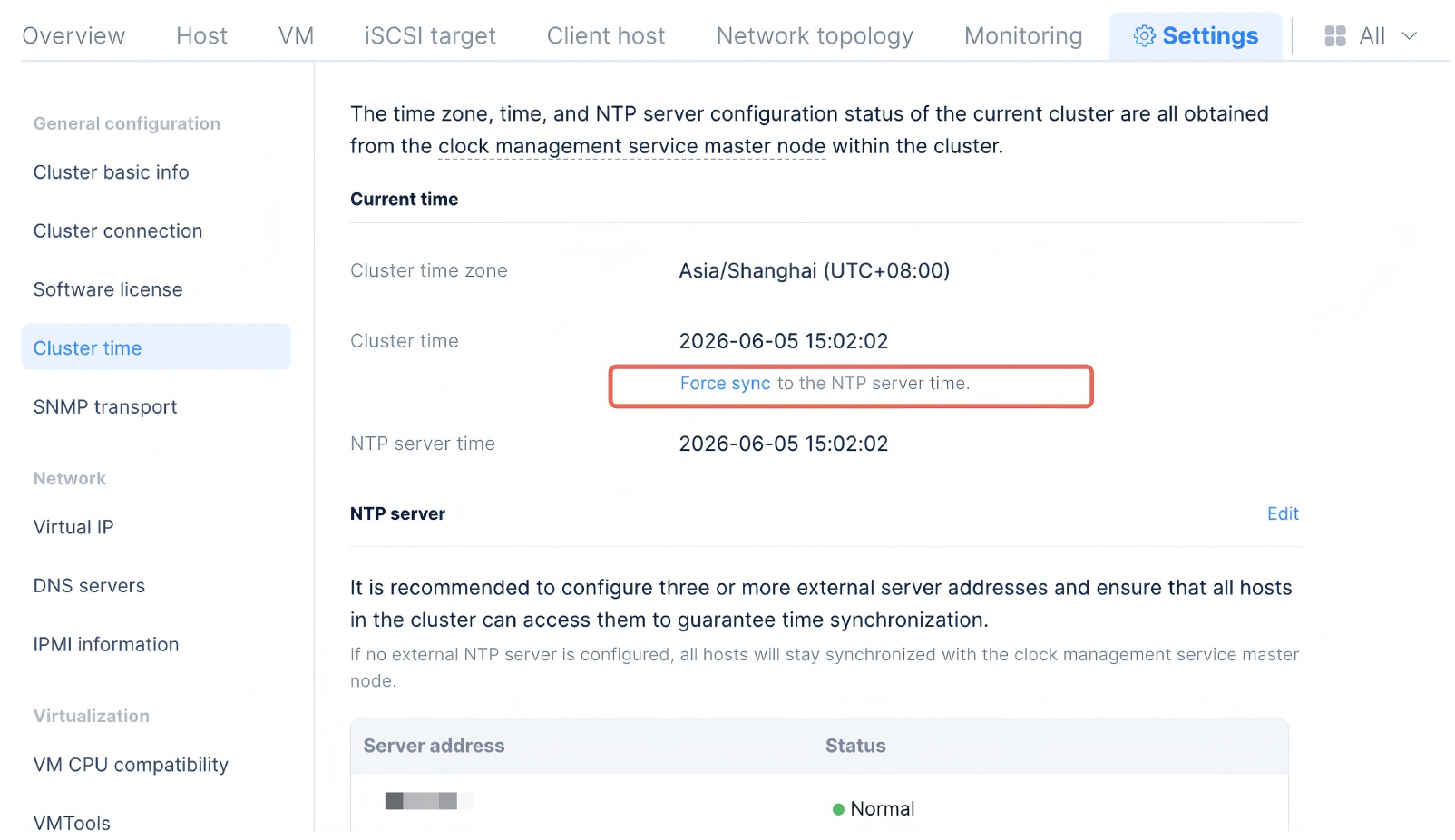
Unified Cluster Time Management: Forced NTP Synchronization and Rapid Anomaly Localization
In enterprises’ virtualization environments, time synchronization is a frequently occurring yet often overlooked risk factor. The common issues are primarily reflected in three aspects:
- Complex Operations:Time synchronization and NTP troubleshooting rely on the command line, resulting in high technical barriers and low efficiency.
- Difficult Diagnostics:The interface only provides simple failure prompts without clear root causes, making troubleshooting dependent on manual experience.
- Unperceivable Risks:The lack of alerts when no external NTP is configured can lead to overall cluster time drift.
To address these issues, SmartX ECP 6.3 has built a set of platform-based time governance capabilities to achieve unified cluster time management, rapid anomaly localization, and closed-loop risk handling. Core capabilities include:
- GUI-based Management:NTP configuration, detection, and synchronization can all be completed directly on the interface.
- Semantic Diagnostics:Synchronization failures can be directly pinpointed as network, port, or time source issues.
- Proactive Risk Perception:Automatic alerts are triggered and repair guidance is provided when no external NTP is configured.
- Forced Synchronization:One-click time calibration can be performed when the time offset is too large.
With this feature, enterprise users can achieve the “discovery, localization, and closed-loop handling” of time-related issues.
- Transform the experience-dependent troubleshooting process into a standardized operational workflow.
- Identify time-related risks in advance to avoid impacting business systems.
- Significantly lower operational complexity and reduce post-sales support issues.
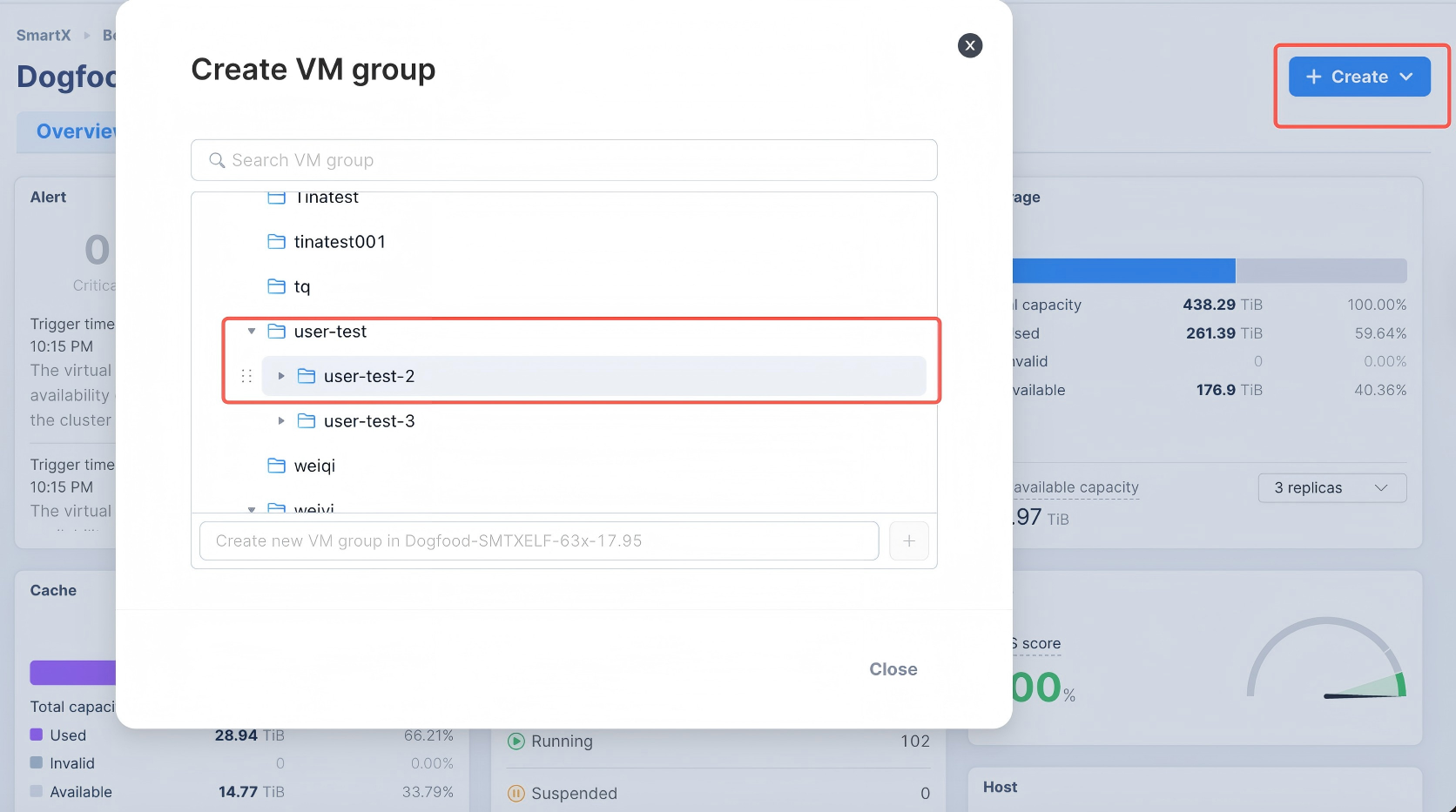
Support for Multi-level VM Groups
As business scales continue to expand, enterprises often need to manage a vast number of VMs. The key to improving O&M efficiency lies in how to effectively categorize, locate, and perform batch operations on these assets.
In previous versions, the CloudTower already supported VM grouping, but it was limited to a single-level structure. In complex business environments, this approach has gradually revealed several limitations. For instance, it cannot clearly reflect the hierarchical relationships between different business lines; it is also difficult to perform granular management based on departments or systems; and as the number of VMs increases, the efficiency of searching and performing batch operations is compromised.
To address these issues, SmartX ECP 6.3 introduces the multi-level VM groups feature in CloudTower. With this feature, users can freely construct multi-level VM groups based on their actual business architecture—for example, organizing resources in a “Department → Business System → VM” hierarchy. This makes the resource structure more clear and intuitive. On this basis, users can still perform batch operations on resources within these VM groups.
This feature can help enterprise to:
- Organize resource structures more clearly and quickly locate target VMs.
- Manage groupings more flexibly to adapt to complex business scenarios.
- Significantly enhance batch operation efficiency and reduce overall O&M costs.
Learn more about performance leap and upgraded features in SmartX ECP 6.3 from our latest blogs:
SmartX ECP 6.3 Released: Leading the New Standard for Critical Business Support in HCI
Unveiling SmartX ECP 6.3 Upgrades in Availability: Expanding HA to SR-IOV, vGPU, and HCT-Enabled VMs
Unveiling SmartX ECP 6.3: How Four Core Innovations Deliver Tier-1 All-Flash Performance
