More and more manufacturing enterprises are accelerating the digital transformation of their IT systems—using advanced software and hardware to improve product quality, streamline processes, and drive cost efficiency. This raises the bar for IT infrastructure, requiring stronger performance, reliability, scalability, unified management, AI readiness, and ecosystem compatibility.
As a full-stack enterprise infrastructure solution, SmartX ECP provides a more stable, secure, and intelligent foundation for manufacturers, supporting five key use cases: building an enterprise cloud with full-stack capabilities, supporting core applications such as MES and ERP, ROBO, VMware/Nutanix replacement, and Dev/Test with VDI.
This blog focuses on the first two use cases, sharing six enterprise stories in building the full-stack enterprise cloud and providing core applications with high-performance and stable support.
>>More use cases: SmartX ECP in Manufacturing: Supporting ROBO, Dev/Test, and VMware/Nutanix Alternative
Building an Enterprise Cloud with Full-stack Capabilities
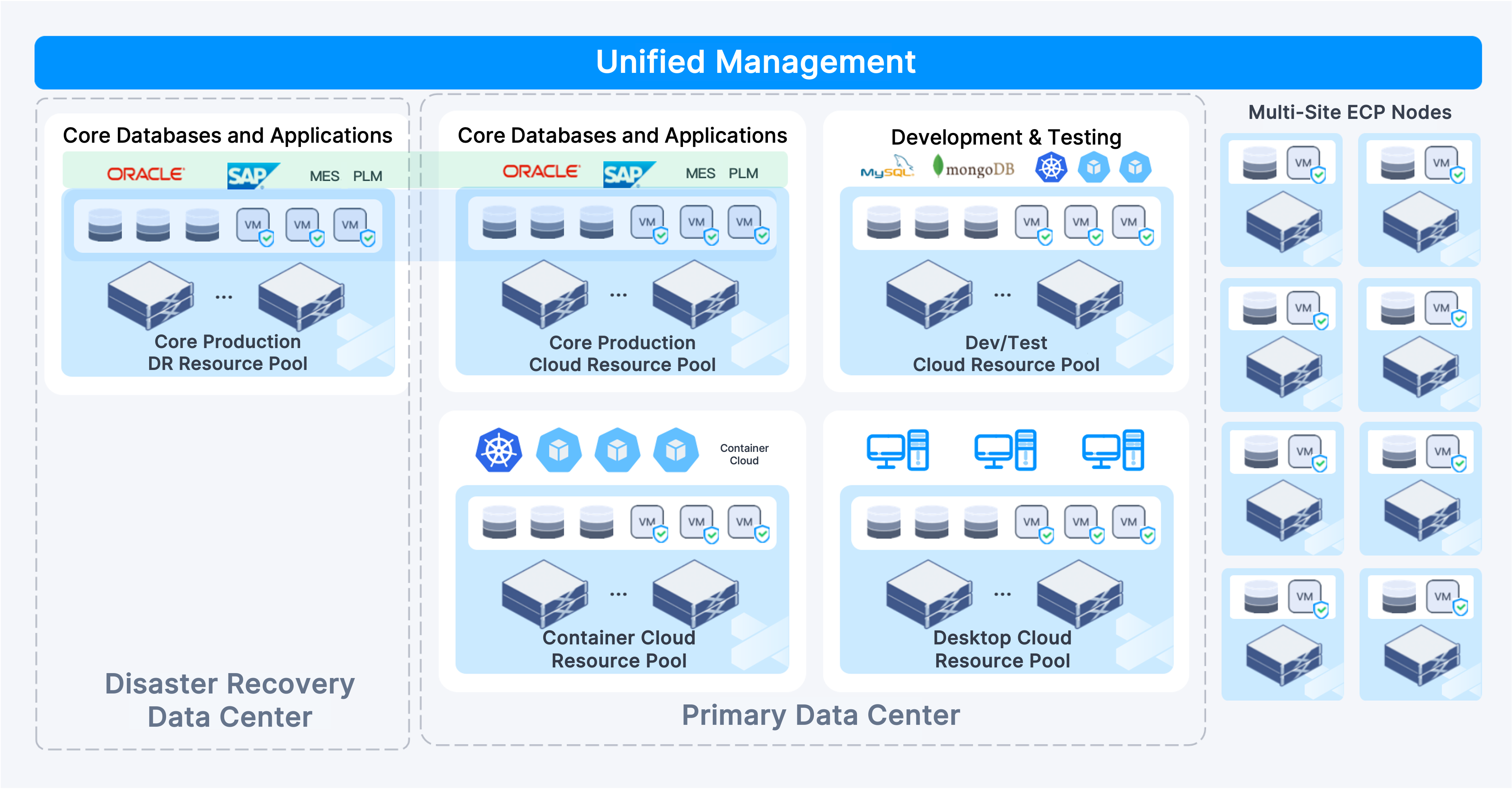
As a full-stack enterprise cloud platform solution, SmartX ECP provides a complete set of infrastructure capabilities, including compute, storage, networking and security, management, backup and disaster recovery, Kubernetes services, and AI application platform. With these capabilities, manufacturers can modernize their entire IT infrastructure under a single unified architecture, meeting a wide range of application needs.
A Leading Apparel Group: From VMware Replacement to Full-Stack Enterprise Cloud Construction
A leading apparel manufacturer and retailer has built a brand matrix covering the full spectrum of family consumption through a multi-brand strategy. Its sub-brands share the group’s supply chain and digital resources.
For years, the group’s data center relied on a combination of hardware and software from global technology leaders such as Cisco, HP, Dell, and Nutanix. However, as different systems were deployed and brought online in phases, the data center gradually evolved into a hybrid architecture—rack servers, database appliances, HCI appliances, and SAN storage all coexisted within the same physical environment. This created a complex ecosystem of multi-vendor and multi-generation infrastructure, significantly increasing the complexity of daily O&M.
Solution Overview
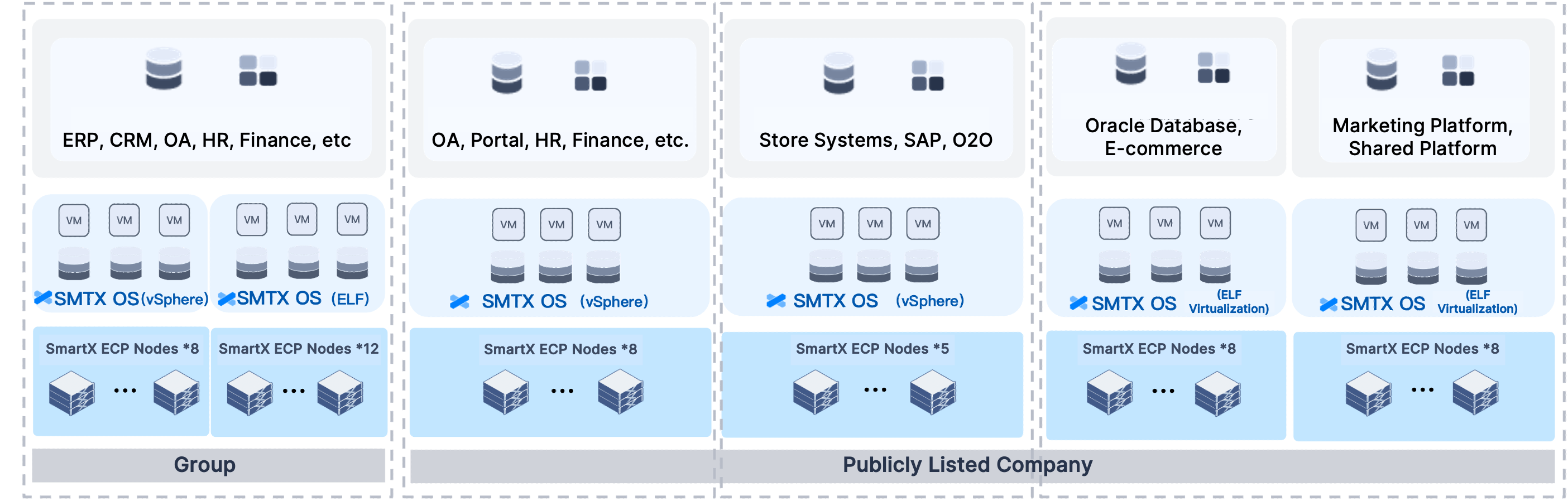
The customer first adopted a converged deployment of VMware vSphere and SMTX OS, running core databases and financial systems of both the group and its listed company on an all-flash cluster. This marked the first step of transformation – from “fragmented” to “converged”.
After validating the capability of SmartX native hypervisor – ELF, the customer expanded its cluster with an ELF-based ECP cluster, while also introducing more components like SKS, SMTX Backup & DR, and Everoute. So far, based on the 45-node SmartX ECP, the group has developed a full-stack enterprise cloud platform, supporting more mission-critical business systems and databases.
Benefits
- Step-by-step transformation – from vSphere-based ECP to ELF-based ECP and a full-stack enterprise cloud platform, the customer successfully replaced VMware while building a modernized enterprise cloud.
- Unified support for critical systems such as ERP and CRM across the group, as well as multiple business systems and databases in the listed company, reducing management complexity.
- Compared with the vSphere-based ECP deployment, the ELF-powered ECP delivered 10–20% higher performance.
Baosight Software: Driving Steel Giant’s Digital Transformation with Hyperconverged and Distributed Storage Architectures
China Baowu Steel Group Corp., Ltd, the largest and most advanced steel conglomerate in China, relies on Baosight Software’s BaoCloud to deliver comprehensive IT infrastructure solutions and services. Baowu’s factories are geographically dispersed, often in remote areas where skilled IT operations staff are scarce. However, its previous hyperconverged solution posed challenges: hardware configurations lacked flexibility, overall costs were high, and after-sales support was slow and cumbersome.
At the same time, Baosight Software adopted foreign centralized storage to provide storage services for BaoCloud. Yet, the centralized architecture could no longer meet the demands of rapid business growth for high performance and elastic scalability. It also faced obstacles in the domestic replacement of FC SAN switches, making an architectural upgrade imperative.
Solution Overview
Baosight Software first deployed SmartX ECP in small-scale clusters across five branch factories. These clusters supported ERP, MES, plant operations management, equipment management, industrial internet platforms, and the corresponding Oracle databases, all managed centrally from the Shanghai headquarters.
After validating the performance and stability of SmartX’s distributed storage, the company went further by replacing part of its EMC and NetApp centralized storage used for cloud services with SmartX distributed storage. Additionally, Baosight adopted servers based on Hygon CPUs to build a heterogeneous cluster, steadily advancing its IT infrastructure modernization and domestic technology transformation.
Benefits
- A single enterprise cloud platform meets multiple needs, including supporting core production workloads, enabling unified management across branch factories, replacing foreign centralized storage, and advancing domestic technology transformation.
- CloudTower provides centralized management of multiple hyperconverged and distributed storage clusters through a single interface, reducing operational complexity.
Learn more about this customer story: Baosight: IT Infra Upgrade Driven by SmartX HCI and Distributed Storage
Xinyi Glass: Building Active-Active ECP Clusters Across Data Centers While Enhancing Network Security
As a leading glass manufacturer with over 30 years of expertise, Xinyi Glass has built a diversified product portfolio spanning float glass, automotive glass, architectural glass, and photovoltaic glass. Operating under a group-based model, multiple listed subsidiaries share core IT resources—placing greater demands on the reliability and security of the group’s IT infrastructure.
Previously, the company relied on a privatized domestic public cloud combined with VMware virtualization and all-flash centralized storage. However, when attempting to increase infrastructure availability with active-active architecture, the original solution faced major challenges: high hardware investment and expansion costs, complex operations, and performance bottlenecks—making it difficult to support Xinyi’s vision of future unmanned smart factories.
Solution Overview
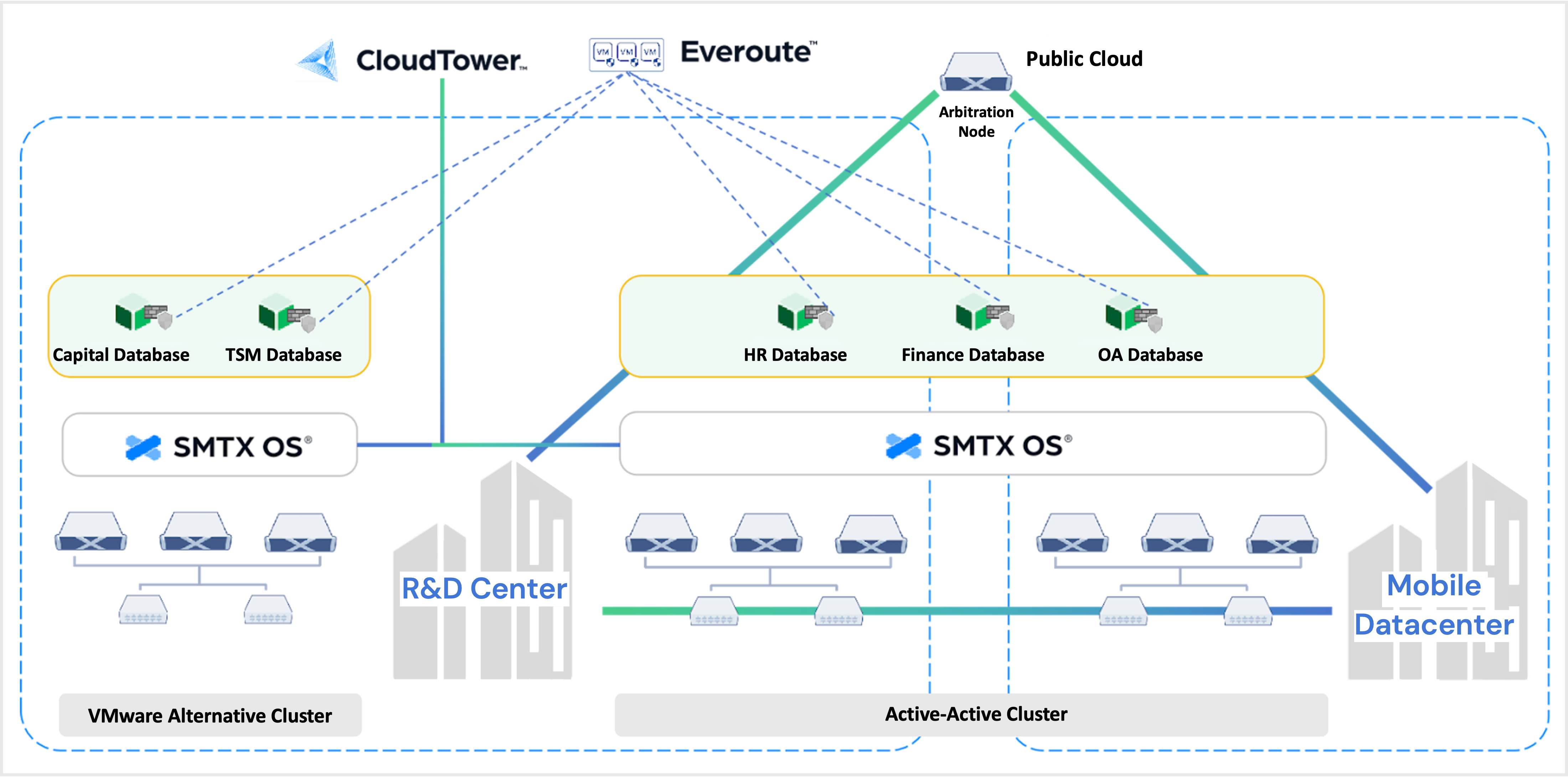
Xinyi Glass deployed two 3-node ECP clusters based on ELF virtualization, located at its R&D center and mobile data center. These were combined with a public cloud VM as the arbitration node, forming a “3+3+1”-node active-active architecture. This supports the HR, finance, and OA application databases, enabling active-active database disaster recovery.
In addition, the company replaced its legacy “vSphere + all-flash centralized storage” architecture for non-active-active workloads with SmartX ECP, supporting applications such as capital management and TSM databases—achieving significant VMware cost savings.
To further enhance security, Xinyi Glass also deployed Everoute to provide a distributed firewall, strengthening east-west network protection and upgrading its enterprise cloud platform capabilities.
Benefits
- Compared with the legacy VMware + all-flash centralized storage architecture, SmartX ECP improved the average TPS performance of core databases by 18% in Swingbench tests, while reducing overall costs by up to 30%.
- Transforming to active-active clusters only requires four additional 10GbE switches, greatly reducing both cost and complexity.
- Transitioning from a traditional virtualization setup to a full-stack enterprise cloud platform enhanced flexibility, reliability, and security across the IT system.
Learn more about this customer story: Xinyi Glass: Building Active-Active ECP Clusters Across Data Centers While Achieving VMware Replacement
Supporting Core Business Systems
Manufacturing core systems and databases require high levels of performance and continuity. The SmartX ECP, built on self-developed distributed storage and a deeply optimized KVM-based virtualization platform, delivers production-grade performance and high reliability for core manufacturing business systems such as MES, ERP, and PLM.
Yangzhou Guoyu Electronics: Running All Core Business Systems on SmartX ECP to Empower Business Growth
Yangzhou Guoyu Electronics Co., Ltd., a subsidiary of China Electronics Technology Group Corporation, operates 5-inch discrete device power chip production lines with an annual output of 720,000 wafers and 5 billion power chips. Guoyu Electronics has strong capabilities in new product development and technical analysis and has been recognized as a provincial-level Five-Star Cloud Enterprise for its achievements in digitalization.
The company plans to increase investment in IT transformation, focusing on data backup while promoting pipeline digitalization. These initiatives place higher demands on the stability, agility, and scalability of the underlying IT infrastructure. Meanwhile, as a manufacturing enterprise operating 24/7, the secure and stable operation of production systems is crucial. However, with traditional architectures, the rising failure rate had been increasing the risk of business disruption.
Solution Overview
Guoyu Electronics deployed a 4-node SmartX ECP cluster to run all its core business systems, including MES, Yonyou ERP, EDA (self-developed system), and SPC data analysis systems. SmartX collaborated with the customer to complete the migration of production workloads from physical servers to the SmartX ECP within just 1.5 days, minimizing the impact caused by the unstable legacy environment. Previously, in multiple customized and standard testing scenarios, the ECP solution consistently demonstrated excellent stability and reliability.
Benefits
- Fast resource deployment: new or modified workloads can go online quickly, improving efficiency.
- Easy-to-use Snapshot: enables rollback to the initial state after anomalies during debugging, saving significant testing and deployment time.
- Proactive services: SmartX engineers perform regular system inspections, respond quickly to customer needs, and provide comprehensive professional support.
- Simplified O&M: greatly reduces operational workload for IT staff.
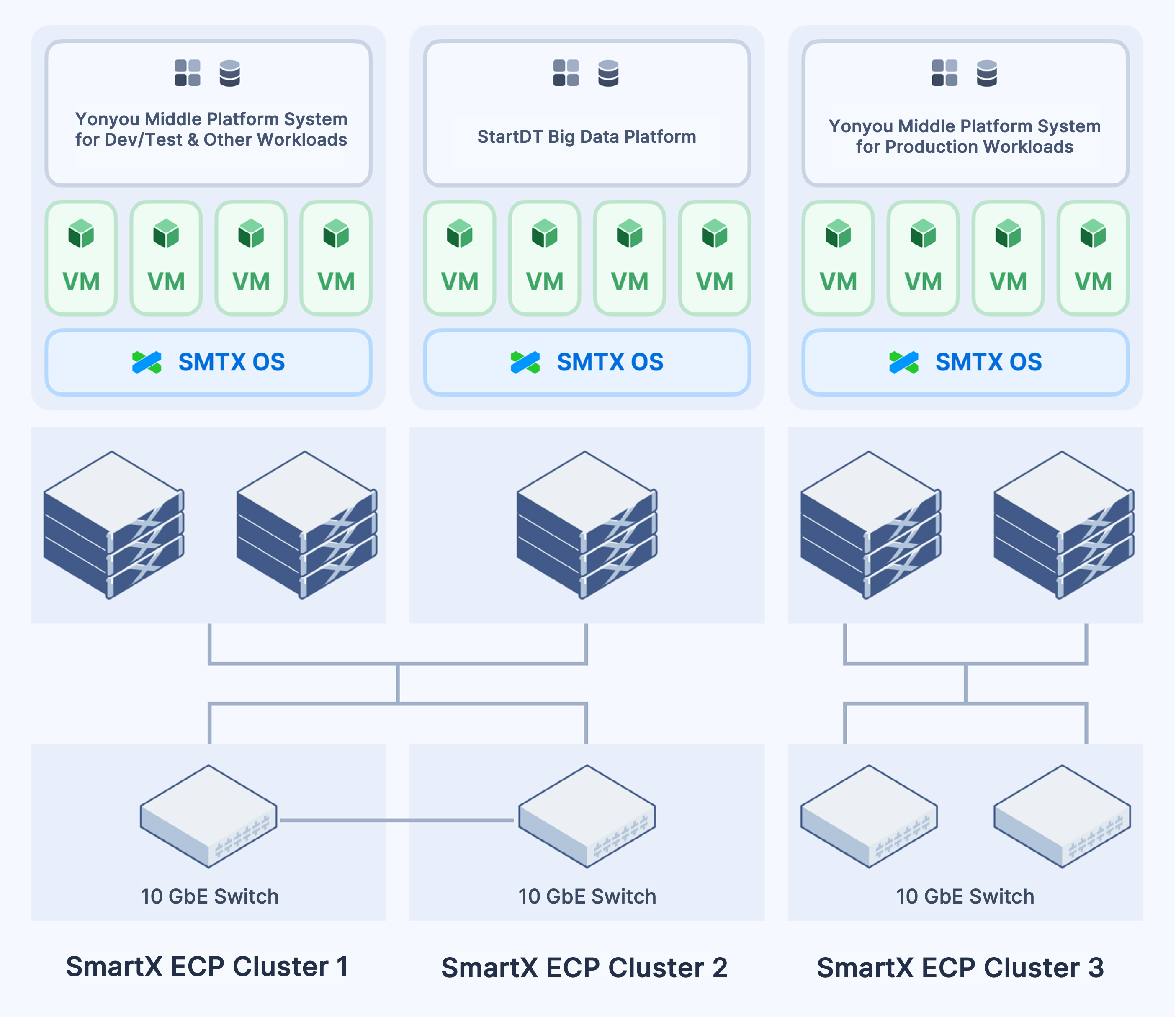
Mingri Holdings: SmartX ECP Supporting Core Databases of the Middle Platform
Mingri Holdings is a well-known enterprise with over 20 years of deep expertise in the plastics and chemical industry chain services. The company needed to quickly build and deploy its middle platform business systems under tight deadlines for both resource procurement and system go-live. At the same time, the actual resource requirements and growth trajectory for its middle platform were unclear, making it difficult to accurately estimate appropriate hardware investment.
The company aimed to introduce a flexible, scalable infrastructure that could dynamically meet resource demands throughout the middle platform rollout and upgrades. This infra solution needed to be highly integrated, offer excellent storage and computing performance, and reliably support hundreds of business VMs—while also saving data center space, reducing IT investment, and simplifying operations and management.
“Through more than three years of collaboration, SmartX ECP has enabled us to build a stable, reliable, agile, and simple infrastructure platform. It has effectively supported our middle platform systems and provided the foundation for our digital transformation.”
Shen Qimin, CIO of Zhejiang Mingri Holdings Group
Solution Overview
Mingri Holdings deployed the infrastructure in three phases aligned with business rollout, building a total of 13-node SmartX ECP cluster. These ECP nodes stably run more than 200 business VMs, covering futures trading, HR, finance, and more. The all-flash architecture clusters also run the Yonyou BIP 5.0 platform, supporting critical databases including Oracle, MySQL, and SQL Server.
Benefits
- ECP appliance delivered, tested, migrated, and went live within 2 months.
- Completed ECP deployment in just 2 hours.
- Reduced business response times, improving front-end trading efficiency.
- Enabled a single IT administrator to handle all O&M tasks.
- Achieved cost savings of up to 50%.
Learn more about this customer story: Zhejiang Mingri Holding Group: A Leading Digital Enterprise Empowered by HCI
Chang’an Kuayue Vehicles: Building a High-Performance Foundation for IoV Big Data Services
Chongqing Chang’an Kuayue Vehicle Co., Ltd., founded in 1999, is a joint venture between Chang’an Automobile and Kuayue Group. As a full-industry-chain commercial vehicle manufacturer, the company focuses on developing, producing, and selling light trucks, minibuses, special-purpose vehicles, and new energy vehicles under the Changan brand.
To meet rapidly growing market demand, Chang‘an Kuayue has been accelerating its IT modernization and strengthening its development of Internet of Vehicle (IoV) technologies. However, its legacy infrastructure—based on VMware virtualization and centralized storage—suffered from poor flexibility and high management complexity, making it unsuitable for supporting IoV workloads. As a result, Changan Kuayue decided to build a new platform tailored to its IoV big data services.
Solution Overview
After extensive testing and validation, Chang’an Kuayue found that SmartX’s native hypervisor ELF delivered 60% higher performance than a VMware-based ECP solution, while also offering easier deployment and management, software-hardware decoupling, and the ability to reuse existing servers.
Based on these test results, the company deployed a 3-node SmartX ECP cluster (based on ELF virtualization) to support its IoV big data system that is built on components such as Kafka and HDFS, and later expanded with an additional 4 nodes to form a heterogeneous cluster. Looking ahead, Chang’an Kuayue plans to migrate its core production databases for PLM and DMS to the SmartX ECP.
Benefits
- Optimized for data-intensive workloads: With SmartX ECP’s replica localization strategy, I/O localization, and RDMA optimization, the platform efficiently supports data-heavy VMs such as Kafka front-end and Redis caches.
- Stability under long-term pressure: Ensures consistent high performance even as vehicle volumes grow and workloads scale.
- Seamless VMware replacement: With SMTX Migration Tool’s minute-level downtime and high-availability migration features, the transition away from VMware was smooth and risk-free.
Learn more about manufacturers’ use cases of SmartX ECP:
Three Manufacturing Customers Share Their Insights on SmartX HCI Disaster Recovery Solutions
Baosight: IT Infra Upgrade Driven by SmartX HCI and Distributed Storage
Smart, Simple and Stable: Modernize Remote Factory IT Infrastructure with SmartX HCI
