More and more manufacturing enterprises are accelerating the digital transformation of their IT systems—using advanced software and hardware to improve product quality, streamline processes, and drive cost efficiency. This raises the bar for IT infrastructure, requiring stronger performance, reliability, scalability, unified management, AI readiness, and ecosystem compatibility.
As a full-stack enterprise infrastructure solution, SmartX ECP provides a more stable, secure, and intelligent foundation for manufacturers, supporting five key use cases: building an enterprise cloud with full-stack capabilities, supporting core applications such as MES and ERP, ROBO, VMware/Nutanix replacement, and Dev/Test with VDI.
This blog focuses on the last three use cases, sharing 4 enterprise stories in leveraging SmartX ECP to support ROBO, VMware/Nutanix replacement, and Dev/Test with VDI.
>>More use cases: SmartX ECP in Manufacturing: Providing Full-Stack Infra Capabilities for Core Applications
Powering ROBO with Simplified IT Infra and Unified O&M
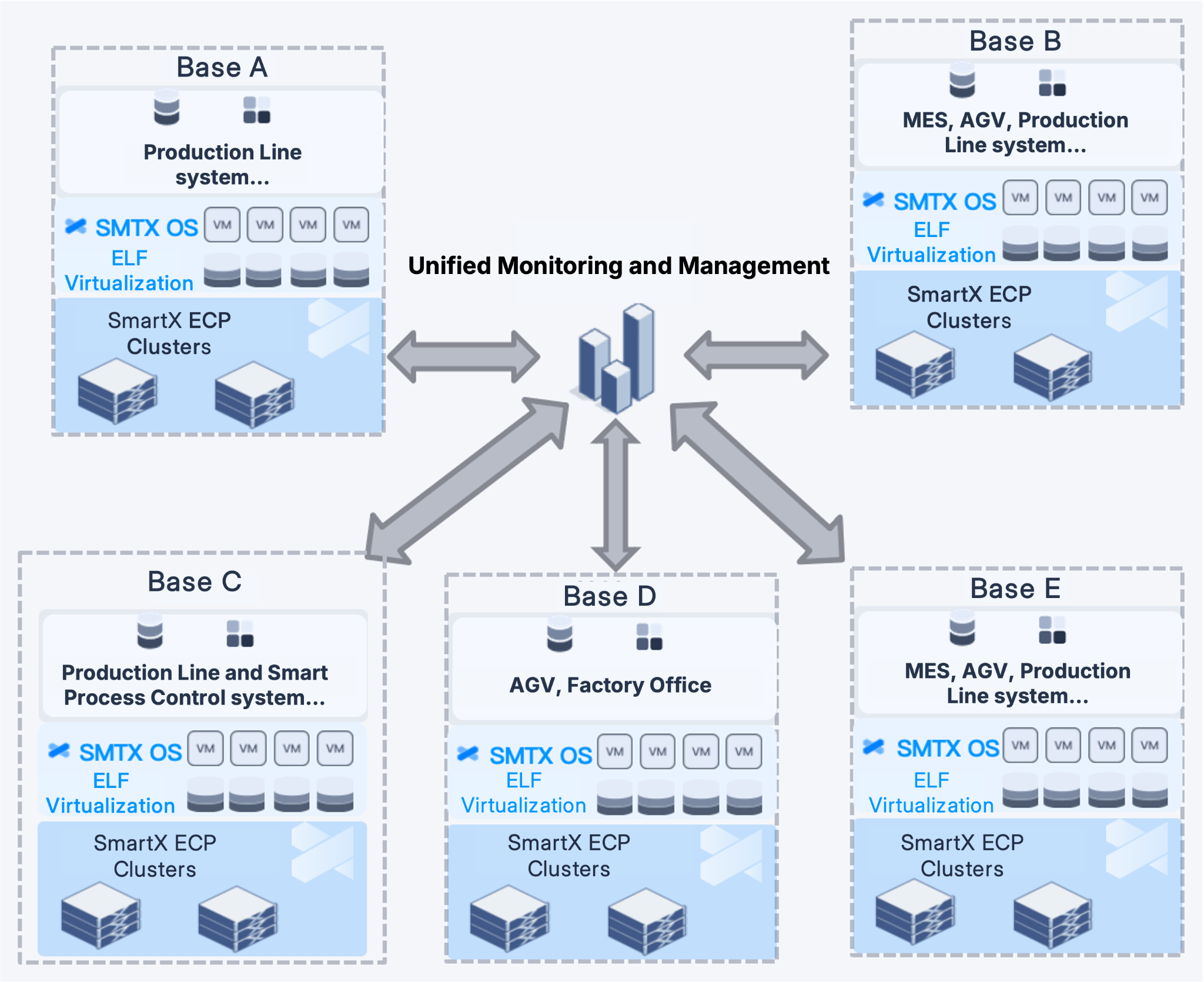
With SmartX ECP, manufacturing enterprises can build streamlined, intelligent, and stable IT infrastructure across multiple remote factories. Unified management through a central platform simplifies operations and maintenance, easing the burden on local IT staff while reducing risks of failures and business disruptions.
>>Learn more about SmartX ECP solution for ROBO: Smart, Simple and Stable: Modernize Remote Factory IT Infrastructure with SmartX HCI
A Global Leader of New Energy Innovative Technologies: Deployed 100+ ELF Nodes Across 7 Sites to Power Core Business Systems
A world-renowned new energy technology company is committed to delivering first-class solutions and services for global new energy applications. Previously, each factory relied on VMware vSphere for virtualization services. However, following VMware’s acquisition by Broadcom, technical support and service availability in Mainland China weakened, while the new licensing model introduced high costs and uncertainty. Therefore, the company hoped to seek a stable, reliable, high-performance domestic alternative for its production line systems across subsidiaries.
Solution Overview
The company adopted ELF virtualization to gradually replace more than 100 VMware clusters across seven sites and subsidiaries, supporting MES, AGV, formation, process management, campus access, and integrated management systems.
The solution was delivered as pure software, compatible with multi-vendor servers. By combining ELF virtualization with ZBS distributed storage under a perpetual licensing model, the company significantly reduced licensing costs. Moreover, the platform integrates with existing O&M and backup tools, further lowering the cost and complexity of IT modernization.
Benefits
- Self-developed distributed storage delivers higher performance, stability, and reliability under the same hardware conditions.
- VMware virtualization replacement reduces subscription costs while advancing IT localization goals.
- Seamless integration with existing O&M monitoring and automated delivery platforms simplifies O&M.
Replacing VMware/Nutanix for Higher Performance and Stability
SmartX has helped numerous manufacturing enterprises replace Nutanix HCI and VMware virtualization and vSAN with SmartX ECP. The platform supports mission-critical systems such as MES, PLM, ERP, industrial control, and SCADA, as well as databases, Dev/Test environments, disaster recovery, and innovative applications such as IoT, IoV, and big data platforms. It delivers high performance, reliability, and simplified operations for a wide range of manufacturing scenarios.
>>Learn more about SmartX ECP solution for VMware and Nutanix replacement:
Your VMware Exit Plan: Four Solutions to Consider Based on SmartX ECP
SmartX vs Nutanix: Product and Performance Comparison, Migration Approaches and Use Cases
A Leading New Energy Battery Manufacturer: Standardizing on ELF as the Sole Virtualization Platform for Future Cluster Deployment
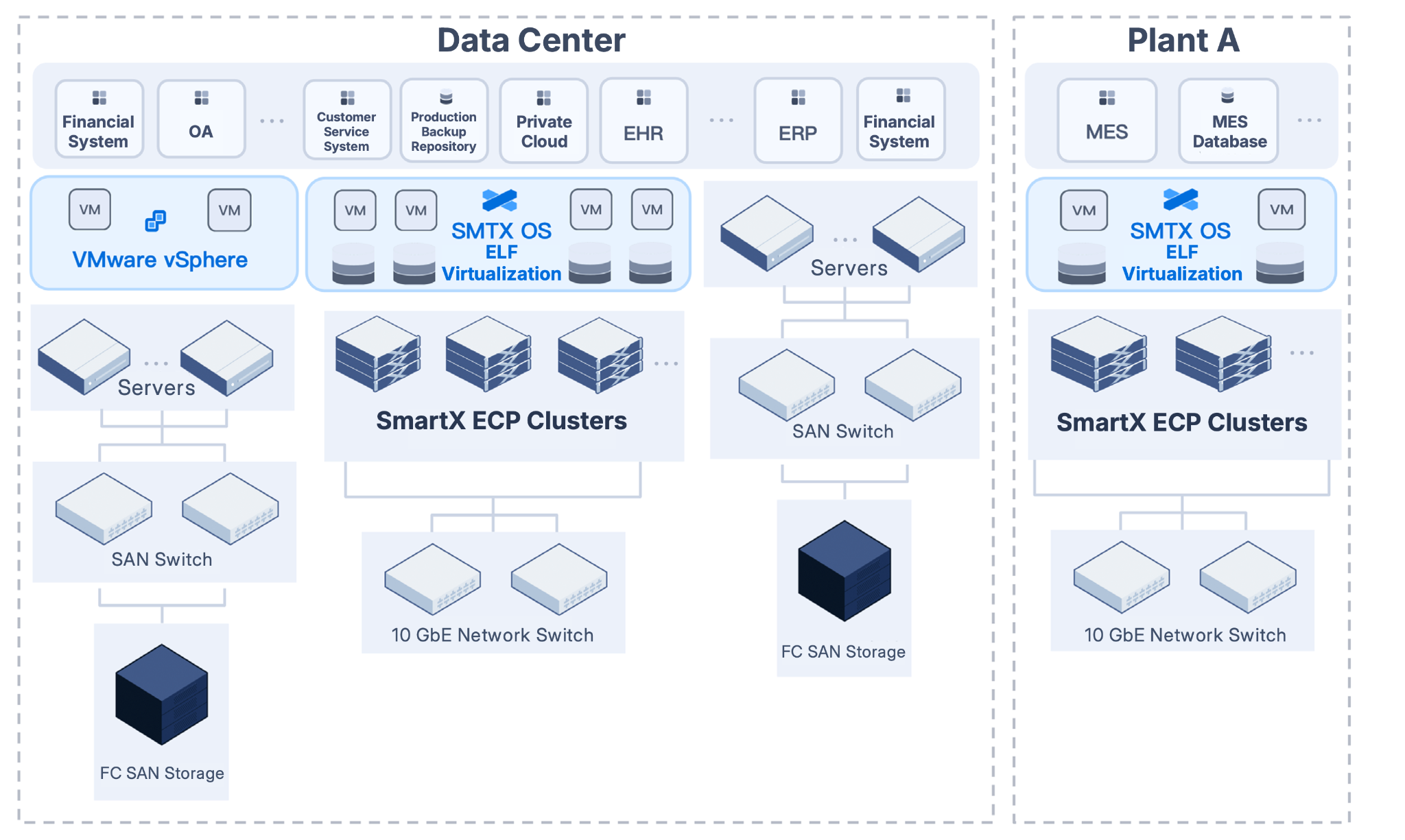
A leading domestic new energy battery manufacturer previously relied on VMware virtualization and centralized SAN storage to support core business systems.
However, when faced with the launch of new business systems such as the BatteryNet private cloud, customer service, HR, and big data platforms, the original infrastructure revealed major limitations: low overall resource utilization, high operational complexity across branch platforms and hardware, aging equipment with poor stability, and limited scalability. These issues made it difficult to keep pace with the company’s fast business growth.
Solution Overview
The manufacturer designated ELF as the exclusive virtualization platform for all new clusters. Over time, more than 100 ELF-based ECP nodes were deployed to support core business systems at headquarters and branch plants, including MOM (AI-MES), big data platforms, BatteryNet private cloud, customer service, HR, and other production systems and databases.
Benefits
- Flexible, on-demand scalability and fast system launches to accelerate business growth.
- Smooth VMware virtualization replacement with a domestic alternative, reducing licensing costs.
- Enhanced performance and reliability for core business systems, enabling agile innovation.
Jiuli Group: Replacing Nutanix with SmartX ECP to Support SAP and Databases
As one of China’s Top 500 private enterprises, Jiuli Group has long specialized in the R&D and production of corrosion-resistant, heat-resistant, and pressure-resistant stainless steel and specialty alloy pipes, wires, bars, pipe fittings, and forgings.
The group initially ran its SAP ECC systems on a Nutanix HCI platform. However, after four years of use, issues such as aging equipment, insufficient performance and capacity, and limited vendor support service in China prompted Jiuli Group to evaluate alternatives to Nutanix.
Solution Overview
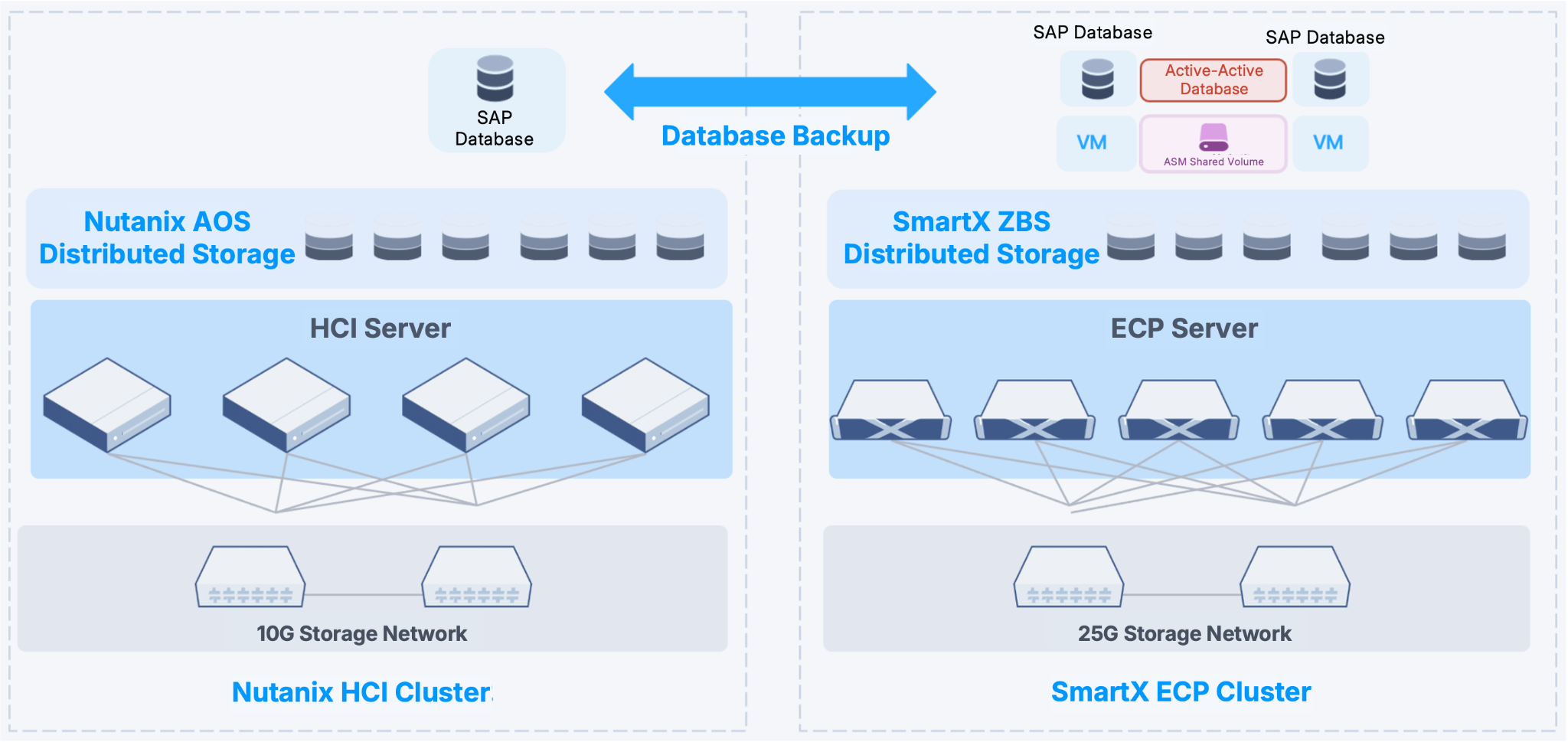
Jiuli Group replaced Nutanix HCI with SmartX ECP to host its SAP systems and databases. Business continuity is ensured through an active-active architecture plus data backup: while the SmartX ECP cluster serves the SAP primary database, the data is simultaneously replicated to the Nutanix cluster, which functions as the standby system.
Benefits
- Compared with the original architecture, the time required for SAP financial month-end closing was reduced from 23 hours to 13 hours, enabling financial reports to be issued one day earlier.
- The cluster was expanded from a 4-node Nutanix cluster to a 5-node enterprise cloud infrastructure cluster. Despite the hardware upgrade, the overall procurement cost was 8.7% lower than the Nutanix solution.
Accelerating Dev/Test and Virtual Desktops
Given the optimized performance and stability, SmartX ECP delivers a smooth VDI experience and supports large numbers of Dev/Test VMs on the server side with high efficiency, boosting overall Dev/Test productivity. Its streamlined and flexible architecture enables users to confidently handle rapid cluster expansion.
>>Learn more about SmartX ECP solution for VDI
MEIZU: Building a Dev/Test Platform on SmartX ECP to Improve Compilation Efficiency
Founded in 2003, MEIZU’s product portfolio spans smartphones, AIoT, and lifestyle products. With rapid business growth, the number of R&D staff increased quickly. However, developers previously relied on office PCs for code compilation, resulting in low hardware utilization, poor compilation efficiency, and challenges in resource sharing and data security. To address these issues, MEIZU sought to expand its compilation resource pool, improve utilization, and simplify operations.
Solution Overview
MEIZU deployed SmartX ECP together with bastion hosts, leveraging Ubuntu-based virtual machines for code compilation. The ECP resource pool was deployed as an appliance and powered by the native hypervisor – ELF.
Benefits
- Effectively consolidated hardware resources and improved code compilation efficiency.
- Built a highly reliable Dev/Test platform with centralized and secure data management.
Learn more about manufacturers’ use cases of SmartX ECP:
Three Manufacturing Customers Share Their Insights on SmartX HCI Disaster Recovery Solutions
Baosight: IT Infra Upgrade Driven by SmartX HCI and Distributed Storage
Smart, Simple and Stable: Modernize Remote Factory IT Infrastructure with SmartX HCI
